
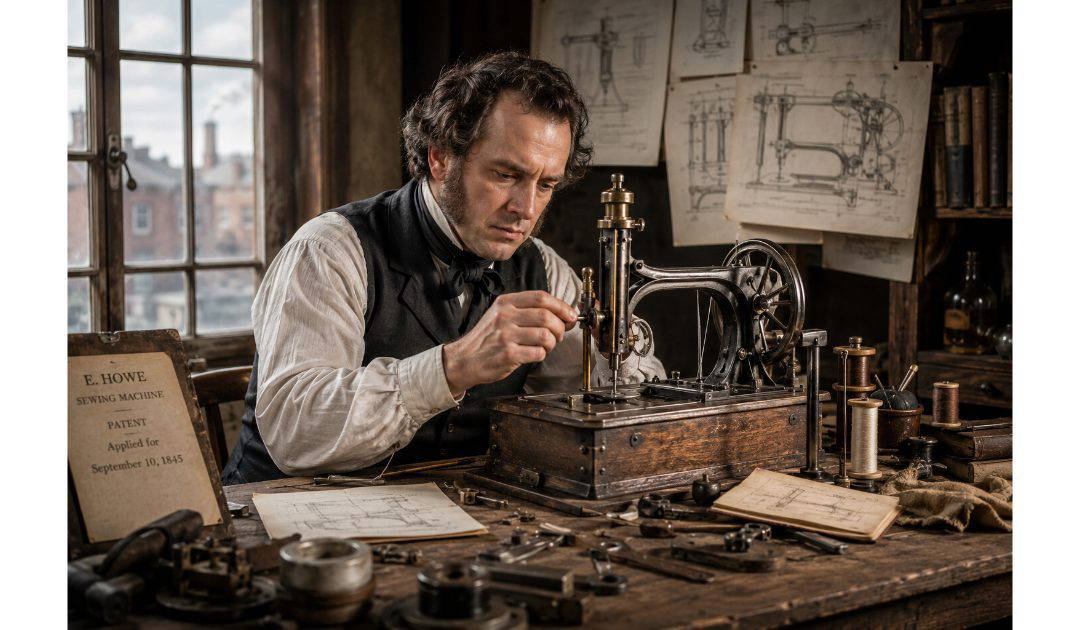
I like writing about inventors, I suppose it’s the engineer in me. I’ve lost track of how many inventors I’ve written about, certainly Colt and Edison. Claire and I enjoy watching the Great British Sewing Bee. I can sew a little, but have never even tried to work a sewing machine. Wikipedia tells me that on the 10th of September, 1846, Elias Howe was granted a patent for the sewing machine.
Elias Howe (1819–1867) was one of the most important inventors of the nineteenth century. Although he did not invent the first sewing machine, he created the first practical lockstitch sewing machine that could be successfully used on a commercial scale. His invention transformed the clothing industry, made the mass production of garments possible, and laid the foundations for the modern textile manufacturing industry. Despite his brilliance, Howe spent many years battling financial hardship and defending his patents before finally receiving the recognition and wealth he deserved.
Howe was born on the 9th of July, 1819 in Spencer, Massachusetts, into a farming family. His father also operated a small mill, and Elias learnt about machinery from an early age. Although his formal education was limited, he showed a natural aptitude for engineering and mechanics. As a teenager he worked in textile factories, where he became familiar with the problems involved in producing clothing. At that time every stitch was sewn by hand, making garments expensive and time-consuming to produce.
During the 1840s many inventors attempted to build a practical sewing machine. Several machines had already been patented in Europe and America, but they generally failed because they tried to imitate the motion of a human hand with a conventional needle. Howe realised that success required a completely different approach rather than copying hand sewing.
Working in a small workshop in Cambridge, Massachusetts, Howe devoted himself to solving the problem. Supported financially by his friend George Fisher, who allowed Howe and his family to live in his house while providing workshop space, Howe spent nearly two years refining his design. His greatest breakthrough was the invention of a machine using a needle with the eye near its point instead of at the opposite end. As the needle passed through the cloth it formed a loop that was caught by a shuttle carrying a second thread. The two threads locked together to produce what is known as a lockstitch, creating a strong and reliable seam.
Howe completed his first successful machine in 1845. It could sew around 250 stitches per minute, several times faster than an experienced hand sewer. Although primitive by modern standards, it demonstrated that machine sewing could be both practical and reliable.
In September 1846 Howe received United States Patent No. 4,750 for his sewing machine. Surprisingly, however, manufacturers showed little interest. Many tailors and seamstresses feared the new machine would threaten their livelihoods, while factory owners were reluctant to invest in unfamiliar technology. Unable to earn enough money from his invention, Howe travelled to England in the hope of finding commercial success. There he sold one machine to a corset manufacturer named William Thomas but soon found himself in financial difficulty. His business relationship with Thomas deteriorated, and Howe eventually returned to America in 1849 almost penniless.
On returning home, Howe discovered that several manufacturers, including Isaac Merritt Singer, were producing sewing machines incorporating features protected by his patent. Singer had greatly improved the practicality and marketing of sewing machines but had used Howe’s lockstitch mechanism without permission.
Rather than giving up, Howe launched a series of patent infringement lawsuits. These legal battles lasted several years and became some of the most significant patent cases in American industrial history. In 1854 the courts ruled decisively in Howe’s favour, confirming that his patent covered the essential lockstitch mechanism. Manufacturers, including Singer, were required to pay royalties to Howe for every machine they produced.
The decision transformed Howe’s fortunes almost overnight. Instead of struggling to survive, he became one of America’s wealthiest inventors. At the height of his success he reportedly earned royalties of around £500,000 per year in today’s values, making him financially secure for the rest of his life. The settlement also encouraged the formation of the Sewing Machine Combination in 1856, one of the earliest patent pools, allowing several manufacturers to share essential patents while paying royalties.
The sewing machine revolutionised society. Clothing became cheaper and more widely available. Uniforms could be produced rapidly, an important advantage during the American Civil War. Upholstery, shoes, sails, tents and countless other textile products could now be manufactured far more efficiently. The invention also created entirely new industries and employment opportunities, even as it reduced the need for some traditional forms of hand sewing.
During the Civil War, Howe himself served briefly with the 17th Connecticut Volunteer Infantry. Although not a frontline soldier for long, he contributed by helping to equip the regiment and supporting the Union cause.
Elias Howe died on the 3rd of October, 1867, at the age of just 48. Although his life was relatively short, his influence was immense. His ingenious lockstitch mechanism remains the basis of most modern sewing machines, and his successful defence of his patents established important legal precedents for protecting inventors’ intellectual property.
Today Elias Howe is remembered not simply as the inventor of a sewing machine, but as the man who transformed a promising idea into a practical, reliable invention that changed manufacturing around the world. His perseverance through years of poverty and legal struggle ensured that his remarkable contribution to industrial history would never be forgotten.