
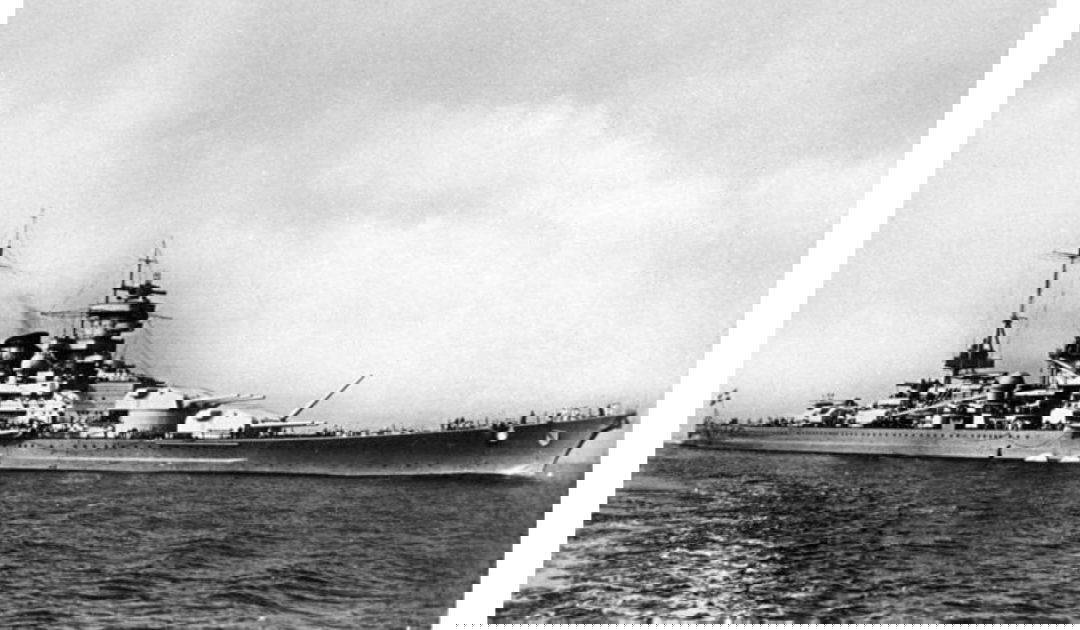
I have written about my father’s war as a Desert Rat. I was commissioned in the Royal Naval Reserve and have an interest in ships and the sea. I have also written about the sinking of the Bismark, but today I shall write about the Scharnhorst. The German warship Scharnhorst was a fast battleship, often referred to as a battlecruiser, of the Kriegsmarine during the Second World War. Alongside her sister ship Gneisenau, she represented a new generation of German capital ships that sought to combine speed, firepower, and resilience. Commissioned in 1939, Scharnhorst played a significant role in the early naval campaigns of the war, becoming one of the most well-known surface vessels of Germany’s navy before her eventual sinking in 1943.
Design and Specifications
Scharnhorst was a product of interwar German naval design, which was constrained by the Treaty of Versailles but revitalised under the rearmament policies of the 1930s. She displaced approximately 31,000 tons fully loaded and measured 235 metres in length. Her armour was substantial for her class, with a belt thickness of up to 350 mm and heavily armoured turrets and decks. Her propulsion system consisted of three steam turbines driving three propellers, allowing for a top speed of around 31 knots—making her exceptionally swift for a ship of her size, giving her the ability to evade more powerful but slower battleships.
In terms of armament, Scharnhorst’s main battery consisted of nine 28 cm (11-inch) SK C/34 guns arranged in three triple turrets—two forward in a superfiring arrangement and one aft. Though smaller than the 38 cm (15-inch) guns of contemporaneous British battleships, these weapons were accurate, had a fast rate of fire, and could inflict serious damage on cruisers and merchant vessels. Secondary armament comprised twelve 15 cm guns, along with a series of dual-purpose anti-aircraft guns and torpedo tubes. She also carried reconnaissance aircraft launched by catapult to assist in raiding and targeting.
Early War Service
Scharnhorst entered active service just after the outbreak of the Second World War and quickly began operations in the North Atlantic. Her first major operation was the sinking of the armed merchant cruiser HMS Rawalpindi in November 1939, a British ship that engaged the German vessel despite being heavily outgunned. This action brought Scharnhorst to the attention of the Royal Navy and demonstrated the threat posed by German surface raiders.
In early 1940, Scharnhorst participated in Operation Weserübung, the German invasion of Norway. Alongside Gneisenau, she encountered and sank the British aircraft carrier HMS Glorious on 8 June 1940, a notable success that demonstrated the striking power of the German battlecruisers. During this engagement, Scharnhorst scored a remarkable hit at a range of over 24,000 metres, one of the longest confirmed hits in naval gunnery history at the time.
Atlantic Raiding and Operation Berlin
Following repairs and refits, Scharnhorst joined her sister ship for Operation Berlin in early 1941, an Atlantic commerce-raiding mission. Exploiting their high speed and the relative weakness of Allied convoy escorts at that stage of the war, the two ships roamed the Atlantic, sinking or capturing over 100,000 tons of Allied merchant shipping over several weeks. Their ability to elude superior British forces highlighted the challenges the Royal Navy faced in defending its global supply lines against fast capital ships.
However, plans to upgrade Scharnhorst’s main armament to 38 cm guns were repeatedly delayed, and the ship spent much of 1941 and 1942 under repair or in port due to bomb damage and mechanical issues. By this time, German surface raiding was increasingly hampered by Allied air patrols, radar, and codebreaking successes.
The Channel Dash and Operations in Norway
In February 1942, Scharnhorst, Gneisenau, and the heavy cruiser Prinz Eugen executed the Channel Dash (Operation Cerberus), a daring transit from Brest in occupied France to Germany via the English Channel. Despite mine damage and British air attacks, Scharnhorst successfully made the journey, showcasing German naval boldness but also underscoring the increasing difficulty of deploying major surface units.
Later, Scharnhorst was redeployed to Norway to threaten Arctic convoys supplying the Soviet Union. Stationed at bases such as Tromsø, she posed a constant danger to Allied shipping, forcing the Royal Navy to commit substantial resources to convoy defence.
The Battle of the North Cape and Sinking
Scharnhorst’s final operation came in December 1943, when she attempted to intercept Arctic Convoy JW 55B. On the 26th of December, she was engaged by a powerful British force led by the battleship HMS Duke of York under Admiral Sir Bruce Fraser. The ensuing Battle of the North Cape was fought in Arctic winter conditions, with low visibility and heavy seas.
Initially, Scharnhorst attempted to use her speed to disengage, but British destroyers and cruisers, aided by radar-directed fire, kept contact. A torpedo attack from the destroyers slowed her down, allowing Duke of York to close and bring her heavy 14-inch guns to bear. After a fierce battle in which she was hit repeatedly, torpedoed several times, and heavily battered, Scharnhorst finally capsized and sank. Only 36 of her crew of nearly 2,000 survived.
Legacy
The loss of Scharnhorst marked the effective end of the German surface fleet’s ability to challenge Allied naval supremacy in the Arctic. Her sinking demonstrated the growing effectiveness of radar, air reconnaissance, and combined arms naval tactics. Today, Scharnhorst is remembered both for her daring operations and as a symbol of the last great era of battleship warfare before aircraft and submarines dominated the seas.