
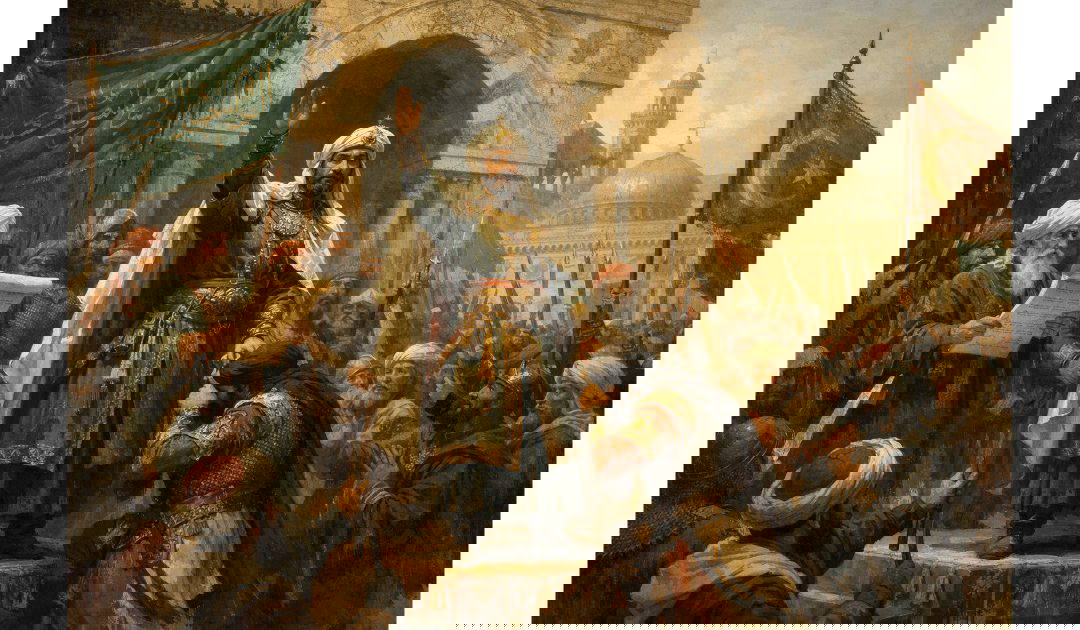
On the 26th of March, 1169, Saladin became the emir of Egypt. Ṣalāḥ al-Dīn Yūsuf ibn Ayyūb—known in the West as Saladin—was one of the most remarkable figures of the medieval world. A soldier, statesman, and devout Muslim, he became the great champion of Islam during the Crusades and the founder of the Ayyubid dynasty, ruling over Egypt, Syria, and much of the Near East in the late twelfth century. His capture of Jerusalem in 1187 electrified both the Islamic and Christian worlds, prompting the Third Crusade, yet his reputation in Europe, unusually for a Muslim leader of the period, became one of chivalry, honour, and magnanimity.
Saladin was born in 1137 or 1138 in Tikrit, in modern Iraq, into a Kurdish family in the service of the Zengid rulers of northern Syria. His father, Najm al-Din Ayyub, and uncle, Shirkuh, were military commanders under Imad al-Din Zengi and later his son, Nur al-Din. Saladin’s early life was not that of a destined conqueror; contemporary sources suggest he was more inclined to religious study than soldiering. However, the political and military environment of the time soon drew him into events of enormous consequence.
The Near East in Saladin’s youth was divided and unstable. Muslim lands were fragmented between rival dynasties, while the Crusader states—established after the First Crusade—controlled significant territories along the eastern Mediterranean coast, including Jerusalem. Nur al-Din, ruler of Aleppo and Damascus, sought to unite Muslim forces against the Crusaders. Egypt, ruled by the weakening Fatimid caliphate, became the focal point of this struggle. Control of Egypt meant wealth, manpower, and strategic advantage.
In 1164, Saladin accompanied his uncle Shirkuh on a military expedition to Egypt, sent by Nur al-Din to prevent the Crusaders from gaining influence there. After a series of campaigns and political intrigues, Shirkuh became vizier of Egypt in 1169 but died shortly afterwards. To the surprise of many, the relatively young and untested Saladin was appointed vizier in his place.
Saladin’s tenure in Egypt proved transformative. Although officially serving the Shi‘ite Fatimid caliph, he was a Sunni Muslim loyal to Nur al-Din. Gradually and carefully, he dismantled the Fatimid regime. In 1171, he abolished the Fatimid caliphate and restored allegiance to the Sunni Abbasid caliph in Baghdad, effectively bringing Egypt back into the Sunni fold. He reorganised the army, strengthened the economy, and established firm control over the region.
When Nur al-Din died in 1174, Saladin seized the opportunity to expand his authority. Over the next decade, through a mixture of warfare, diplomacy, and political manoeuvring, he brought Syria, northern Mesopotamia, and parts of Arabia under his rule. By the early 1180s, he had achieved what many before him had failed to do: the political unification of much of the Muslim Near East. This unity was essential for confronting the Crusader states.
Saladin framed his campaigns as a jihad, a holy struggle to reclaim lands lost to the Crusaders. His leadership combined religious conviction with pragmatic statecraft. He strengthened fortifications, built alliances, and prepared for a decisive confrontation. That moment came in 1187.
The immediate cause of war was the reckless behaviour of Reynald of Châtillon, a Crusader lord who attacked Muslim caravans in violation of truces. Saladin responded by mobilising a vast army. On the 4th of July, 1187, at the Battle of Hattin near the Sea of Galilee, he decisively defeated the Crusader forces led by King Guy of Jerusalem. The Crusader army was effectively destroyed. Reynald was captured and personally executed by Saladin for his repeated violations, while King Guy was spared.
The victory at Hattin opened the way to Jerusalem. City after city fell to Saladin’s forces with relatively little resistance. In October 1187, Jerusalem surrendered after negotiations. The contrast with the Crusaders’ bloody capture of the city in 1099 was stark. Saladin allowed inhabitants to ransom themselves and leave safely; many were released even when they could not pay. Christian holy sites were respected, though the Dome of the Rock and al-Aqsa Mosque were restored to Islamic use. His conduct enhanced his reputation even among his enemies.
The fall of Jerusalem sent shockwaves through Europe and prompted the Third Crusade, led by three of the most powerful monarchs of the time: Richard I of England, Philip II of France, and the Holy Roman Emperor Frederick Barbarossa. Although Frederick drowned en route and Philip eventually returned home, Richard the Lionheart proved a formidable opponent.
Between 1189 and 1192, Saladin and Richard fought a series of engagements along the Levantine coast. Richard recaptured Acre and won victories at Arsuf and Jaffa, but he could not retake Jerusalem. Saladin, though stretched by the prolonged conflict, managed to prevent a decisive Crusader breakthrough. Despite their rivalry, mutual respect developed between the two leaders. Medieval chroniclers recount gestures of courtesy, such as Saladin sending fruit and snow to cool Richard during illness, though some details may be embellished.
In 1192, the two sides agreed to the Treaty of Jaffa. Jerusalem remained in Muslim hands, but Christian pilgrims were allowed access, and the Crusaders retained a narrow strip of coastal territory. It was a pragmatic settlement reflecting the limits of both sides.
Saladin returned to Damascus exhausted. Years of campaigning had drained his resources and health. He died there on the 4th of March, 1193. It is said that he left so little personal wealth that there was barely enough to pay for his funeral, a testament to his generosity and lack of personal enrichment.
Saladin’s legacy endured long after his death. In the Islamic world, he was celebrated as the great unifier and defender of the faith. In Europe, he became a symbol of noble adversary, appearing in medieval romances and later literature as the model of chivalric virtue. His combination of piety, military skill, political acumen, and personal honour made him one of the most admired figures of the Crusading era.