
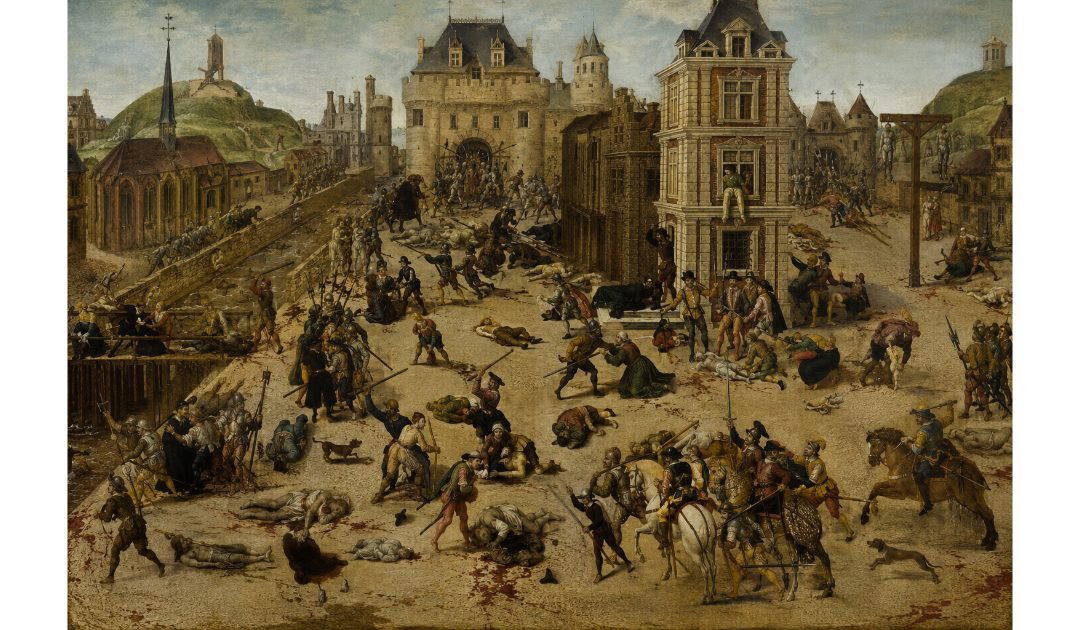
The Saint Bartholomew’s Day Massacre was one of the darkest episodes in European history and a defining moment in the French Wars of Religion. Beginning in Paris on the night of 23rd – 24th of August 1572, the feast day of Saint Bartholomew, thousands of French Protestants, known as Huguenots, were murdered by Catholic mobs with the encouragement, or at least the acquiescence, of leading figures in the French government. The violence quickly spread from Paris to towns and cities across France, leaving between 5,000 and 30,000 people dead, although modern historians generally estimate the total at around 10,000.
The massacre occurred against the backdrop of decades of religious conflict. Following the Protestant Reformation, many French nobles and townspeople embraced the teachings of John Calvin. This rapid spread of Protestantism alarmed the Catholic monarchy and much of the French nobility. Between 1562 and 1570, France endured three bitter civil wars between Catholics and Huguenots. Neither side was able to achieve a decisive victory, and peace settlements repeatedly collapsed.
By 1572, an uneasy peace had been established by the Peace of Saint-Germain. The young King Charles IX, heavily influenced by his formidable mother, Catherine de Medici, hoped to strengthen national unity through the marriage of his sister, Margaret of Valois, to the Protestant leader Henry of Navarre. The wedding, held in Paris on 18 August 1572, drew hundreds of prominent Huguenot nobles to the overwhelmingly Catholic capital.
Although intended as a symbol of reconciliation, the marriage instead heightened tensions. Many ordinary Parisians deeply distrusted the Protestant visitors. Catholic preachers denounced the Huguenots, while political factions at court feared the growing influence of the Protestant leader Gaspard II de Coligny. Coligny had become a trusted adviser to Charles IX and was encouraging the king to support the Dutch revolt against Catholic Spain. Catherine de’ Medici and other councillors reportedly feared that Coligny was gaining too much influence over the young king.
On the 22nd of August, just four days after the royal wedding, an assassin attempted to kill Coligny, shooting him with an arquebus as he returned from a meeting with the king. Although badly wounded, he survived. The failed assassination outraged the Huguenot nobles, who demanded justice and threatened retaliation if the culprit was not found. The royal court feared that armed conflict might erupt in the streets of Paris.
Exactly what happened next remains one of history’s great controversies. Most historians believe that Catherine de’ Medici and members of the royal council decided to eliminate a small group of Huguenot leaders in order to prevent a Protestant uprising. Whether Charles IX reluctantly approved the plan or was persuaded under pressure is still debated. Whatever the original intention, events rapidly spiralled beyond anyone’s control.
In the early hours of the 24th of August, royal guards and Catholic soldiers murdered Admiral Coligny in his lodging. His body was thrown from a window into the street, where an angry crowd mutilated it before dragging it through Paris. Once news of Coligny’s death spread, bells rang from churches across the city, and organised killings turned into a general massacre. Catholic mobs, often identifying Huguenot homes with white crosses placed on the doors beforehand, broke into houses and slaughtered men, women and children alike. Many victims were hacked to death with swords or clubs before their bodies were thrown into the River Seine.
The violence continued for several days in Paris before spreading to cities including Orléans, Lyon, Bordeaux, Rouen and Toulouse. In some towns local authorities attempted to prevent bloodshed, while in others they actively encouraged it. Thousands more Protestants were killed over the following weeks.
Henry of Navarre narrowly escaped death. Forced to convert temporarily to Catholicism, he remained effectively a prisoner at court until he managed to escape several years later. He eventually returned to Protestantism, led the Huguenot cause during the later Wars of Religion, and in 1589 became King Henry IV of France. In 1593 he famously converted once more to Catholicism, reportedly remarking that “Paris is well worth a Mass,” although the authenticity of that quotation remains uncertain. His subsequent Edict of Nantes granted substantial religious freedoms to French Protestants and brought a measure of peace after decades of civil war.
The Saint Bartholomew’s Day Massacre shocked Europe. Protestant countries viewed it as proof of Catholic cruelty, while the papacy and some Catholic rulers initially celebrated what they believed was the suppression of a dangerous rebellion. Over time, however, the massacre came to be regarded by many on both sides as a tragic example of the destructive consequences of religious hatred and political fanaticism.
Today, the massacre is remembered not only for its immense loss of life but also for its lasting impact on French history. It destroyed any remaining trust between Catholics and Protestants, prolonged the French Wars of Religion for another quarter of a century, and became an enduring symbol of how fear, political calculation and religious intolerance can combine to unleash catastrophic violence. It remains one of the most infamous massacres in European history and a powerful reminder of the human cost of sectarian conflict.