
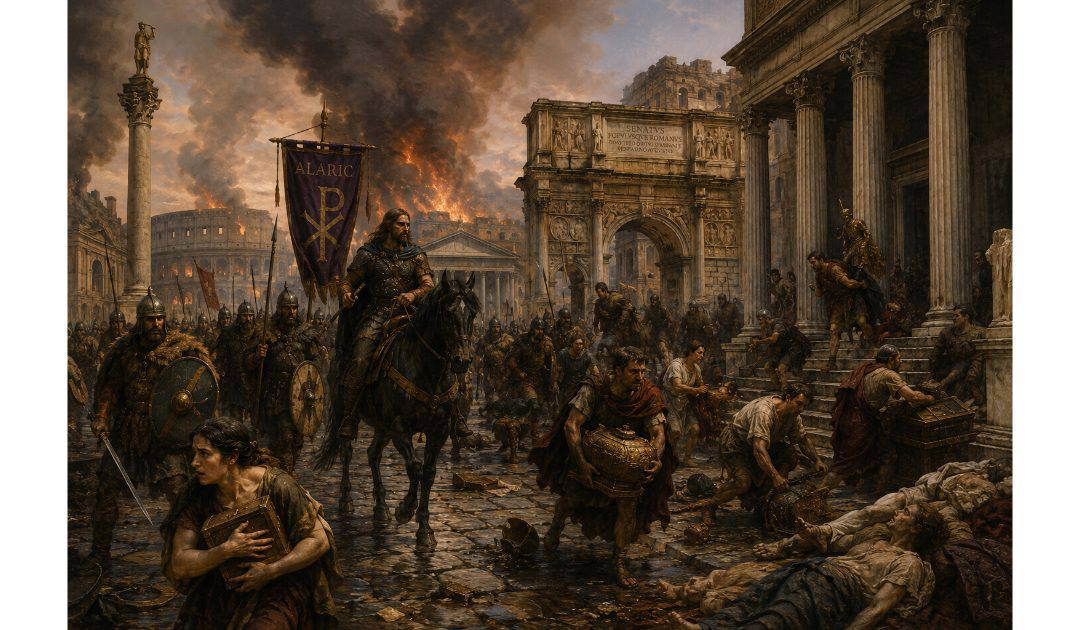
On the 27th of August, 410CE, the sacking of Rome by the visigoths ended after three days. I have written about the sacking of Rome by the Vandals in 455 CE, so let us consider the first sacking of Rome.
By the beginning of the fifth century, the Western Roman Empire was already in serious decline. Political instability, economic weakness, military overstretch and repeated barbarian invasions had undermined imperial authority. The city of Rome itself was no longer the political capital of the Western Empire. Emperors had moved their court first to Milan and later to the more defensible city of Ravenna, whose marshes and strong fortifications made it much harder to attack. Nevertheless, Rome remained the symbolic heart of the empire, home to magnificent monuments, ancient temples and churches, and a population of perhaps half a million people.
The Visigoths had originally entered Roman territory decades earlier. Pressured westward by the advance of the Huns, they had crossed the Danube in 376 seeking refuge within the empire. Poor treatment by Roman officials led to rebellion, culminating in the Roman defeat at the Battle of Adrianople in 378, where the Emperor Valens was killed. Thereafter, the Visigoths remained a powerful independent force within imperial territory.
King Alaric had once served as an ally of Rome, commanding Gothic troops in the Roman army. However, he believed both he and his Visigoth people had been denied fair treatment and adequate lands on which to settle. His repeated requests for official recognition, payment and territory were either delayed or rejected by the Western imperial government. Frustrated, Alaric marched into Italy several times between 401 and 410, seeking to force negotiations.
Rome was first besieged in 408. The city escaped immediate destruction by paying an enormous ransom. According to ancient sources, the Romans surrendered thousands of pounds of gold and silver, silk garments, dyed cloth and large quantities of pepper, one of the luxury commodities of the ancient world. Even after receiving this payment, Alaric continued to seek a negotiated settlement with the Emperor Honorius, who remained safely behind the walls of Ravenna.
Negotiations repeatedly broke down. Imperial ministers distrusted Alaric, while Honorius refused many of his demands. Matters worsened when Roman forces attacked Gothic representatives during peace talks. Convinced that diplomacy had failed, Alaric returned to Rome for a third siege in 410.
On the night of the 24th of August, 410, the Salarian Gate was opened, probably by slaves or sympathisers within the city. The Visigoths entered and took control. For three days they looted Rome. Although ancient writers naturally portrayed the event dramatically, the sack appears to have been relatively restrained compared with many later medieval conquests.
The Visigoths sought portable wealth rather than wholesale destruction. Gold, silver, jewellery, furniture and valuable works of art were carried away. Wealthy houses were stripped of their treasures, while many poorer districts suffered comparatively little. Several great public buildings remained standing, and archaeological evidence suggests that widespread burning was limited.
One remarkable feature of the sack was Alaric’s respect for Christian churches. Himself an Arian Christian, he reportedly ordered that major churches, particularly the basilicas of Saints Peter and Paul, should be treated as places of sanctuary. Many Romans fled to these churches and were spared violence. Although killings, assaults and acts of brutality undoubtedly occurred, the sack was less indiscriminately destructive than earlier or later captures of major cities.
Among the notable captives was Galla Placidia, the sister of Emperor Honorius. She remained with the Goths for several years and later married the Visigothic king Ataulf, illustrating the increasingly complex relationship between Romans and Goths.
The reaction throughout the empire was profound. For pagans, the disaster appeared to demonstrate that abandoning the ancient Roman gods had brought divine punishment. Christians argued the opposite. Augustine of Hippo responded by writing his monumental work, The City of God, arguing that earthly kingdoms inevitably rise and fall, while the true Kingdom of God is eternal. His work became one of the most influential books in Christian history.
Ironically, the sack did not immediately end the Western Roman Empire. The imperial government survived for another sixty-six years, until the deposition of the last western emperor in 476. Nevertheless, the capture of Rome shattered the aura of Roman invincibility. The Eternal City, once the unquestioned centre of the known world, had proved vulnerable.
After leaving Rome, Alaric intended to invade Roman North Africa, whose grain supplied much of Italy. However, he died later in 410, probably from illness, near the city of Cosenza in southern Italy. According to later tradition, he was buried beneath the bed of the Busento River together with part of his treasure, although the location of his grave has never been discovered.
Today, the Sack of Rome in 410 is remembered not primarily for the scale of its destruction but for its immense symbolic significance. It marked a turning point in European history, demonstrating that even the greatest empire of antiquity was not immune to decline. The event became an enduring symbol of the fragility of political power and the transformation of the Roman world into the medieval kingdoms that would eventually emerge from its ruins.