
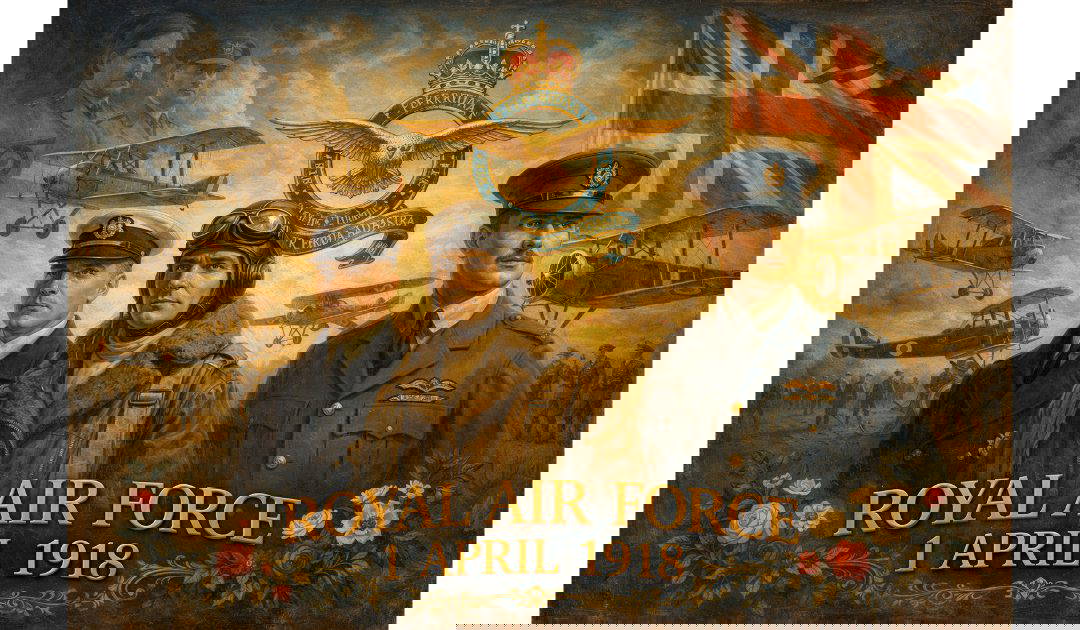
The Royal Air Force was created on the 1st of April, 1918, when the Royal Flying Corps and the Royal Naval Air Service were merged. Coincidently it was also on the 1st of April, 1908, that the Territorial Force was formed as a volunteer reserve component of the British Army. It was renamed the Territorial Army in 1920. I have always been fascinated by flying, and tried to join the Oxford University Air Squadron but my “colour blindness” prevented it.
Aviation was still in its infancy when war broke out in 1914. The RFC and RNAS initially used aircraft for reconnaissance, observing enemy troop movements from above. Very quickly, however, aircraft were armed, and air combat developed. By 1916–17, dogfights between fighter planes, strategic bombing raids, and aerial photography were all crucial parts of the conflict. The growing importance of air power led the British government to create a unified service. On 1 April 1918, the RAF was born, with over 20,000 aircraft and 300,000 personnel, making it the largest air force in the world at that time.
Although the war ended only months later, the RAF’s existence was secured. Many questioned whether an independent air force was necessary in peacetime, but advocates argued that future wars would be decided in the air. The RAF survived severe post-war cuts and developed new doctrines, particularly the idea of strategic bombing and the use of air power to police parts of the British Empire, notably in Iraq and the North-West Frontier of India.
During the 1920s and 1930s, the RAF struggled with limited funding but made important technological advances. Aircraft became faster, stronger, and more reliable. Radar, a British innovation, was developed in the late 1930s and would prove decisive. As tensions rose in Europe with the rise of Nazi Germany, the RAF expanded rapidly. Fighter Command, Bomber Command, and Coastal Command were established as distinct branches.
Aircraft such as the Supermarine Spitfire and Hawker Hurricane were introduced, designed specifically to counter the growing Luftwaffe threat. Airfields and radar stations were constructed along the south and east coasts of Britain as part of an integrated air defence system.
The RAF’s most famous hour came in 1940 during the Battle of Britain. After the fall of France, Britain stood alone against Nazi Germany. The Luftwaffe sought to gain air superiority in preparation for a possible invasion. For months, RAF Fighter Command, under Air Chief Marshal Sir Hugh Dowding, resisted relentless German attacks.
Using radar, ground control, and highly skilled pilots, the RAF inflicted heavy losses on the Luftwaffe. The Spitfire and Hurricane became legendary aircraft, and the young pilots who flew them were immortalised by Winston Churchill’s words: “Never in the field of human conflict was so much owed by so many to so few.” The failure of Germany to defeat the RAF forced Hitler to abandon plans to invade Britain.
Throughout the war, the RAF played a vital role in bombing campaigns over Germany, anti-submarine operations in the Atlantic, support for ground troops in North Africa and Europe, and the D-Day landings. Bomber Command, under Sir Arthur Harris, carried out massive raids on German cities, a strategy still debated for its effectiveness and moral implications.
After 1945, the RAF adapted to a new strategic reality: the Cold War. Jet aircraft replaced propeller-driven planes, and the RAF became a key part of NATO’s defence against the Soviet Union. Britain developed its own nuclear deterrent, initially delivered by RAF V-bombers: the Valiant, Vulcan, and Victor. These aircraft symbolised Britain’s status as a nuclear power during the 1950s and 1960s.
The RAF also played roles in conflicts linked to the end of empire and global politics, including the Malayan Emergency, the Suez Crisis, the Falklands War in 1982, and operations in the Balkans, Iraq, and Afghanistan. The Falklands conflict demonstrated the RAF’s long-range capability when Vulcan bombers flew from Ascension Island to attack Argentine positions in Operation Black Buck.
In recent decades, the RAF has transformed into a highly technological, flexible force. Modern aircraft such as the Eurofighter Typhoon and the F-35 Lightning II provide advanced air combat and strike capabilities. The RAF also operates transport aircraft like the C-17 Globemaster and A400M Atlas, enabling rapid global deployment of troops and aid. The RAF is heavily involved in intelligence, surveillance, and reconnaissance, using drones and sophisticated sensor systems. It has participated in NATO missions, counter-terrorism operations, and humanitarian relief efforts worldwide. Space and cyber capabilities are increasingly part of its remit as warfare evolves beyond traditional domains.
The RAF has developed a strong identity and culture. Its ranks, traditions, and insignia reflect its history. The roundel symbol and the motto Per Ardua ad Astra (“Through adversity to the stars”) are widely recognised. The service has also made significant strides in inclusion, with women and personnel from diverse backgrounds playing increasingly prominent roles.
From fragile biplanes over the trenches of the First World War to supersonic jets and unmanned systems in the twenty-first century, the RAF’s history mirrors the development of aviation itself. Its creation established air power as a central element of modern warfare, and its achievements—especially during the Battle of Britain—remain central to British national memory.