
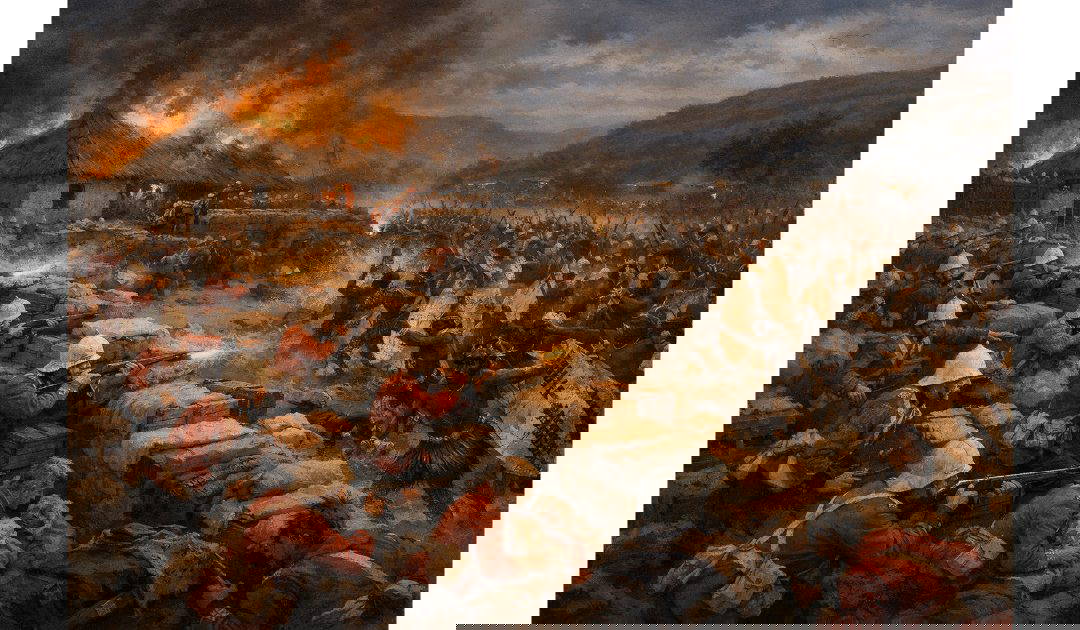
On the 23rd of January, 1879, the Battle of Rorke’s Drift ended. It is depicted in the classic 1964 film Zulu, directed by Cy Endfield, and starring Michael Cane, Stanley Baker, Jack Hawkins, Ulla Jacobssen and many others.
The Battle of Rorke’s Drift, fought on the night of 22–23 January 1879, is one of the most famous engagements in British military history. Occurring during the Anglo-Zulu War, it was remarkable not for its scale but for the extraordinary disparity in numbers and the determined defence mounted by a small British garrison against a vastly larger Zulu force.
Rorke’s Drift was a modest mission station and supply depot located near the Buffalo River, which marked the border between the British colony of Natal and the Zulu Kingdom. On the 22nd of January, 1879, British forces suffered a catastrophic defeat at Isandlwana, only a few miles away, where a Zulu army annihilated a column of over 1,300 men. Later that afternoon, news of the disaster reached Rorke’s Drift, placing the small garrison there in immediate peril.
The defenders numbered approximately 150 men, most of them soldiers of B Company, 2nd Battalion, 24th Regiment of Foot. They were joined by a handful of Natal Native Contingent troops, engineers, and hospital staff. Command fell to two junior officers: Lieutenant John Chard of the Royal Engineers and Lieutenant Gonville Bromhead of the 24th Foot. Recognising the danger, Chard and Bromhead made the rapid decision to fortify the station rather than retreat. Using mealie bags (sacks of corn), biscuit boxes, and wagons, they constructed a rough defensive perimeter around the mission buildings and storehouse.
Late in the afternoon, a Zulu force estimated at between 3,000 and 4,000 warriors appeared. These men, largely from the reserve regiments of the Zulu army that had fought earlier at Isandlwana, launched their assault shortly before sunset. Armed mainly with spears (iklwa) and cowhide shields, but also with some captured firearms, the Zulu warriors advanced with remarkable courage and discipline.
The battle quickly became a desperate struggle at close quarters. Zulu attacks came from multiple directions, probing the British defences for weaknesses. One of the most dramatic episodes occurred at the hospital, where Zulu warriors broke into the building and fierce hand-to-hand fighting erupted. Soldiers such as Privates John Williams and Henry Hook famously hacked through interior walls to rescue wounded comrades room by room, under constant threat.
As the night wore on, the defenders withdrew to an inner perimeter after parts of the hospital were abandoned and set ablaze. The burning buildings illuminated the battlefield with an eerie glow, while rifle fire and Zulu war cries echoed through the darkness. Ammunition shortages became a serious concern, and the exhausted British soldiers fought on with grim determination, often firing at point-blank range.
Despite repeated assaults, the Zulu warriors were unable to break the final defensive line. Shortly before dawn, the attacks diminished and then ceased altogether. When daylight came, the defenders found the field strewn with Zulu dead and wounded. Estimates of Zulu casualties vary, but are generally placed at between 350 and 500 killed. British losses were comparatively light: 17 defenders were killed or died of wounds.
Later that morning, British relief columns arrived, confirming that the Zulu force had withdrawn. The defence of Rorke’s Drift was widely hailed in Britain as a heroic stand, particularly in the wake of the shock and humiliation of Isandlwana. The action resulted in the awarding of eleven Victoria Crosses. Among the recipients were Chard and Bromhead, as well as several privates whose bravery under fire was widely celebrated.
In the years since, the Battle of Rorke’s Drift has taken on a powerful symbolic status. It has often been portrayed as an example of discipline, courage, and resilience in the face of overwhelming odds, most famously in the 1964 film Zulu. However, modern historians also seek to place the battle within its broader context: a war of imperial expansion initiated by British aggression against the Zulu Kingdom, whose soldiers fought with skill, organisation, and extraordinary bravery.