
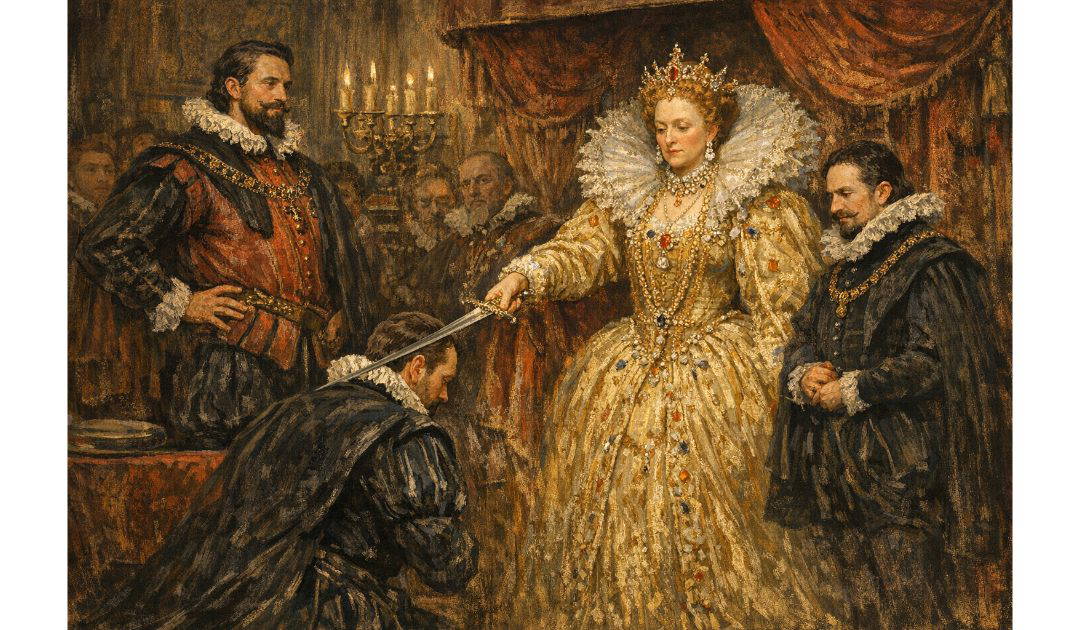
Robert Cecil was born on the 1st of June 1563. Robert Cecil, 1st Earl of Salisbury (1563–1612) was one of the most skilled and calculating statesmen of late Tudor and early Stuart England. The younger son of the formidable chief minister William Cecil, 1st Baron Burghley, Robert inherited not only his father’s political instincts but also his vast intelligence network and administrative machinery. Though physically frail and often mocked for his slight stature and hunchbacked appearance, he possessed a formidable intellect and an unrivalled capacity for political management. He served both Elizabeth I and her successor James I of England, ensuring a relatively smooth transition between the Tudor and Stuart dynasties.
Robert was educated at Cambridge and later travelled on the Continent, where he observed European courts and diplomacy firsthand. Unlike his father, who had risen through service under Henry VIII and Edward VI, Robert was groomed from an early age for high office. By the 1590s, as Elizabeth I grew older and factional rivalries intensified, Cecil emerged as a central figure in government.
His chief rival at court was the flamboyant favourite Robert Devereux, 2nd Earl of Essex. My ancestor, the Elizabethan spy, Sir Anthony Standen, worked for Essex after the death of Francis Walsingham. Essex represented a more aggressive foreign policy, especially against Spain, and cultivated popularity with the public and the military. Cecil, by contrast, preferred caution, financial prudence, and diplomatic subtlety. The rivalry culminated in Essex’s failed rebellion in 1601. Cecil played a decisive role in uncovering and suppressing the plot, and Essex was executed for treason. The episode demonstrated Cecil’s mastery of intelligence and political survival.
One of Cecil’s greatest achievements was orchestrating the peaceful succession of James VI of Scotland to the English throne in 1603. As Elizabeth aged without an heir, uncertainty over the succession posed a grave risk of civil disorder. Though Elizabeth never publicly named her successor, Cecil secretly corresponded with James, preparing the ground for his accession. When Elizabeth died in March 1603, James was proclaimed king with remarkable speed and minimal unrest. Cecil’s foresight ensured continuity of government and preserved political stability.
Under James I, Cecil’s influence grew even further. He was created Baron Cecil in 1603, Viscount Cranborne in 1604, and finally Earl of Salisbury in 1605. He also succeeded his father as Lord Treasurer in 1608, taking on responsibility for the kingdom’s precarious finances. James, unlike Elizabeth, was less frugal and more extravagant, and the royal finances were strained. Salisbury attempted reforms, including the controversial “Great Contract” of 1610, which aimed to exchange certain feudal revenues for a fixed annual grant from Parliament. Although the scheme ultimately failed, it showed his pragmatic approach to fiscal reform and his awareness that medieval financial structures were no longer adequate for a modern state.
Cecil is perhaps most widely remembered for his role in exposing the Gunpowder Plot. In November 1605, a group of Catholic conspirators led by Robert Catesby planned to blow up the House of Lords during the State Opening of Parliament, killing the king and leading Protestant leaders. Cecil received an anonymous letter warning of the danger, and through careful investigation the authorities discovered Guy Fawkes guarding barrels of gunpowder beneath Parliament. The plot’s discovery strengthened the government’s resolve against Catholic dissent and enhanced Salisbury’s reputation as a vigilant protector of the realm. Some historians have speculated that Cecil may have known more about the conspiracy in advance than he admitted, possibly allowing it to develop far enough to justify harsher measures. While evidence for this theory remains inconclusive, it reflects the aura of intrigue surrounding his career.
Cecil’s foreign policy was marked by pragmatism. He helped negotiate the 1604 Treaty of London, ending the long war with Spain that had drained Elizabethan resources. Peace allowed England to stabilise financially and focus on trade and colonisation. He was not an ideologue but a realist, seeking security and balance rather than glory.
Despite his political brilliance, Cecil was not widely loved. He lacked the charisma of figures like Essex and was often portrayed by enemies as manipulative and secretive. Yet his administrative competence and dedication to continuity were crucial in an age of religious tension and dynastic uncertainty. He embodied the emerging professional civil servant: methodical, informed, and deeply involved in the machinery of state.
Robert Cecil died in 1612, leaving behind a strengthened bureaucratic framework and a dynasty secure on the English throne. He had served as the essential bridge between the last Tudor monarch and the first Stuart king. Though overshadowed in popular memory by more dramatic figures, Salisbury’s quiet effectiveness shaped the course of early seventeenth-century England and ensured that political transition did not descend into chaos.