
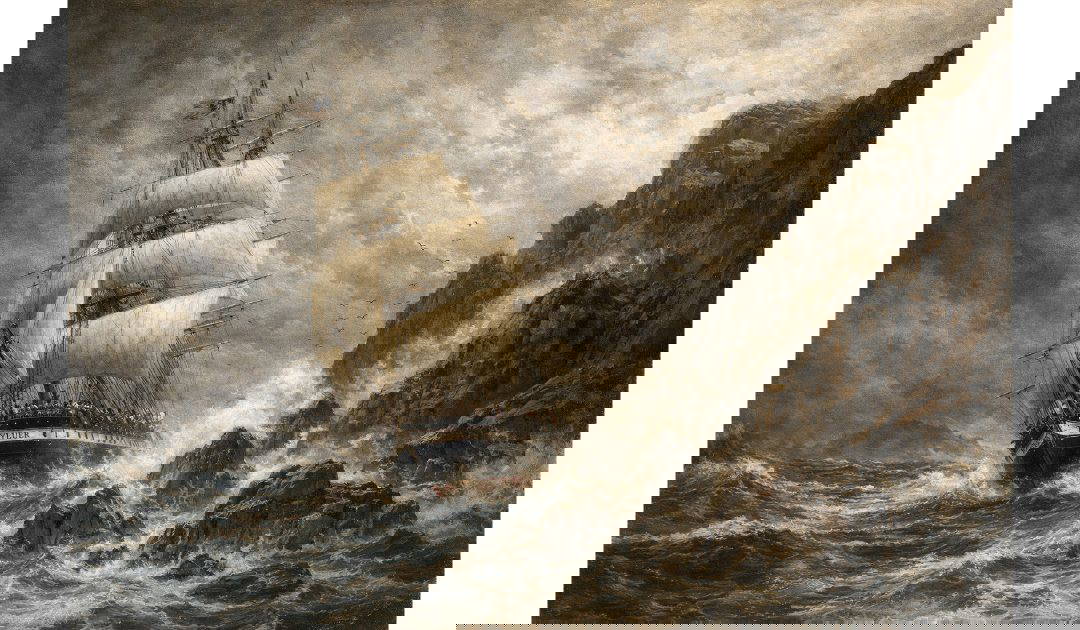
On the 21st of January, 1854, RMS Tayleur sank on her maiden voyage near Lambey Island on her maiden voyage from Liverpool to Australia. The RMS Tayleur was a British iron-hulled sailing ship whose disastrous maiden voyage in January 1854 resulted in one of the worst maritime tragedies of the nineteenth century. Her loss, only hours after leaving port, became a cautionary tale about the dangers of rapid industrial innovation, inadequate seamanship, and poor safety standards during the age of transition from sail to steam.
Tayleur was built in Warrington, Lancashire, by Charles Tayleur & Company, a firm better known for manufacturing railway equipment than ocean-going vessels. Launched in 1853, she was designed as a state-of-the-art emigrant ship for the White Star Line, intended to carry passengers from Britain to Australia during the height of mid-Victorian emigration. At over 1,750 tons and nearly 230 feet long, Tayleur was among the largest iron sailing ships of her day. Her iron hull, sleek lines, and towering masts represented the cutting edge of naval engineering.
However, the very innovations that made RMS Tayleur impressive also contributed to her downfall. Iron-hulled ships were still relatively new, and their effect on magnetic compasses was not fully understood. Tayleur’s compasses were improperly corrected, rendering them dangerously inaccurate. Compounding this problem was the inexperience of both her captain and much of her crew. Captain John Noble was a respected officer but had never commanded a ship of such size, nor one constructed of iron.
On the 19th of January, 1854, Tayleur departed Liverpool on her maiden voyage to Melbourne, carrying around 652 people—crew and passengers combined. Many passengers were emigrants seeking a new life in Australia, including families and young couples filled with hope. Weather conditions were poor almost immediately, with strong winds and rough seas in the Irish Sea. As the ship made her way westward, navigational errors began to mount.
Believing they were sailing south of Ireland, the crew in fact steered too far north due to the faulty compass readings. Strong winds and currents pushed Tayleur steadily toward the east coast of Ireland. By the morning of the 21st, land was sighted—too late. The ship was perilously close to Lambay Island, just north of Dublin Bay. Attempts to change course were unsuccessful, hampered by poor communication, confusion on deck, and the difficulty of handling such a massive vessel in heavy seas.
RMS Tayleur struck rocks off Lambay Island and was driven repeatedly against the shore by powerful waves. Chaos erupted on board. Lifeboats were either damaged, swept away, or could not be launched properly—some had never been tested, and others were inadequately secured. The rigging collapsed, masts fell, and the ship began to break apart. Many passengers were trapped below decks, while others were thrown into the freezing sea.
Despite the proximity of land, rescue was extremely difficult. The sea was violent, and the rocky coastline treacherous. Some survivors managed to cling to wreckage or swim ashore, aided by local fishermen and island residents who risked their lives to help. Nevertheless, the death toll was appalling. Of the more than 650 people on board, approximately 380 lost their lives, making the wreck one of the deadliest maritime disasters in the Irish Sea.
The public inquiry that followed revealed a catalogue of failures. The magnetic compass error was identified as a critical factor, as was the lack of proper trials before the voyage. Crew training was inadequate, safety drills were minimal or nonexistent, and lifeboat arrangements were poorly designed. The investigation stopped short of placing full blame on any single individual, but it exposed systemic weaknesses in maritime regulation and oversight.
The sinking of the Tayleur had lasting consequences. It highlighted the urgent need for improved navigational standards on iron ships and better understanding of magnetic deviation. It also contributed to growing calls for stricter safety regulations, which would later be embodied in reforms such as the Merchant Shipping Acts. For the White Star Line, the disaster was an early stain on a company that would later become world-famous—and infamous again with the loss of the Titanic in 1912.
Today, the RMS Tayleur is remembered as a tragic symbol of overconfidence in new technology and the human cost of inadequate preparation. Her story stands as a reminder that progress, when not matched by caution and competence, can be deadly.