
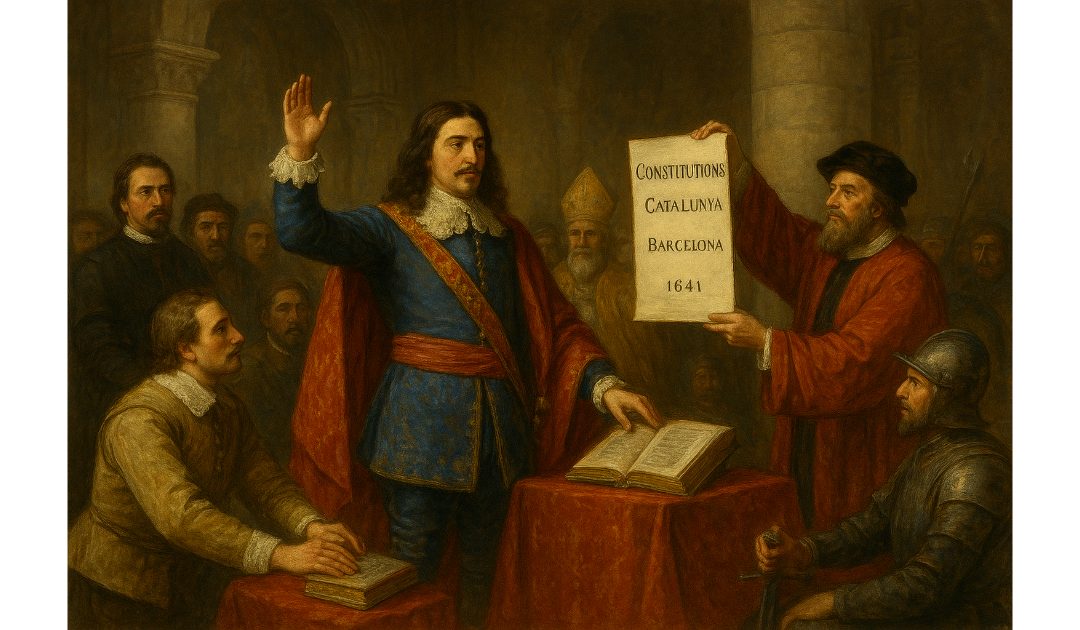
On the 30th of December, 1641, during the Reapers’ War, Louis XIII of France was appointed Count of Barcelona. This caught my interest because Louis XIII is a key character in The Suggested Assassin, the third book in the Sir Anthony Standen Adventures, and also my work in progress.
The Reapers’ War, also known in history as the Catalan Revolt (1640–1659), was a major conflict within the broader context of the Thirty Years’ War and the Franco-Spanish War. It principally involved the Principality of Catalonia rising in rebellion against the rule of Philip IV of Spain, and France under Louis XIII taking an active role in the conflict as part of its strategy to weaken Habsburg dominance in Europe.
The origins of the conflict are deeply rooted in the social and political tensions of early seventeenth-century Spain. Catalonia, though part of the Spanish Monarchy, maintained its own laws (the Usatges and Constitutions) and institutions, which the Castilian crown was bound to respect. The lengthy and costly wars of the Spanish monarchy—fighting simultaneously against the Dutch, the French, and in the German states—required more soldiers, more taxes, and the billeting of troops. Catalonia, with its strong local identity and privileges, was resistant to the pressures of centralisation and the heavy burdens of military occupation.
In 1635, France under Cardinal Richelieu and King Louis XIII entered the Thirty Years’ War directly against Spain. The Franco-Spanish front along the Pyrenees quickly became active. The Spanish monarchy sought to use Catalonia as a springboard for campaigns, stationing troops in the region without the consent of local authorities. This inflamed tensions, leading to widespread discontent among peasants and urban residents alike. Matters came to a head in 1640, when the oppressive billeting of royal troops and abuses committed by soldiers triggered rural uprisings. The revolt began in earnest with the Corpus de Sang events in Barcelona on the 7th of June, 1640, when a mob of reapers—seasonal labourers who had come to the city for work—killed the Spanish viceroy, Dalmau de Queralt, Count of Santa Coloma. This act ignited the war proper, known thereafter as the Reapers’ War.
Louis XIII of France played a decisive role in shaping the trajectory of the conflict. Cardinal Richelieu’s strategic aim was to encircle and weaken the Spanish Habsburgs by supporting their internal enemies. When the Catalan institutions, led by the Generalitat under Pau Claris, realised that rebellion against the Spanish crown would inevitably provoke a massive response, they sought foreign protection. In a remarkable political manoeuvre in 1641, the Catalan authorities declared the French king Louis XIII as Count of Barcelona, effectively recognising him as their sovereign. In doing so, they placed Catalonia under French protection, transforming the regional revolt into an international war.
Louis XIII’s acceptance of the title was both a political and military decision. His role was not to govern Catalonia directly but to provide the military support necessary to resist Spanish re-conquest. French troops, under experienced commanders, entered Catalonia and engaged Spanish forces. One of the most significant early battles was the Battle of Montjuïc in January 1641, where Franco-Catalan forces defeated the Spanish army attempting to retake Barcelona. This victory temporarily solidified French influence and sustained the rebellion.
Throughout the conflict, Louis XIII’s role was largely as the figurehead and guarantor of French military aid. Day-to-day decisions were managed by Richelieu and later by French generals and administrators. Nonetheless, his kingship lent legitimacy to Catalonia’s break with Madrid and gave France the pretext to intervene overtly in Iberian affairs. The French monarchy used the Reapers’ War as part of its wider campaign to erode Habsburg power, linking the events in Catalonia to the broader currents of the Franco-Spanish War.
However, the war was not solely a story of French success. While Louis XIII’s support allowed the rebellion to survive for years, the conflict in Catalonia became a protracted and exhausting struggle. The local population suffered from the presence of both Spanish and French armies, and French governance grew increasingly heavy-handed over time. By the mid-1640s, as Louis XIII’s health declined and Richelieu had died (1642), the French commitment wavered, though the war continued under the regency of Anne of Austria for the young Louis XIV.
The Reapers’ War formally concluded with the Treaty of the Pyrenees in 1659, long after Louis XIII’s death in 1643. Nevertheless, his role in the early 1640s was crucial. By accepting the Catalan offer of sovereignty and deploying troops, he transformed a regional revolt into a pivotal theatre of the Franco-Spanish conflict. This intervention weakened Spanish resources, contributed to the eventual French territorial gains in Roussillon and Cerdanya, and demonstrated the interplay between domestic revolts and grand dynastic wars of the seventeenth century.