
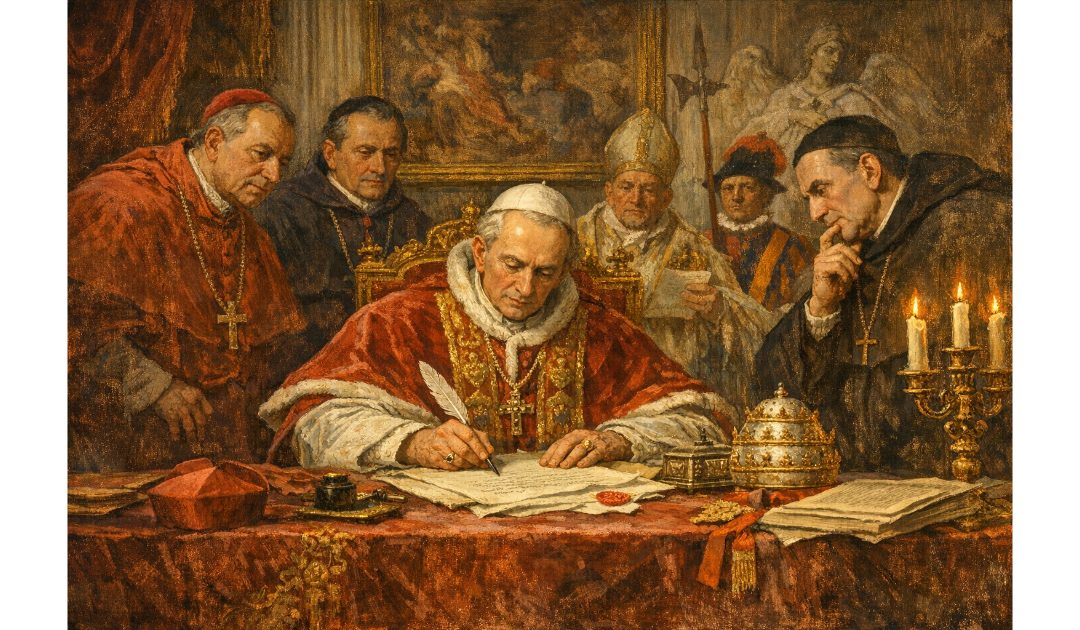
On the 13th of March, 1826, Pope Leo XII published the apostolic constitution Quo Gravioria in which he renewed the prohibition on Catholics becoming Freemasons. My father was a Freemason so this caught my attention today.
Quo Graviora (which is more serious?) was one of the most forceful and comprehensive papal condemnations of Freemasonry in the modern era. It did not represent a new policy, but rather a reaffirmation and tightening of a long-standing Catholic hostility to Masonic societies that dated back nearly a century. By the time Leo XII wrote, the Church regarded Freemasonry not merely as a secretive fraternal organisation but as a grave spiritual, moral, and political threat to Christian society.
To understand Quo Graviora, it is necessary to see it in continuity with earlier papal documents. The first condemnation of Freemasonry came in 1738, when Pope Clement XII issued In Eminenti Apostolatus, forbidding Catholics from joining Masonic lodges on pain of excommunication. This was reaffirmed by Benedict XIV in Providas Romanorum (1751). During the turbulent decades of the late eighteenth and early nineteenth centuries—an era marked by the Enlightenment, the French Revolution, Napoleonic wars, and widespread anti-clerical movements—the Church increasingly associated Freemasonry with revolutionary and secularist ideologies.
By Leo XII’s pontificate (1823–1829), Europe was in the uneasy aftermath of Napoleon’s fall. Conservative monarchies had been restored, but secret societies, liberal movements, and nationalist conspiracies were rife, especially in Italy, Spain, and France. Many of these groups operated with structures, rituals, and oaths resembling those of Masonic lodges. To the papacy, Freemasonry seemed not only spiritually dangerous but politically subversive.
Quo Graviora therefore had a dual purpose: doctrinal clarity and practical enforcement. Leo XII explicitly reaffirmed all previous papal condemnations of Freemasonry and extended them to any similar secret societies, regardless of the names they used. The document condemned:
- The secrecy of Masonic oaths
- The religious indifferentism implied in Masonic teaching
- The danger these societies posed to both Church and state
- The spread of rationalist and deist ideas hostile to revealed religion
The Pope insisted that the Church’s earlier prohibitions were still in force and that Catholics who joined such organisations incurred automatic excommunication. Bishops were instructed to be vigilant, and confessors were warned not to absolve members unless they had genuinely renounced their involvement.
At the heart of the Church’s objection to Freemasonry was religious indifferentism. Masonic lodges admitted men of different religions and encouraged a vague belief in a “Great Architect of the Universe” rather than adherence to any specific creed. From the Catholic perspective, this was deeply problematic. The Church taught that salvation came through the true faith revealed by Christ and preserved in the Catholic Church. Freemasonry, by placing all religions on an equal footing, appeared to deny the uniqueness and necessity of Catholic truth.
Moreover, Masonic rituals were secret and bound members by solemn oaths. The Church regarded this as morally dangerous. Catholics were expected to live openly within a sacramental and ecclesial framework. Secret commitments, especially those that might conflict with obedience to Church authority, were viewed with suspicion. The papacy feared that Masonic loyalty could supersede loyalty to the Church.
There was also a strong intellectual dimension to the conflict. Freemasonry in the eighteenth and early nineteenth centuries was closely associated with Enlightenment thought: rationalism, natural religion, scepticism about miracles, and criticism of ecclesiastical authority. Many prominent Enlightenment figures were Freemasons, and Masonic lodges often served as forums for ideas that questioned traditional religious structures. To the Church, this appeared as an organised network spreading doctrines that undermined revelation, clerical authority, and the supernatural basis of Christianity.
Politically, the situation made matters worse. In countries such as Italy and Spain, secret societies inspired by or connected to Freemasonry were involved in revolutionary plots against Catholic monarchies and papal rule. The Carbonari in Italy, for example, were frequently linked—rightly or wrongly—with Masonic principles. Because these groups promoted constitutionalism, nationalism, and the reduction of clerical power, the papacy came to see Freemasonry as part of a broader revolutionary movement seeking to dismantle the old Christian order of society.
Thus, in Quo Graviora, Leo XII portrayed Freemasonry not simply as a theological error but as a social and political danger. He warned that these societies worked “in darkness” to corrupt morals, weaken religion, and disturb public order. The secrecy of their meetings and the complexity of their rites suggested, in the papal mind, that they had something to hide—something incompatible with Christian virtue.
The language of the constitution is severe. Leo XII speaks of the “perverse sect” and the “poisonous doctrines” spread under the cover of fraternal association. He makes clear that the Church’s condemnation is not based on misunderstanding but on long observation of the effects of these societies on Christian peoples.
It is important to note that the Church’s stance was shaped by the historical context. The papacy had witnessed the French Revolution, during which the Church had been persecuted, property confiscated, and clergy executed or exiled. Many churchmen believed that Masonic and Enlightenment networks had helped foster the anti-clerical spirit that made such events possible. Whether this perception was fully accurate mattered less than the fact that it was widely believed in Rome.
Quo Graviora therefore reinforced a line that would continue throughout the nineteenth century. Later popes, notably Pius IX and Leo XIII, would issue even more elaborate condemnations of Freemasonry, culminating in Leo XIII’s Humanum Genus (1884), which described the struggle between the Church and Freemasonry as a battle between two opposing visions of civilisation.
In summary, Quo Graviora was Leo XII’s emphatic restatement that Catholics could not be Freemasons. The Church opposed Freemasonry because it promoted religious indifferentism, required secret oaths that conflicted with ecclesial loyalty, fostered rationalist ideas hostile to revelation, and appeared politically linked to movements that undermined Christian society. For Leo XII and his contemporaries, Freemasonry was not merely a fraternal club but a powerful ideological and social force threatening the foundations of faith and order.