
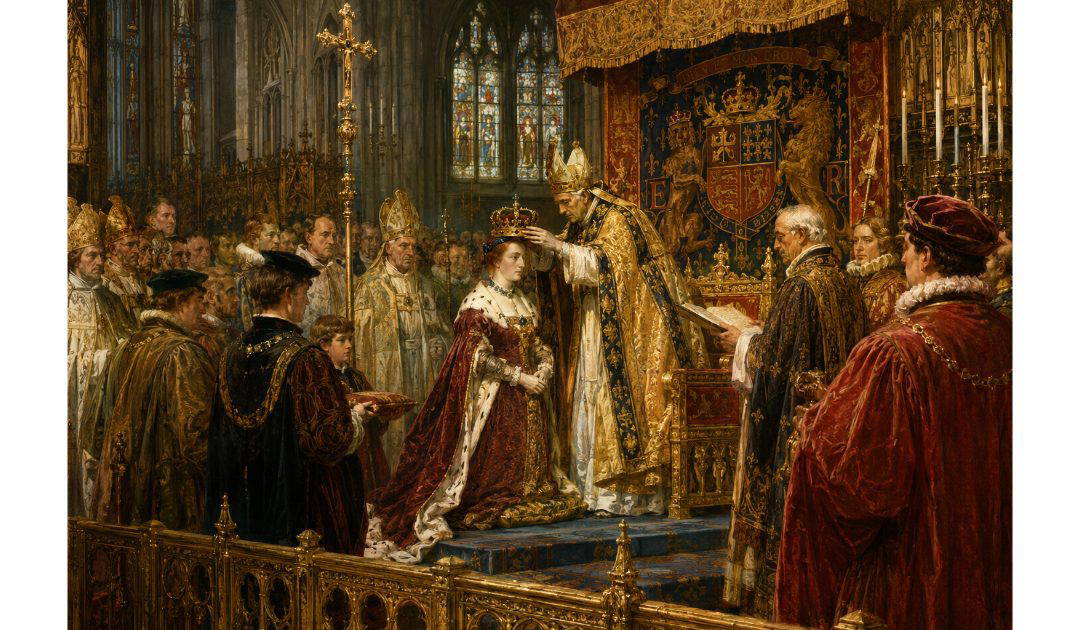
On the 1st of October, 1553, Queen Mary I was crowned in Westminster Abbey. My ancestor Sir Anthony Standen, the Elizabethan spy, would have been around four years of age. In The Spy who Sank the Armada, the first book in the Sir Anthony Standen Adventures, Anthony witnesses and is profoundly disturbed by the burning of the Stratford Martyrs in 1556.
Mary was the daughter of Henry VIII and Catherine of Aragon. She was born at Greenwich Palace on the 18th of February, 1516. She became queen in July 1553, after defeating the attempt to place her Protestant cousin, Lady Jane Grey, on the throne. Mary reigned for just over five years, until her death in November 1558. Her reign was dominated by her determination to restore Roman Catholicism to England, a policy that earned her the enduring nickname “Bloody Mary.”
Mary was Henry VIII’s only surviving legitimate child by Catherine of Aragon. As a young girl she was highly educated and spoke several languages. She was also deeply religious and developed a strong attachment to the Catholic faith of her mother. Henry’s break with Rome created enormous difficulties for her. When he declared his marriage to Catherine invalid and married Anne Boleyn, Mary was declared illegitimate and separated from her mother. She was eventually forced to acknowledge her father’s supremacy over the Church of England, although she never accepted Protestantism.
When Henry died in 1547, Mary’s younger half-brother Edward VI became king. Edward was a committed Protestant, and during his reign England moved further away from Catholicism. Mary refused to abandon her faith, leading to repeated confrontations with the government.
Edward died on the 6th of July, 1553, aged only fifteen. Fearing that Mary would restore Catholicism, his advisers attempted to exclude her from the succession. Edward’s will nominated Lady Jane Grey, his Protestant cousin, as queen. Jane was proclaimed queen on the 10th of July. Mary, however, escaped to East Anglia and rapidly gathered support. Within days, much of the country declared for her. Jane’s supporters collapsed, and Mary entered London in triumph on the 3rd of August, 1553.
Mary became the first woman to be crowned queen regnant of England in her own right. Her coronation was an important moment because the English monarchy had traditionally been associated with male rule. Mary was determined to demonstrate that a woman could exercise sovereign authority just as effectively as a king.
One of her first major problems was her choice of husband. Mary wanted a Catholic marriage that would strengthen her religious settlement and provide an heir. She eventually chose Philip of Spain, son of the powerful Emperor Charles V. Their marriage took place at Winchester Cathedral in July 1554. The match was extremely unpopular in England, where many feared that England would become subordinate to Spain. Philip was made king of England by marriage, but Mary’s government carefully restricted his constitutional powers.
Opposition to the marriage contributed to Wyatt’s Rebellion in 1554. Led by Sir Thomas Wyatt the Younger, the rebellion threatened London. Mary demonstrated considerable courage by addressing the citizens of London at Guildhall and declaring that she would defend her kingdom. The rebellion collapsed, but its aftermath was bloody. Lady Jane Grey, who had been imprisoned in the Tower, was executed along with her husband, Lord Guildford Dudley.
Mary’s most consequential policy was the restoration of Roman Catholicism. Parliament repealed Edwardian religious legislation and restored papal authority. The Mass returned to churches, married clergy were required to separate from their wives, and Catholic bishops were restored. Mary also attempted to restore monastic property, although the widespread redistribution of church lands under Henry VIII made a complete restoration impossible.
Her religious policy became notorious because of the persecution of Protestants. Beginning in 1555, her government executed hundreds of Protestants who refused to accept Catholic teaching. Around 280 people were burned at the stake during her reign, including prominent figures such as Hugh Latimer, Nicholas Ridley and Thomas Cranmer. These executions profoundly damaged Mary’s reputation. Later Protestant historians portrayed her as exceptionally cruel, although the religious persecutions of the sixteenth century were not unique to England.
Mary desperately wanted an heir. She experienced what appeared to be pregnancies in 1554 and 1557, but neither produced a child. These were probably false pregnancies, possibly associated with illness or hormonal changes. Her failure to produce an heir meant that the Protestant succession remained a possibility.
Mary’s reign also suffered from military and economic problems. In 1558 England lost Calais, its last possession in France, after a French attack. The loss was a severe humiliation and deeply affected Mary.
Mary’s health deteriorated during 1558. She died at St James’s Palace on the 17th of November, 1558, aged forty-two. She was succeeded by her Protestant half-sister, Elizabeth I, whose accession reversed many of Mary’s religious policies.
Mary I remains a fascinating and tragic figure. She was intelligent, determined and deeply committed to her beliefs, but inherited a kingdom divided by religion and damaged by years of political and constitutional upheaval. Her attempt to restore Catholic England ultimately failed, yet her reign was an important stage in the struggle over the country’s religious identity. The nickname “Bloody Mary” has endured, but behind it was a monarch confronting extraordinary political, religious and personal difficulties in an age when religious disagreement could carry the penalty of death.