
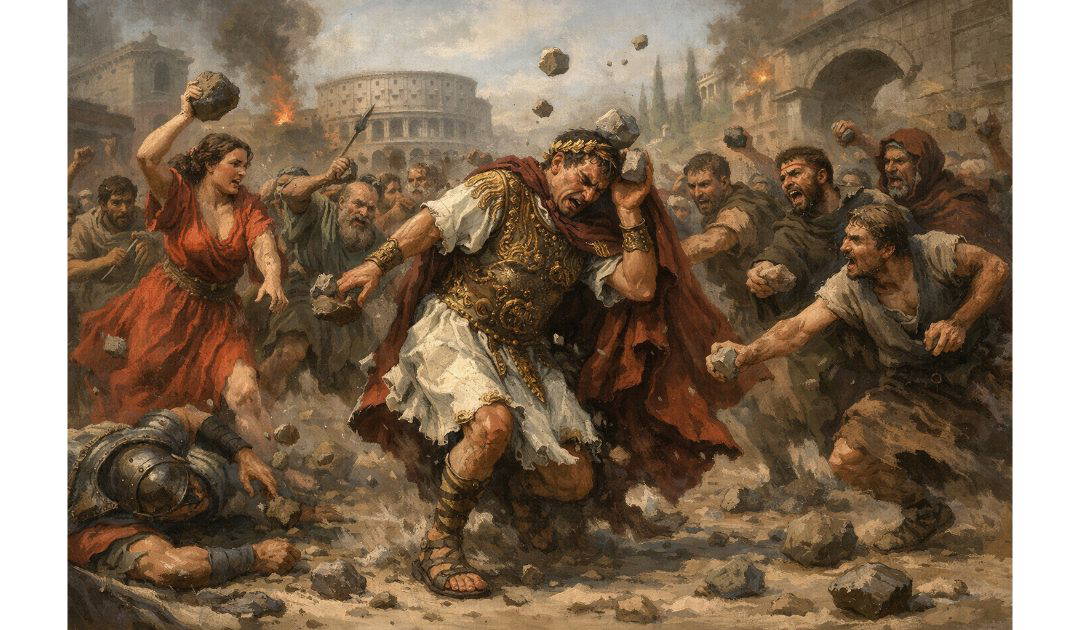
On the 31st of May, 455 CE, Emperor Petronius Maximus was stoned to death by an angry mob whilst trying to flee Rome. Petronius Maximus was Western Roman Emperor for a brief and ill-fated reign in the spring of 455 AD. Though he ruled for little more than two months, his career and violent death illustrate the extreme fragility of imperial power in the dying years of the Western Roman Empire.
Born around 396 into a wealthy and aristocratic Roman family, Maximus belonged to the powerful Anicii circle, one of the most influential senatorial networks in Italy. Unlike many emperors of the fifth century who rose through the army, Maximus was a civilian aristocrat. His advancement came through traditional offices: he served as praetor, tribune and notary, and eventually attained the prestigious post of urban prefect of Rome. Twice he held the consulship, in 433 and 443, marking him as one of the leading political figures of his generation.
During this period, real power in the Western Empire did not lie with the emperor but with military strongmen. The dominant figure was the general Flavius Aetius, often called “the last of the Romans.” Aetius had held together the crumbling western provinces through a mixture of diplomacy and force, famously defeating Attila at the Battle of the Catalaunian Plains in 451. Maximus, as a leading senator, operated in a political world overshadowed by such military commanders.
The turning point came in 454. Emperor Valentinian III, increasingly suspicious of Aetius’ influence, personally murdered the general during a palace audience. This shocking act destabilised the regime. Without Aetius, the western court was left vulnerable. According to later sources, Maximus had hoped to be appointed to Aetius’ former position of influence but was passed over. Whether out of resentment or political calculation, he became involved in a conspiracy against Valentinian.
On the 16th of March, 455, Valentinian III was assassinated while reviewing troops in Rome. The killers were former followers of Aetius. Ancient historians such as Priscus and later chroniclers suggest that Maximus played a role in organising or encouraging the plot, though the exact details remain uncertain. In the chaotic aftermath, Maximus moved quickly. Using his wealth to secure the loyalty of palace officials and elements of the guard, he had himself proclaimed emperor the very next day.
His accession, however, lacked broad legitimacy. The Western Empire was already fragmented, with Gaul, Spain and Africa either lost or under tenuous control. One of Maximus’ most consequential decisions was to compel the widowed empress Licinia Eudoxia, daughter of Theodosius II, to marry him. He also married her daughter Eudocia to his own son, Palladius, whom he elevated to the rank of Caesar. These moves were intended to strengthen his dynastic claim, but they instead created dangerous enemies.
Before Valentinian’s death, Eudocia had been betrothed to Huneric, the son of Genseric, king of the Vandals. The Vandals had established a powerful kingdom in North Africa, controlling vital grain supplies to Rome and maintaining a formidable fleet. By breaking this arrangement, Maximus provoked Genseric. According to later tradition, Licinia Eudoxia herself may have appealed to the Vandal king for aid or revenge, though this story is debated by historians.
In May 455, Genseric sailed from Carthage to Italy. As news of the Vandal fleet’s approach spread, panic gripped Rome. Maximus proved unequal to the crisis. He attempted to organise resistance but quickly abandoned the effort and decided to flee the city. His authority evaporated almost instantly.
On the 31st of May, 455, as he tried to escape Rome, Maximus was confronted by a furious mob. The population, terrified of the impending Vandal attack and enraged by the emperor’s perceived cowardice, turned on him. He was stoned and beaten to death in the streets. His body was reportedly mutilated and thrown into the Tiber. His son Palladius was also killed. Maximus had reigned for approximately seventy-five days.
Shortly afterward, Genseric entered Rome. Although Pope Leo I negotiated to prevent wholesale destruction, the Vandals looted the city for two weeks. The sack of 455 further symbolised the accelerating collapse of western imperial authority.
Petronius Maximus’ brief rule reveals much about the late Western Empire. By the mid-fifth century, emperors were often figureheads, dependent on military strongmen, court factions and barbarian alliances. Civilian aristocrats like Maximus could still aspire to the purple, but without military backing their position was precarious. His reliance on senatorial influence and palace intrigue proved no match for the geopolitical realities of the time.
Historians generally judge Maximus harshly, portraying him as ambitious and ineffectual. Yet he was also a product of a system already in terminal decline. The empire he inherited was financially strained, militarily overstretched and politically fractured. His violent end — killed not by a rival general but by his own people — underscores how little reverence the imperial office commanded in 455.
Within two decades of his death, the Western Roman Empire would formally cease to exist in 476. Petronius Maximus stands as one of its most fleeting and tragic rulers, emblematic of an age when the imperial crown had become less a symbol of power than a perilous burden.