
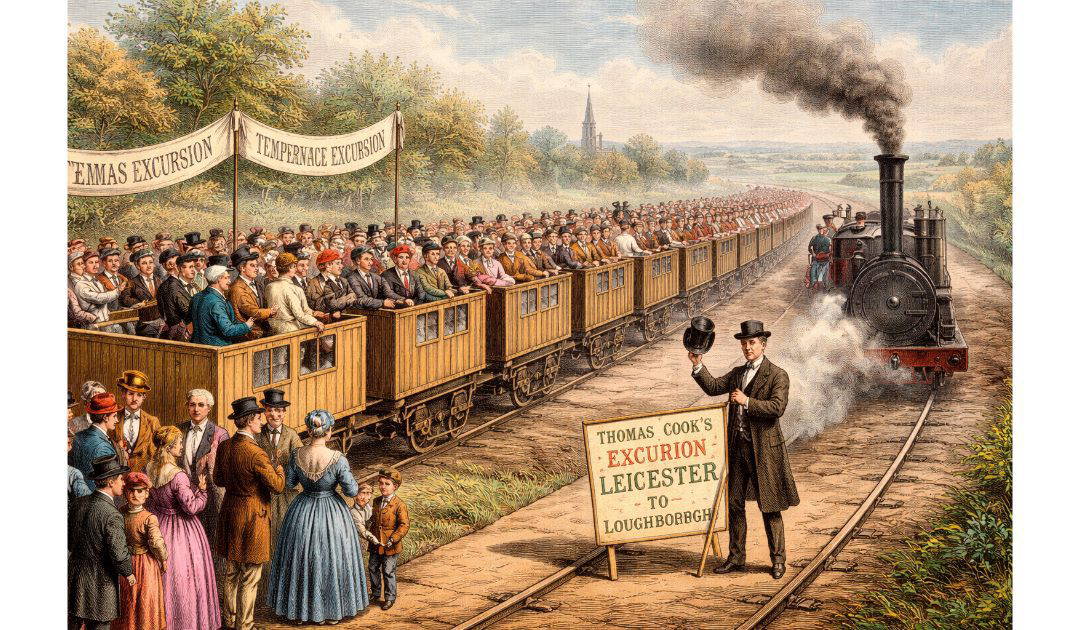
On the 5th of July, 1851, Thomas Cook organised the first package holiday, or excursion, from Leicester to Loughborough. I have posted on a few of the package holidays that Claire and I have taken, such as the Valley of the Kings, and Machu Picchu. Let’s explore the origin of the package holiday.
The story of Thomas Cook begins in the early nineteenth century and is closely tied to the growth of modern leisure travel. What started as a modest social initiative by a Baptist preacher evolved into one of the world’s most recognisable travel brands, helping to shape tourism as we know it today.
The company’s founder, Thomas Cook, was born in 1808 in Derbyshire, England. A deeply religious man and a committed campaigner for the temperance movement, Cook’s first foray into organised travel was not commercial but moral. In 1841, he arranged a railway excursion for members of a temperance society, transporting around 500 people from Leicester to Loughborough to attend a meeting. He negotiated a reduced fare with the railway company and included food and entertainment, effectively creating the first package tour.
This initial success inspired Cook to expand his idea. In the 1840s and 1850s, Britain was undergoing rapid industrialisation, and the expansion of the railway network made travel more accessible. Cook recognised the potential of organised excursions for the emerging middle and working classes. He began offering trips to destinations such as Liverpool, North Wales, and Scotland, carefully planning itineraries, accommodation, and meals. His approach removed much of the uncertainty and complexity of travel, making it more appealing to people who had never ventured far from home.
By 1855, Cook had taken a significant step by organising his first international tour, taking British travellers to the Paris Exhibition of 1855. This marked the beginning of international tourism as a structured industry. Cook’s tours were notable for their attention to detail and affordability, opening up continental Europe to a broader audience.
The business grew further when Cook’s son, John Mason Cook, joined him. Under the partnership of “Thomas Cook & Son,” the company expanded rapidly. They introduced innovations that became standard in the travel industry, including hotel coupons and circular notes—early forms of traveller’s cheques—that allowed tourists to pay for services abroad without carrying large amounts of cash.
One of the company’s most remarkable achievements came in 1869 when it organised tours to Egypt and the Middle East. Travel to these regions had previously been the preserve of the wealthy or adventurous explorers. Cook’s carefully managed tours along the Nile, complete with chartered steamers, made such journeys more accessible and comfortable. The company even managed tourist services for the Egyptian government for a time, demonstrating its growing influence.
In 1872–73, Thomas Cook & Son organised the first round-the-world tour, a groundbreaking venture that lasted 222 days and covered thousands of miles by rail and steamship. This ambitious undertaking captured the public imagination and cemented the company’s reputation as a pioneer of global travel.
After Thomas Cook’s death in 1892, the business continued under family leadership, particularly his son and later his grandsons. The company maintained its innovative edge into the early twentieth century, adapting to new forms of transport such as motor cars and ocean liners. It also played a role in organising travel for major events and pilgrimages, including trips to the Holy Land.
During the twentieth century, ownership of the company changed several times. In 1928, the Cook family sold the business, and it was later acquired by Midland Bank. After the Second World War, in 1948, the company was nationalised by the British government, reflecting its importance to the national economy and tourism sector. During this period, Thomas Cook expanded its services, catering to the growing demand for holiday travel in the post-war era.
The rise of air travel in the 1950s and 1960s transformed the industry, and Thomas Cook adapted by offering package holidays to destinations across Europe and beyond. The company became synonymous with affordable overseas holidays, particularly to Mediterranean resorts, as more people in Britain took advantage of increased leisure time and disposable income.
In the late twentieth and early twenty-first centuries, Thomas Cook underwent further mergers, acquisitions, and privatisations. It became a major international travel group, operating airlines, hotels, and high-street travel agencies. However, the company faced increasing challenges from online booking platforms, changing consumer habits, and financial pressures.
In 2019, after years of mounting debt and failed restructuring efforts, Thomas Cook Group collapsed, ceasing operations and leaving hundreds of thousands of travellers stranded. A group of enthusiastic employees bought the brand and reinvented it as an online travel agency.
The legacy of Thomas Cook is immense. The company pioneered the concept of package holidays, introduced financial innovations for travellers, and helped democratise travel. From a single railway excursion in 1841 to a global travel empire, Thomas Cook’s vision transformed tourism into a mass industry, making the world more accessible to millions.