
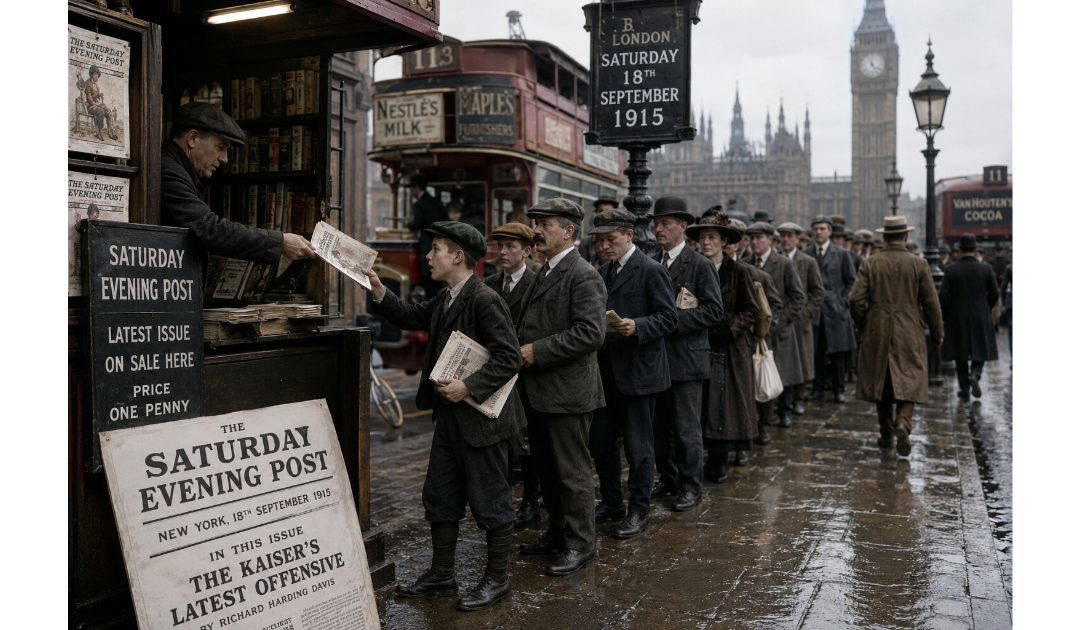
On the 18th of September, 1915, the Saturday Evening Post published a short story called Extricating Young Gussie by P.G. Wodehouse. It was the first appearnce of Bertie Wooster and his valet, Jeeves. I’ve written about some of my favourite writers such as Raymond Chandler, Josephine Tey, and Richard Hillary, but there is definitely room for P.G. Wodehouse.
P. G. Wodehouse, born Pelham Grenville Wodehouse on the 15th of October, 1881, was one of the greatest comic writers in the English language. Over a career spanning more than seventy years, he produced nearly one hundred books, over two hundred short stories, numerous plays, lyrics for musical comedies, and countless magazine articles. His elegant prose, intricate plots and unforgettable characters have delighted readers across generations. Although fashions in literature have changed dramatically since he first began writing, Wodehouse’s work has retained its popularity because it offers timeless humour rather than social commentary or political argument.
Wodehouse was born in Guildford, Surrey, the son of a British colonial civil servant. Much of his childhood was spent separated from his parents, who lived in Hong Kong while he remained in England with relatives and at boarding schools. These experiences later influenced the school stories that launched his literary career. He attended Dulwich College, where he excelled academically and developed his love of writing, although financial circumstances prevented him from attending university.
After leaving school, Wodehouse worked reluctantly for the Hong Kong and Shanghai Bank in London. Banking held little appeal, and he devoted his spare time to writing humorous articles and fiction. His first novel, The Pothunters, appeared in 1902 and established him as a promising author of school stories. Before long, he abandoned banking altogether to pursue writing full time.
His reputation expanded rapidly through his contributions to magazines in Britain and the United States. Wodehouse also became a successful lyricist, collaborating with composers on musical comedies in London’s West End and on Broadway. His light, witty lyrics displayed the same verbal dexterity that distinguished his novels.
Today, Wodehouse is best remembered for creating one of literature’s greatest comic partnerships: the amiable but none-too-bright Bertie Wooster and his supremely capable valet, Jeeves who quickly became Wodehouse’s most famous creation. Bertie continually finds himself entangled in romantic misunderstandings, troublesome relatives, impossible engagements and eccentric acquaintances, only to be rescued by Jeeves’s flawless intelligence and subtle manipulation. The stories combine ingenious plotting with sparkling dialogue, making them enduring favourites.
Another beloved series centres on Lord Emsworth, the absent-minded Earl of Blandings, whose greatest passion is his prize pig, the Empress of Blandings. Set in the idyllic Blandings Castle, these novels introduce a gallery of unforgettable comic characters, including domineering sisters, absent-minded aristocrats, scheming secretaries and efficient butlers. Wodehouse’s fictional England is one where serious problems rarely intrude, and misunderstandings are invariably resolved with good humour.
A hallmark of Wodehouse’s writing is his extraordinary command of language. His similes are delightfully unexpected, his dialogue crackles with wit, and even the smallest description is enlivened by imaginative comparisons. Rather than relying on jokes alone, he built comedy through character, timing and the gradual escalation of absurd situations. His plots resemble elaborate clockwork mechanisms in which every misunderstanding eventually falls perfectly into place.
Despite his literary success, Wodehouse’s reputation suffered during the Second World War. Living in France when Germany invaded in 1940, he was interned by the occupying forces before being persuaded to make a series of radio broadcasts from Berlin intended for American audiences. Although the broadcasts were largely humorous accounts of his internment and contained little propaganda, many people in Britain regarded them as naïve and insensitive because they originated from enemy-controlled territory. After the war, official investigations concluded that he had not acted treasonously, but public opinion remained divided for many years.
Wodehouse settled permanently in the United States after the war, becoming an American citizen in 1955 while retaining his affection for England. He continued writing well into old age, maintaining an astonishing level of productivity. Remarkably, his style remained fresh and consistent throughout his long career.
Recognition eventually returned. In 1975, only weeks before his death at the age of ninety-three, Wodehouse was appointed a Knight Commander of the Order of the British Empire in acknowledgement of his immense contribution to literature. Although illness prevented him from receiving the honour in person, it symbolised the restoration of his standing in Britain.
Today, P. G. Wodehouse is celebrated as a master of comic fiction whose works have never gone out of print. His novels continue to inspire television adaptations, stage productions and new generations of readers. Writers from Evelyn Waugh to Douglas Adams have acknowledged his influence, praising his incomparable style and technical brilliance. In creating a world where wit triumphs over worry and happiness is never far away, Wodehouse secured his place as one of the most beloved humorists in literary history.