
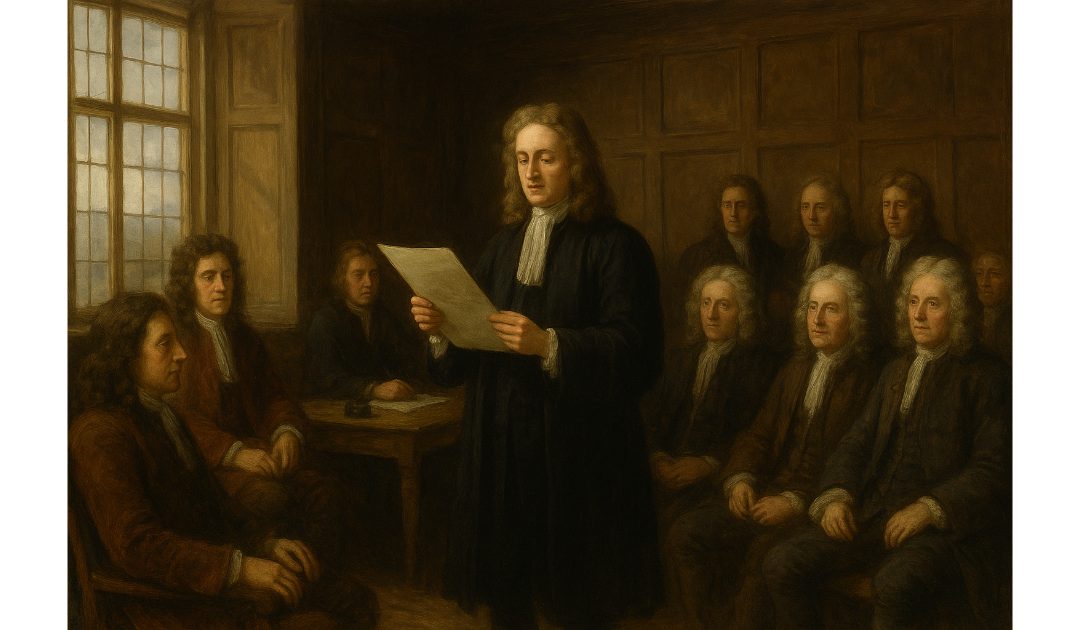
On the 10th of December, 1684, Edmund Halley read Isaac Newton’s paper De motu corporum in gyrum (which I will loosely translate as On the motion of bodies in orbit) to the Royal Society. This short Latin treatise, only about nine pages long, served as the immediate precursor to his monumental Philosophiæ Naturalis Principia Mathematica (1687). While brief, it introduced the essential mathematical framework and physical principles that would underpin classical mechanics and the law of universal gravitation.
The context of this paper lies in the scientific debates of the late seventeenth century. Astronomers, building upon the work of Copernicus, Galileo, and Kepler, had amassed a great deal of observational data about planetary motion. Johannes Kepler’s three laws, derived from Tycho Brahe’s meticulous observations, accurately described the elliptical paths of the planets and the proportionality between their orbital periods and distances. However, Kepler had offered no underlying physical explanation for why the planets moved as they did. Natural philosophers were left searching for the mechanism that governed celestial motions.
Newton’s interest in this problem was revived in 1684 through a conversation with the mathematician and astronomer Edmond Halley. Halley inquired what kind of force would produce Kepler’s elliptical orbits under the new understanding of celestial mechanics. Newton is said to have answered that an inverse-square law of attraction would suffice. Pressed by Halley to provide a demonstration, Newton composed De motu corporum in gyrum, which he sent to the Royal Society later that year.
The paper begins by considering a body moving under the influence of a centripetal force, one that is always directed toward a fixed point. Newton mathematically derives the relationship between the force and the curve of the orbit, showing that the path of a body subject to such a force could be an ellipse, a parabola, or a hyperbola, depending on its velocity and distance. He also demonstrates that a force inversely proportional to the square of the distance from the centre produces orbits consistent with Kepler’s laws, particularly the area law, which states that a line joining a planet to the Sun sweeps out equal areas in equal times.
Several crucial concepts appear in De motu for the first time in a systematic way. Newton introduces the idea of centripetal force and treats it as a measurable, mathematical quantity rather than a vague tendency. He also applies methods of geometric reasoning and infinitesimal limits to analyse the instantaneous motion of a planet along an orbit. This approach anticipates the more formalised use of calculus in the Principia, though Newton framed his original arguments using classical Euclidean geometry to ensure rigour and acceptance among contemporary mathematicians.
The treatise is divided into a series of propositions and corollaries, each building upon the last to establish a coherent argument. For example, Newton proves that if a planet moves under a force pointing towards the Sun, the area law automatically follows. He then demonstrates that an inverse-square force implies that the orbits will satisfy Kepler’s harmonic law relating period and radius. By linking these geometric results to physical causation, Newton was able to show that the same principles governing falling bodies on Earth applied to planets in the heavens, unifying terrestrial and celestial physics for the first time.
In historical terms, De motu is as significant for its brevity as for its content. It served as a condensed blueprint for the first book of the Principia. Encouraged by Halley and other contemporaries, Newton expanded this short paper into a three-volume work, adding extensive proofs, generalisations, and applications to the Moon, comets, tides, and the shape of the Earth. Nevertheless, the essential insight—that an inverse-square centripetal force leads to Keplerian motion—was already fully present in this early draft.
The impact of De motu was immediate within Newton’s circle, even if it was not widely published at the time. It convinced Halley of the need to sponsor the Principia and to ensure its printing at his own expense. The paper also demonstrated to the Royal Society that Newton had solved a problem that had eluded generations: the mathematical explanation of planetary motion. In Newton’s hands, the heavens were no longer ruled by separate or speculative principles; the same force that caused an apple to fall also bound the Moon to its orbit.