
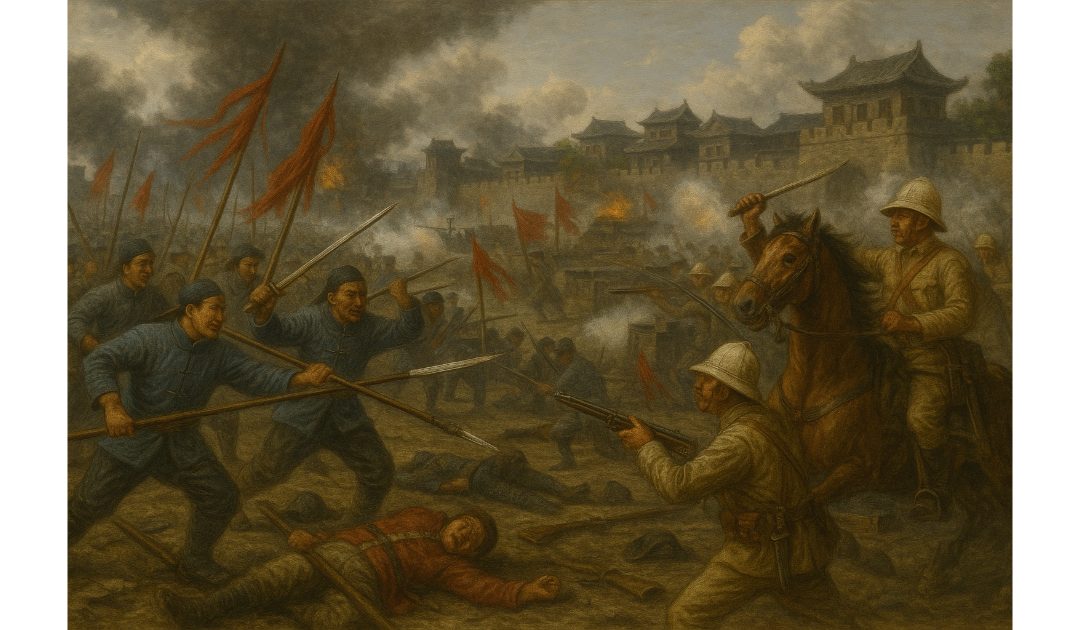
I suppose because I’m British I’m attracted to the great achievements of Britain and its people. However one cannot escape the fact that Britain hasn’t always been squeaky clean. I have posted about the appalling delay to the abolition of slavery, and today I must turn to another dark period in Britain’s history.
On the 4th of September, 1839, th Battle of Kowloon was fought, the first armed conflict in the First Opium War. The First Opium War (1839–1842) was a significant conflict between the British Empire and the Qing Dynasty of China, primarily driven by disputes over trade, diplomatic relations, and the illegal opium trade. This war marked the beginning of what is often referred to as the “Century of Humiliation” for China, profoundly impacting its sovereignty and relations with foreign powers.
Background and Causes
In the early 19th century, the British Empire was experiencing rapid industrial growth, fuelling a high demand for Chinese goods such as tea, silk, and porcelain. However, China’s economy was largely self-sufficient, and it showed little interest in British manufactured goods. This trade imbalance resulted in a substantial outflow of silver from Britain to China. To counteract this deficit, the British East India Company began exporting opium, cultivated in British India, to China. This created a profitable trade triangle: British goods to India, Indian opium to China, and Chinese tea to Britain.
The opium trade had devastating social and economic effects on China. Addiction spread widely, affecting all strata of society and undermining productivity and social stability. Recognising the destructive impact, the Qing government sought to suppress the opium trade. In 1839, Emperor Daoguang appointed Lin Zexu, a dedicated and incorruptible official, as Special Commissioner to eradicate opium use and trade. Lin’s strict measures included destroying large quantities of opium in Canton (now Guangzhou), which directly challenged British commercial interests.
Outbreak of War
The British government, viewing Lin’s actions as an affront to free trade and British honour, dispatched a naval expedition to China, initiating the First Opium War. The British military possessed advanced technology and superior naval power, including steam-powered warships, which starkly contrasted with the Qing’s outdated fleet and military tactics.
The conflict began with the British blockade of the Pearl River and attacks on key Chinese coastal cities. British forces quickly demonstrated their dominance through a series of decisive victories, exploiting both military superiority and the Qing’s fragmented command structure. The British captured important ports and key cities, including Chusan (Zhoushan) and later advancing towards the Yangtze River, threatening the economically vital city of Nanjing.
Key Battles and Developments
One of the pivotal confrontations was the Battle of Chuenpi in January 1841, where British forces decisively defeated the Chinese, leading to the signing of the Convention of Chuenpi. However, the treaty was not ratified, and hostilities resumed. The British continued their offensive, capturing strategic locations along the Chinese coastline.
The Qing military, plagued by corruption, inadequate training, and inferior weaponry, struggled to mount an effective resistance. The British, leveraging their naval superiority, launched amphibious assaults and controlled major waterways, cutting off supplies and exerting pressure on the Qing government.
The Treaty of Nanjing
The war concluded with the Treaty of Nanjing in August 1842, the first of the so-called “unequal treaties” imposed on China by Western powers. Under the treaty’s terms, China ceded Hong Kong Island to Britain, opened five treaty ports (Canton, Amoy, Fuzhou, Ningbo, and Shanghai) to British trade and residence, and granted extraterritorial rights to British citizens, meaning they were subject to British, not Chinese, law.
Furthermore, the Qing government agreed to pay a large indemnity to cover Britain’s war expenses and compensate for the destroyed opium. The treaty significantly undermined China’s sovereignty, marking the beginning of increased foreign influence and intervention in Chinese affairs.
Consequences and Legacy
The First Opium War had profound and lasting effects on China. It exposed the Qing Dynasty’s weaknesses, both militarily and administratively, sparking domestic unrest and contributing to the eventual decline of imperial rule. The humiliation suffered by China fuelled anti-foreign sentiment and internal reform movements, setting the stage for future conflicts, including the Second Opium War (1856–1860).
For Britain, the war secured vital commercial advantages, establishing a strong foothold in East Asia and enhancing its global imperial presence. The acquisition of Hong Kong transformed it into a significant trading hub and symbol of British colonial power.
Moreover, the war highlighted the devastating impact of the opium trade, both in terms of human suffering and geopolitical consequences. It also underscored the complexities of imperialism, where economic interests, moral justifications, and military might intertwined to shape historical events.
In contemporary China, the First Opium War remains a potent symbol of national humiliation and foreign exploitation. It serves as a historical lesson on the importance of sovereignty, resilience, and the need for modernisation, themes that continue to resonate in China’s national consciousness today.