
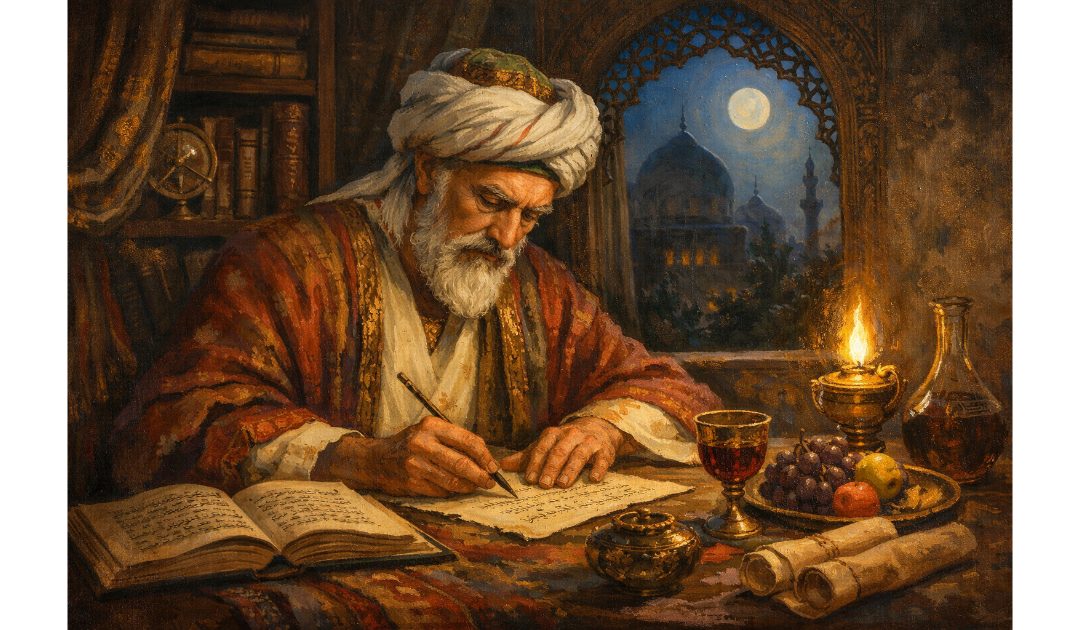
The Persian poet, mathematician and astronomer, Omar Khayyám, was born on the 18th of May 1048. Omar Khayyám (c. 1048–1131) was one of the most remarkable intellectual figures of the medieval Islamic world: a mathematician of the first rank, a serious astronomer, and a poet whose quatrains later captivated readers across the globe. Born in Nishapur in northeastern Persia (modern Iran), he lived during the flourishing of Seljuk power and at a time when Persian culture, language, and scholarship were undergoing a powerful revival.
Khayyám’s name means “tentmaker,” probably reflecting his father’s profession rather than his own. From an early age he displayed extraordinary intellectual gifts. He studied in Nishapur and later in centres of learning such as Balkh and Samarkand. These cities were part of a vibrant intellectual network stretching from Central Asia to Baghdad, where Greek philosophy, Indian mathematics, and Islamic theology were studied, debated, and developed.
In his own lifetime, Khayyám was primarily known not as a poet but as a mathematician. His most important mathematical work was a treatise on algebra, often translated as Treatise on Demonstration of Problems of Algebra. In it, he offered a systematic classification of cubic equations and devised geometric methods for solving them using intersections of conic sections.
While earlier mathematicians had made advances in algebra, Khayyám brought new rigour and clarity to the subject. He recognised that cubic equations could not, in general, be solved by the algebraic methods available at the time and instead turned to geometry. By constructing solutions through the intersection of parabolas and circles, he demonstrated a profound grasp of both algebraic structure and classical Greek geometry, particularly that of Euclid.
Khayyám also wrote a commentary on Euclid’s Elements, in which he explored the theory of parallel lines and ratios. His work on what would later be known as the parallel postulate anticipated debates that would eventually lead, centuries later, to non-Euclidean geometry. Though he did not overthrow Euclid, he clearly recognised logical tensions within the traditional framework.
Khayyám’s reputation brought him to the attention of the Seljuk ruler Malik-Shah I. Around 1074, he was invited to Isfahan to head a royal observatory. There, with a team of astronomers, he undertook one of the most impressive scientific projects of the medieval period: the reform of the Persian calendar.
The result was the Jalali calendar, introduced in 1079. It was astonishingly accurate, more precise even than the later Gregorian calendar introduced in Europe in 1582 under Pope Gregory XIII. The Jalali system calculated the length of the solar year with extraordinary care, producing a calendar whose error accumulated far more slowly than that of the Julian system then in use in Christendom.
Khayyám’s astronomical tables and calculations reflected a careful empirical spirit. He combined observation with mathematical modelling, embodying the sophisticated scientific culture of the Islamic Golden Age.
Like many scholars of his era, Khayyám was also a philosopher. He engaged deeply with the works of Avicenna (Ibn Sina), whose synthesis of Aristotelian philosophy and Islamic thought dominated intellectual life in Persia. Khayyám’s surviving philosophical writings suggest a rationalist bent. He was interested in metaphysics, the nature of existence, and the problem of free will.
Some later readers have portrayed him as a sceptic or even a freethinker hostile to religion. However, the historical record is more complex. He seems to have operated within the broad framework of Islamic belief, though perhaps with a philosophical independence that made him controversial. Political upheavals following the death of Malik-Shah curtailed royal patronage, and Khayyám appears to have returned to a quieter life in Nishapur, teaching and writing.
Today, Khayyám is best known in the West for the Rubáiyát—a collection of short, four-line poems (rubā‘īyāt) traditionally attributed to him. These quatrains meditate on time, fate, love, wine, and the fleeting nature of human life. They often adopt a tone of melancholy scepticism:
Life is short; the future uncertain; the present moment all we truly possess.
However, the textual history of the Rubáiyát is complicated. Manuscripts vary widely, and scholars debate how many of the quatrains were genuinely composed by Khayyám. His poetic fame in the English-speaking world largely stems from the 1859 translation by Edward FitzGerald. A manuscript of some of his rubáiyát (four-line verses) survives in the Bodleian Library and a copy of this manuscript is thought to have inspired Fitzgerald to begin the translation. FitzGerald’s version was less a literal translation than a creative reimagining, shaping Khayyám into a lyrical, wine-loving fatalist whose verses resonated with Victorian doubts and longings.
Through FitzGerald’s adaptation, Khayyám became a cultural phenomenon in Britain and America. His lines were quoted in drawing rooms, inscribed on gravestones, and illustrated in lavish editions. In Persia, however, he remained more widely recognised as a scientist and philosopher than as a poet.
Omar Khayyám stands at the intersection of science and poetry, reason and imagination. In mathematics, he helped advance algebra beyond its classical inheritance. In astronomy, he contributed to one of the most accurate calendar systems of the pre-modern world. In literature, whether through authentic quatrains or later attributions, he gave voice to enduring human anxieties about mortality and meaning.
He died in Nishapur around 1131. According to tradition, he predicted that his grave would lie in a garden where blossoms would fall upon it in spring. Today, his tomb in Iran remains a place of pilgrimage, not only for admirers of Persian poetry but also for those who recognise in him a symbol of the rich intellectual life of the medieval Islamic world.
Few figures embody so completely the unity of scientific precision and poetic reflection. Omar Khayyám’s life reminds us that the pursuit of knowledge and the contemplation of existence need not be separate paths, but can converge in a single, searching mind.