
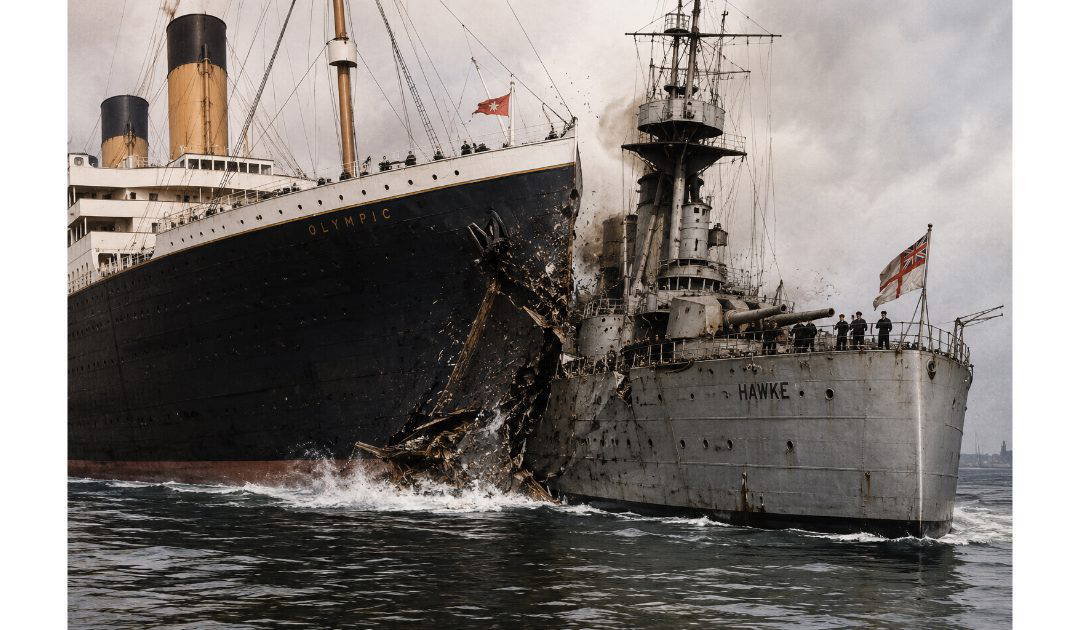
On the 20th of September, 1911, RMS Olympic collided with HMS Hawke. As a yachtsman and former officer of the Royal Naval Reserve, I can confirm that collisions between ships are to be avoided if at all possible. However her sister ships in the White Star Line, RMS Titanic and HMHS Britannic suffered worse fates.
The White Star Line was one of the world’s most famous shipping companies, renowned for operating some of the finest passenger liners ever built. Although its name is forever linked with the tragic loss of Titanic in 1912, the company enjoyed a history stretching back more than eighty years and pioneered many of the standards of comfort, luxury and safety that came to define transatlantic travel. Among all its ships, RMS Olympic stands out as its greatest long-term success—a vessel whose distinguished career more than justified her reputation as “Old Reliable.”
The White Star Line originated in Liverpool in 1845, initially carrying emigrants to Australia during the gold rushes. Financial difficulties eventually forced the original company into liquidation, but the White Star name was purchased in 1867 by the shipping magnate Thomas Henry Ismay. Under Ismay’s leadership, the company adopted a philosophy that differed from many of its rivals. Rather than competing solely on speed, White Star concentrated on comfort, reliability and luxury. Wealthy travellers appreciated spacious cabins, elegant public rooms and attentive service, while emigrants benefited from cleaner and more comfortable accommodation than was available on many competing ships.
By the beginning of the twentieth century, competition between White Star and the Cunard Line had become intense. Cunard’s fast liners Lusitania and Mauretania had captured the coveted Blue Riband for Atlantic speed. White Star responded by commissioning three enormous vessels that would be larger and more luxurious than anything afloat. These became the Olympic-class liners: Olympic, Titanic and Britannic. They were designed by the celebrated naval architect Thomas Andrews and built at the Harland & Wolff shipyard in Belfast.
Launched on the 20th of October, 1910, RMS Olympic entered service in June 1911 as the largest passenger ship in the world. She measured 882 feet 9 inches (269 metres) long, displaced over 45,000 gross tons and featured four towering funnels, although only three carried boiler exhaust; the fourth improved ventilation and gave the ship a balanced appearance. Her interiors were designed to resemble the finest hotels and country houses, featuring richly panelled dining rooms, a magnificent Grand Staircase, Turkish baths, a swimming pool, squash court, gymnasium and luxurious first-class suites. Second-class accommodation rivalled first class on many other liners, while even third-class passengers enjoyed standards far superior to those found on older emigrant ships.
Olympic’s maiden voyage from Southampton to New York was an immediate success. She proved remarkably stable and comfortable in heavy seas, quickly becoming popular with both passengers and crew. However, only a few months later, on the 20th of September, 1911, she was involved in a serious collision with the Royal Navy cruiser HMS Hawke in the Solent. As the two ships passed close together, the immense displacement of water created by Olympic pulled the smaller cruiser towards her. Hawke‘s bow struck Olympic’s starboard side near the stern, causing extensive damage to both vessels. Although there were no fatalities, the Admiralty blamed White Star, and the expensive repairs delayed Olympic’s schedule.
The following year brought an even greater challenge. On the 15th of April, 1912, Titanic sank after striking an iceberg during her maiden voyage, killing more than 1,500 people. The disaster profoundly affected Olympic’s career. She was temporarily withdrawn from service while numerous safety improvements were made. These included the installation of additional lifeboats for everyone aboard, raising several watertight bulkheads and improving emergency procedures. These modifications later became standard practice throughout the passenger shipping industry.
When the First World War broke out in 1914, Olympic was requisitioned as a troopship. Repainted in camouflage and armed for defence, she transported tens of thousands of soldiers across the Atlantic and Mediterranean. Her size and speed made her invaluable. During the war she carried more than 200,000 troops and steamed hundreds of thousands of miles without losing a single passenger to enemy action. In one remarkable incident in May 1918, Olympic rammed and sank the German submarine U-103, one of the few merchant liners ever to destroy an enemy submarine by direct collision. Her wartime service earned widespread admiration from both the Royal Navy and the British government.
After the war, Olympic returned to civilian service following extensive refurbishment. Throughout the prosperous 1920s she resumed regular crossings between Southampton, Cherbourg and New York, carrying celebrities, businessmen, politicians and thousands of emigrants. Although newer liners gradually appeared, Olympic remained popular because of her reliability, excellent sea-keeping qualities and experienced crew.
The onset of the Great Depression reduced passenger numbers dramatically, and the shipping industry struggled. In 1934 White Star merged with its long-time rival Cunard to form Cunard-White Star. Olympic continued sailing for another year before being retired in 1935 after completing 257 round-trip Atlantic crossings. She was sold for scrap, with much of her magnificent interior preserved in hotels, private homes and museums, where pieces can still be seen today.
Unlike her sisters, Titanic, which sank in 1912, and Britannic, which struck a mine and sank in 1916, Olympic enjoyed a full and productive career lasting almost twenty-four years. She safely carried hundreds of thousands of passengers, served her country in wartime with distinction and became one of the most respected ships ever built. While Titanic remains the more famous name, many maritime historians regard RMS Olympic as the true triumph of the White Star Line—a magnificent liner whose long, dependable service perfectly embodied the company’s ideals of quality, comfort and reliability.