
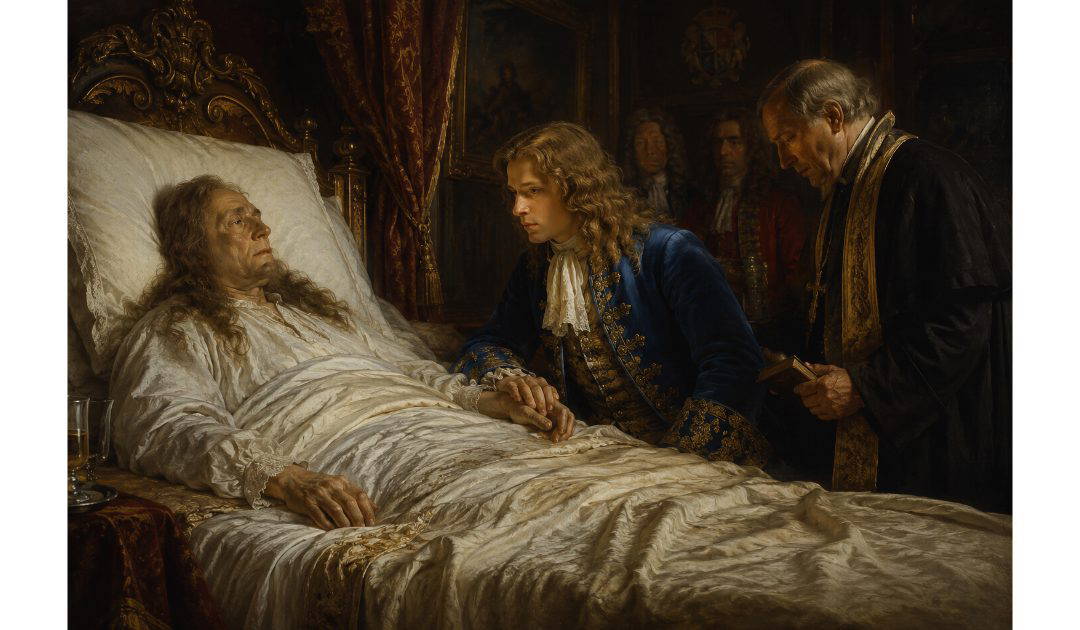
On the 16th of September, 1701, James Frances Edward Stuart, known as the Old Pretender, became the Jacobite claimant to the thrones of England and Scotland on the death of his father, James II.
James Francis Edward Stuart, known to his supporters as James III and VIII and to his opponents as the Old Pretender, was the son of King James II of England and his second wife, Mary of Modena. Born on the 10th of June, 1688, at St James’s Palace in London, his arrival transformed the politics of Britain and helped trigger one of the most significant constitutional crises in British history.
Before James Francis Edward’s birth, many Protestants expected that James II’s Protestant daughters, Mary and Anne, would eventually inherit the throne. The birth of a healthy Catholic son raised the prospect of a permanent Catholic dynasty. Rumours quickly spread that the baby was not genuine and had been smuggled into the royal bedchamber in a warming pan. Although modern historians dismiss this story as baseless propaganda, it proved remarkably effective in undermining confidence in the infant prince and his parents.
Only a few months after his birth, the so-called Glorious Revolution unfolded. A group of English nobles invited William III of England, husband of James II’s daughter Mary, to invade England. James II fled to France in December 1688, taking his infant son with him. Parliament declared that James II had effectively abdicated, and William and Mary became joint monarchs. For Jacobites—those who believed in the hereditary right of the Stuart dynasty—the infant James became the rightful king upon his father’s death in 1701.
Life in exile shaped James Francis Edward’s character. The exiled Stuart court settled first at the Château de Saint-Germain-en-Laye near Paris under the protection of King Louis XIV. James received an excellent education, becoming fluent in several languages and developing interests in theology, military affairs and diplomacy. He was known for his dignity, courtesy and sincere religious devotion, although many contemporaries thought him reserved and lacking the charisma needed to inspire followers.
Louis XIV recognised James as the legitimate King of England, Scotland and Ireland after James II died. However, international politics constantly affected his fortunes. During the War of the Spanish Succession, France supported the Stuart claim when convenient but was equally willing to abandon it during peace negotiations.
James made his first serious attempt to regain his kingdoms in 1708. A French fleet carried him towards Scotland, hoping to spark a Jacobite rising. Poor weather and the presence of the Royal Navy prevented a landing, and the expedition returned to France without achieving anything.
His greatest opportunity came in 1715. Following the death of Queen Anne in 1714, the crown passed to the Protestant George I of Great Britain under the Act of Settlement. Many Scottish Highland chiefs and some English supporters rose in rebellion on James’s behalf. Although the Earl of Mar gathered a considerable force in Scotland, the campaign suffered from indecisive leadership. James himself landed at Peterhead in December 1715, but by then the rebellion was already collapsing after the inconclusive Battle of Sheriffmuir and the defeat of the English Jacobites at Preston. Finding little prospect of success, he departed from Montrose only six weeks later, earning criticism for his apparent lack of energy.
After the failure of the 1715 Rising, James spent most of the remainder of his life in Rome, where Pope Clement XI provided him with the Palazzo Muti as his residence. In 1719 he married Maria Clementina Sobieska, granddaughter of the famous Polish king John III Sobieski. They had two sons: Charles Edward Stuart, born in 1720, and Henry Benedict Stuart, born in 1725.
James never abandoned his claim to the throne, but advancing age and repeated disappointments diminished his political influence. Leadership of the Jacobite cause gradually passed to Charles Edward Stuart, whose dramatic campaign during the Jacobite Rising of 1745 came far closer to restoring the Stuarts than any effort made by his father. Even after the crushing defeat at Culloden in 1746, James remained convinced that divine providence would ultimately restore his family, although the political reality made this increasingly improbable.
Personally, James was regarded as honest, pious and cultured. Unlike many exiled princes, he avoided extravagance and scandal. Yet these admirable qualities were accompanied by caution and indecision. He lacked the boldness that many believed necessary for a successful claimant, and he often relied too heavily on foreign powers whose interests rarely aligned with his own.
James Francis Edward Stuart died in Rome on the 1st of January, 1766, at the age of seventy-seven. For nearly sixty-five years he had maintained his claim to the British throne, longer than any other major Jacobite pretender. He was buried in St Peter’s Basilica, where his remains later rested alongside those of his wife and, eventually, his sons.
Although he never wore the crown he claimed by birthright, James Francis Edward Stuart, the Old Pretender, occupies a central place in British history. His existence precipitated the Glorious Revolution, his claim inspired decades of Jacobite resistance, and his descendants became enduring figures of romance and legend. Through him, the Stuart cause survived well into the eighteenth century, leaving a lasting imprint on the political and cultural history of Britain.