
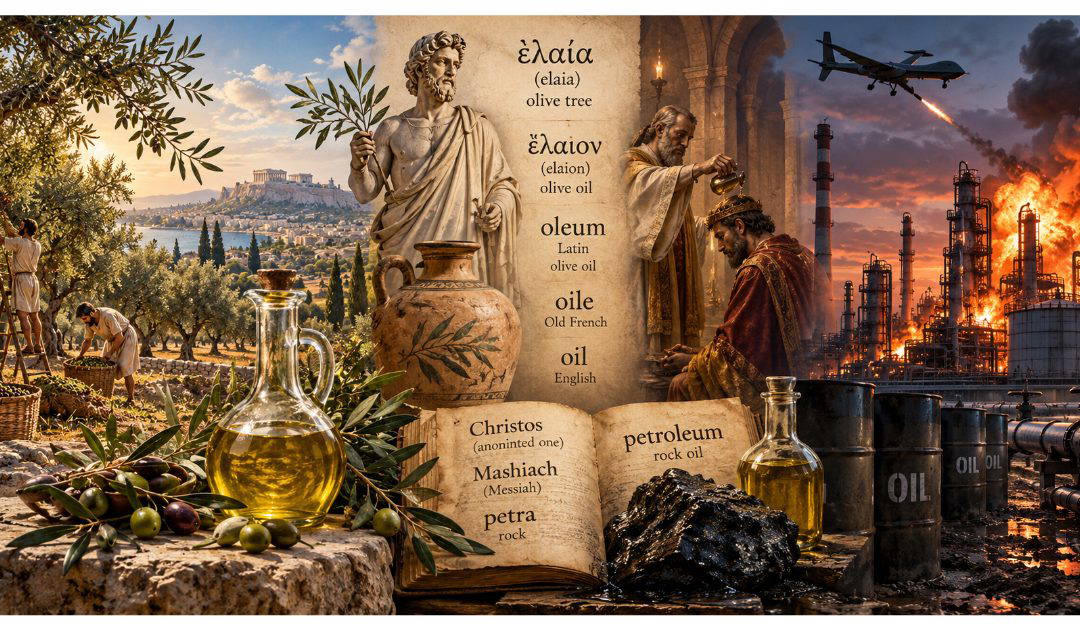
The word oil has a history stretching back more than three thousand years, beginning with one of the Mediterranean’s most important agricultural products: the olive.
Our English word derives from the Old French oile or uile, which came from the Latin oleum, meaning olive oil. The Romans borrowed this from the Greek elaion (ἔλαιον), itself derived from elaia (ἐλαία), meaning olive tree or olive. The Greek word may have originated in an earlier Mediterranean language, reflecting the importance of olive cultivation long before classical civilisation.
The word entered Old English as ele, but the modern form developed through French influence following the Norman Conquest of 1066. By the Middle English period, spellings such as oyle were becoming established.
Originally, oil referred principally to olive oil, used for cooking, lighting, medicine, religious ceremonies and personal grooming. As other oily substances became familiar, the meaning broadened to include animal fats and vegetable oils.
The word acquired particular religious significance through the practice of anointing. The Greek Christos, meaning ‘anointed one’, corresponds to the Hebrew Mashiach, or Messiah. Both refer to the ancient custom of anointing kings and priests with oil.
The word petroleum combines the Latin petra, meaning rock, borrowed from Greek, with oleum, literally giving us ‘rock oil’. Although natural petroleum had been known since antiquity, its commercial exploitation expanded dramatically during the nineteenth century.
This produced an interesting linguistic distinction. In Britain, petrol became the usual name for the refined fuel used in motorcars, while Americans preferred gasoline, commonly shortened to gas. The American expression ‘gas station’ therefore refers to somewhere selling a liquid!
The word also developed numerous figurative meanings. To ‘oil the wheels’ means to make a process run smoothly, while ‘pouring oil on troubled waters’ describes calming a dispute. The latter expression recalls the observation that oil spread over water can reduce small surface ripples. Conversely, an ‘oil slick’ suggests environmental disaster, while a ‘snake-oil salesman’ is a dishonest promoter of supposedly miraculous remedies.
Thus, a word originally associated with the humble Mediterranean olive has expanded to embrace religion, industry, commerce, diplomacy and deception. Strangely it was diplomacy and deception in the news that made me think about oil.