
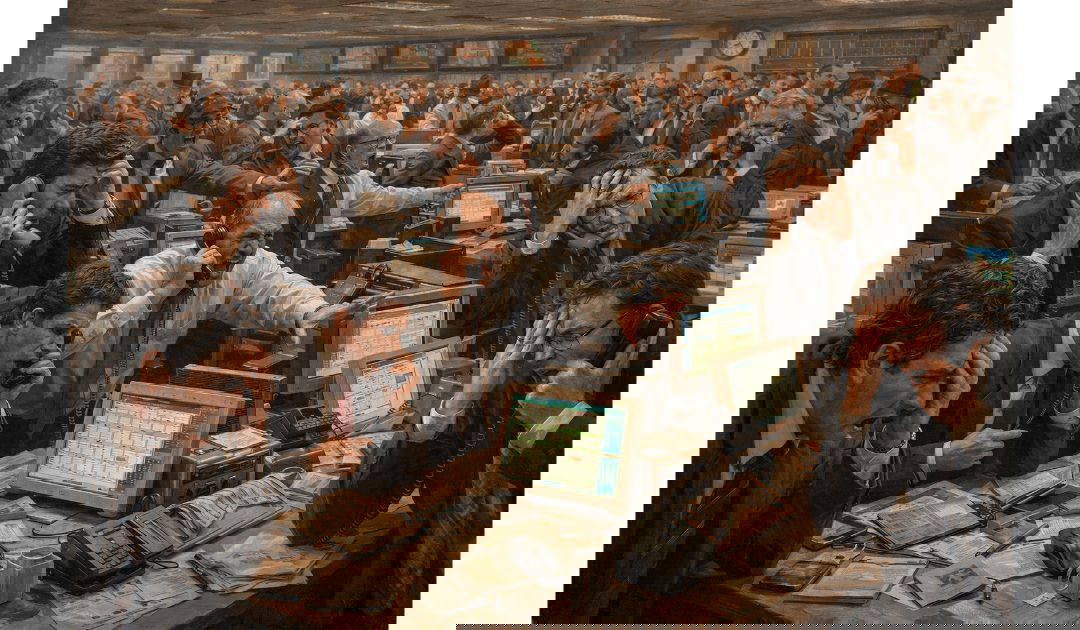
On the 26th of February, 1995, the UK’s oldest investment bank, Barings, collapsed after the rogue securities broker, Nick Leeson, lost $1.4 billion speculating on futures contracts using the Singapore International Monetary Exchange.
The collapse of Barings Bank in 1995 was one of the most dramatic financial failures in modern British history. Founded in 1762, Barings was Britain’s oldest merchant bank and had long been associated with stability, prestige, and elite finance. Its sudden downfall, caused by the unauthorised trading of a single employee, shocked the financial world and exposed deep flaws in risk management, oversight, and corporate culture at the heart of global banking.
Barings’ reputation had been built over more than two centuries. It had financed wars against Napoleonic France, advised governments, and acted as banker to royalty. By the late twentieth century, however, Barings was struggling to adapt to a rapidly changing financial environment. Deregulation, globalisation, and the rise of complex derivatives trading were reshaping banking, and the institution sought higher profits by expanding into futures and options markets in Asia.
Central to the collapse was Nick Leeson, a young and ambitious trader sent to Singapore in 1992 to work at Barings Futures Singapore (BFS). Leeson was appointed both head trader on the Singapore International Monetary Exchange (SIMEX) and head of settlement operations. This dual role was highly unusual and fundamentally dangerous, as it allowed him to trade and also to oversee the recording and reporting of those trades—removing a crucial internal control.
Leeson’s original mandate was to conduct arbitrage: exploiting small price differences between Nikkei 225 futures traded in Singapore and Osaka. Properly executed, this strategy should have generated small but steady profits with minimal risk. Instead, Leeson began taking increasingly large speculative positions, betting on the direction of the Japanese stock market. When early losses occurred in 1992, he concealed them in a secret “error account”, numbered 88888, which he claimed was used for minor trading mistakes.
Rather than reducing risk, Leeson doubled down. Over the next two years he dramatically increased the size of his positions, particularly in Nikkei futures and options. To senior management in London, he appeared to be a star performer, reporting consistent profits that bolstered Barings’ balance sheet. In reality, the losses hidden in the error account were mounting at an alarming rate, eventually reaching hundreds of millions of pounds.
The situation became catastrophic in January 1995, when the Kobe earthquake struck Japan. The disaster caused a sharp fall in the Nikkei index, directly undermining Leeson’s massive bets that the market would rise. In response, he attempted to recover losses by taking even larger positions, including risky “short straddle” options strategies that left Barings dangerously exposed to market volatility. Instead of stabilising the situation, these gambles magnified the losses.
By February 1995, the scale of the problem was impossible to conceal. Leeson fled Singapore on 23 February, leaving behind a note that read simply, “I’m sorry.” When Barings’ management finally uncovered the true extent of the losses, they discovered that the bank owed £827 million—more than twice its available capital. On the 26th of February, 1995, Barings Bank was declared insolvent.
The collapse sent shockwaves through global financial markets. That a single trader could bring down a venerable institution seemed almost unbelievable. Yet subsequent investigations revealed that Leeson’s actions were only part of the story. Barings’ internal controls were woefully inadequate. Senior management failed to understand the products being traded, ignored warning signs from auditors and regulators, and placed excessive trust in reported profits without proper verification.
The Bank of England and other regulators were criticised for their limited oversight, particularly of Barings’ overseas operations. The episode highlighted how global financial institutions had become too complex for traditional supervisory frameworks, with activities spread across jurisdictions and time zones.
In March 1995, Barings was sold to the Dutch bank ING for the nominal sum of £1, effectively marking the end of Barings as an independent institution. Nick Leeson was later arrested in Germany, extradited to Singapore, and sentenced to six and a half years in prison. His memoir, Rogue Trader, and its subsequent film adaptation turned the collapse into a cautionary tale for a wider public.
The fall of Barings Bank became a landmark case in financial history. It demonstrated that catastrophic failure could arise not only from market forces but from human error, poor governance, and cultural complacency. Above all, it showed that reputation and tradition were no defence against risk mismanagement. In an era of increasingly complex finance, the collapse of Barings served as a stark warning that unchecked ambition and inadequate controls could bring even the mightiest institutions to ruin.