
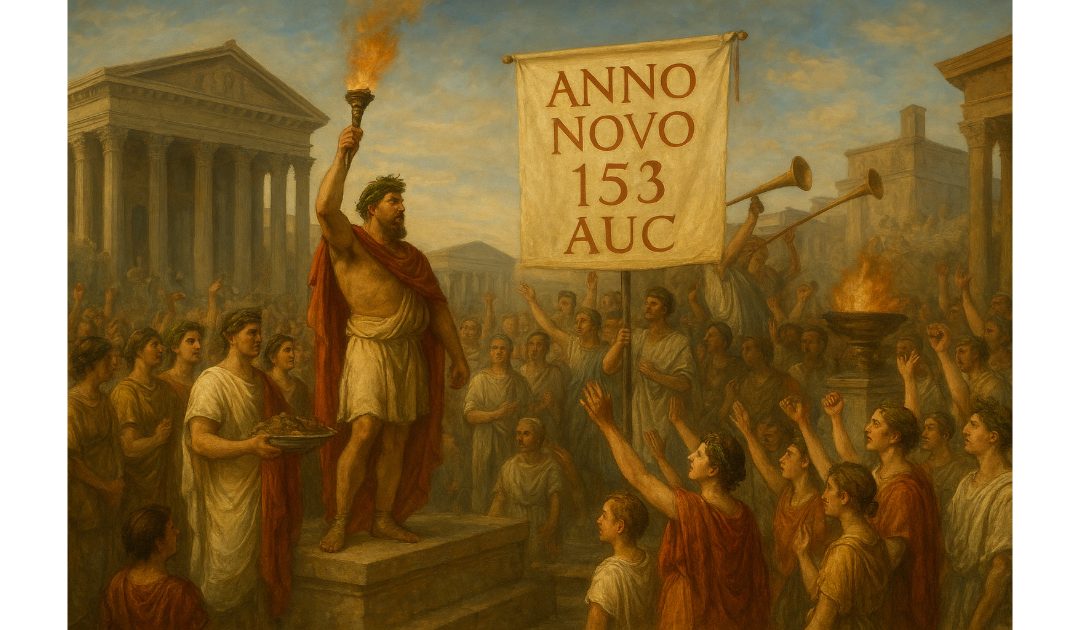
Happy New Year! But why the 1st of January? It was on the 1st of January, 153BCE that Roman first began their year in office on the 1st of January. In 45BCE the Julian calendar was adopted as the civil calendar of the Roman Republic with the 1st of January as the first day of the year. It wasn’t until 1600 that Scotland switched from 25th of March to the 1st of January as the start of their new year. Well they make enough fuss about it now!
It was on the 1st of January, 1700, that Russia switched to the Anno Domini era from Anno Mundi. Anno Mundi, often abbreviated as AM or A.M., is a Latin term meaning “in the year of the world,” used to denote a chronology that counts years from the supposed creation of the world. It has traditionally been most associated with Jewish and early Christian chronologies, where it served as a way of aligning sacred history with a structured timeline of human existence. The concept has been influential in historical, theological, and scholarly contexts, as it reflects attempts to understand history as a divinely ordered sequence beginning with Creation.
The foundational use of Anno Mundi dates back to ancient Jewish calculations. The Hebrew calendar, still in liturgical use today, is fundamentally an Anno Mundi system. It calculates the current year based on a traditional reckoning of the years since the creation of the world according to the Hebrew Bible. This is derived from careful study of the genealogies found in the Torah, particularly in the book of Genesis, where the ages of patriarchs and lineages are meticulously recorded. By adding up these ages from Adam onwards, scholars in antiquity created a timeline that could be extended to their present day, producing a year count “since the world began.”
The most widely accepted Jewish calculation places the creation of the world in 3761 BCE. Therefore, the Hebrew year 1 AM corresponds to 3761 BCE in the proleptic Gregorian calendar. For instance, the year 5785 AM began in the autumn of 2024 CE and ended in the autumn of 2025 CE. This form of dating is primarily used in religious contexts, such as in the Hebrew calendar and for determining festival dates, but it also informs historical studies of rabbinic literature and medieval Jewish thought.
Early Christians also engaged with the Anno Mundi system, though their calculations often differed. Church historians and theologians such as Eusebius of Caesarea and later Byzantine chroniclers attempted to create universal histories that connected biblical narrative with the known history of empires. Different Christian traditions arrived at various dates for Creation. For example, the Byzantine Anno Mundi calendar placed the creation at 5509 BCE, which became the standard for the Eastern Orthodox Church and the official dating system of the Byzantine Empire until its fall in the fifteenth century. Clerks and chroniclers would often date documents by both the regnal year of the emperor and the year “since the creation of the world.”
Western Christian scholars were also drawn to Anno Mundi calculations, especially during the medieval period when biblical chronology was seen as essential to understanding God’s plan for history. Figures such as the Venerable Bede and, later, James Ussher in the seventeenth century, attempted precise computations of the world’s age. Archbishop Ussher famously calculated that Creation occurred in 4004 BCE, a date that became widely cited in English Bibles and literature for centuries. This represents a form of Anno Mundi dating, as it situates all events within a timeline anchored to the biblical origin of the world.
So I wish all my readers a Very Happy New Year, whether it be 2026 or 5787.