
Greenland has been in the news for all the wrong reasons. Before Trump starts getting excited about New South Greenland, it doesn’t exist. But on the 15th of March, 1823, Benjamin Morrell erroneosly reported sighting it near Antarctica.
Benjamin Morrell (1795–1839) was an American sea-captain and sealing vessel master whose adventurous career took him across the world’s oceans in the early 19th century. Morrell’s book A Narrative of Four Voyages (1832), chronicling his travels in the Pacific, Atlantic and Southern Oceans, was filled with bold claims of distant lands, astonishing animal riches and extreme latitudes reached. The book was probably ghost-written by the journalist Samuel Woodworth, which may have shaped both its style and embellishments. His contemporaries and later historians often criticised Morrell as prone to exaggeration and error, earning him a reputation as one of the more colourful — and sometimes unreliable — chroniclers of the age of sail.
In June 1822 Morrell took command of the American schooner Wasp, departing New York on a voyage that would bring him into the largely unexplored waters of the Southern Ocean. After hunting seals in the South Atlantic and visiting remote islands such as Bouvet Island (which he claimed to find easily, though other explorers struggled), Morrell ventured into what is now known as the Weddell Sea in early March 1823. At that time, this part of the Antarctic was almost entirely unknown to Western navigators, with little reliable cartographic information available.
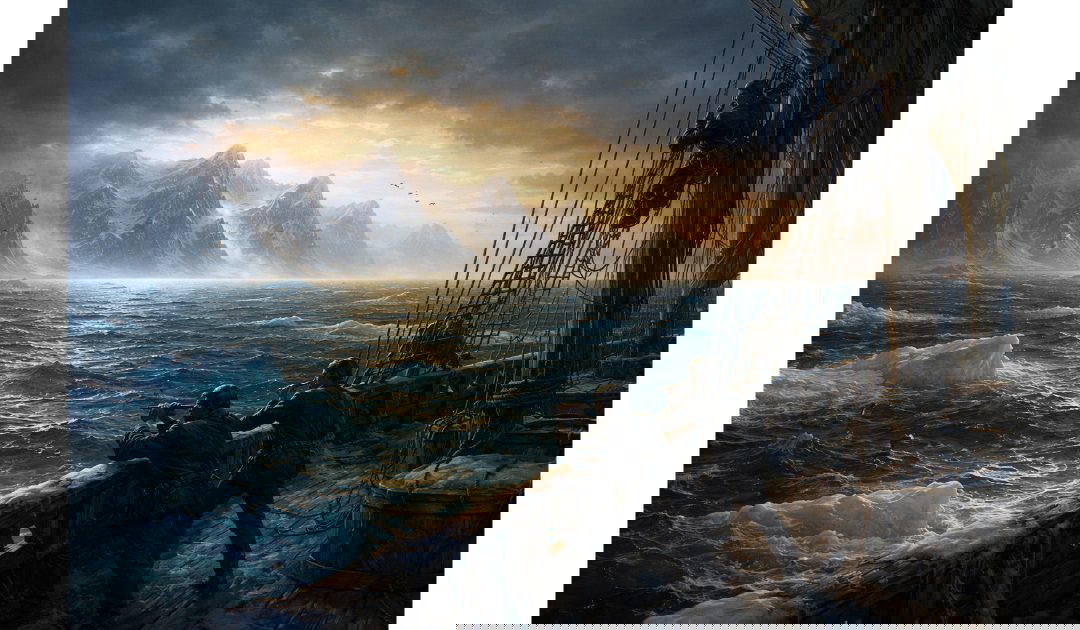
According to Morrell’s narrative, on the 15th of March, 1823, the day after turning north from his purported furthest southern latitude, he and his crew sighted what appeared to be a significant stretch of land. From the Wasp’s masthead, Morrell recorded in his journal that land bearing west was visible at about three leagues (roughly nine miles) away. By mid-afternoon he claimed they were close enough to see details of this coastline, which he believed to be the continuation of a landform previously sighted by another sealer — Captain Robert Johnson — in 1821. Morrell referred to this newly seen land as “New South Greenland” and described sailing along its edge for some 300 nautical miles (about 480 km), with abundant wildlife such as seals and seabirds dotting the coast.
This appearance of land was plausible to Morrell because of the limited knowledge of Antarctic geography at the time. Few expeditions had penetrated so far south or east within the Weddell Sea, and Morrell’s crude charts and observations seemed to place him in a region where no accurate survey existed. In his account, he assigned the credit for discovering and naming the land to Captain Johnson rather than claiming glory for himself.
Despite the precise coordinates and vivid descriptions Morrell provided, no such landmass exists at or near the position he recorded. Subsequent Antarctic expeditions throughout the 19th and early 20th centuries — including those by explorers such as Wilhelm Filchner and Ernest Shackleton — found no trace of the coast or islands where New South Greenland was supposed to lie. Soundings taken from ice-bound ships in the Weddell Sea revealed depths of thousands of feet, confirming that there was no nearby land buried just below the sea surface.
So why did Morrell think he saw land? Researchers have proposed several explanations, and it’s likely that more than one factor played a role:
- Navigational error: Determining exact longitude at sea in the early 1800s was notoriously difficult without a reliable chronometer. Morrell himself admitted to being “destitute of the various nautical and mathematical instruments” necessary for precise positioning. If his recorded position was off by as much as 10° of longitude (equivalent to hundreds of miles), he might have been looking toward known Antarctic coastline — such as the Foyn Coast of the Antarctic Peninsula — from a vastly different direction.
- Optical illusions and mirages: Polar regions frequently produce atmospheric refractions known as superior mirages or fata morgana effects, where distant ice edges, icebergs or even open sea can appear as solid land with cliffs, peaks and valleys. Such phenomena could easily deceive even experienced mariners under the right conditions.
- Human error and misremembering: Morrell’s narrative was written nearly a decade after the event, and scholars suggest he may have misremembered details or inadvertently combined them with other explorers’ published accounts (notably James Weddell’s).
- Reputation and exaggeration: Morrell was known to make questionable geographical claims, including phantom islands in the Pacific. Some later commentators have suggested that his account of New South Greenland might have been influenced by a desire to impress or to embellish his travels — though he did not overtly claim the discovery for himself.
New South Greenland remains a classic example of a phantom island — a place once believed to exist, charted by explorers, and later erased from maps when better information became available. It reflects not only the challenges faced by early Antarctic seafarers, but also the limitations of navigation, observation, and cartography in an era before aerial surveys and satellite mapping. Morrell’s story, for all its flaws, helped underscore the importance of careful verification and peer review in the exploration of our planet’s most remote frontiers.