
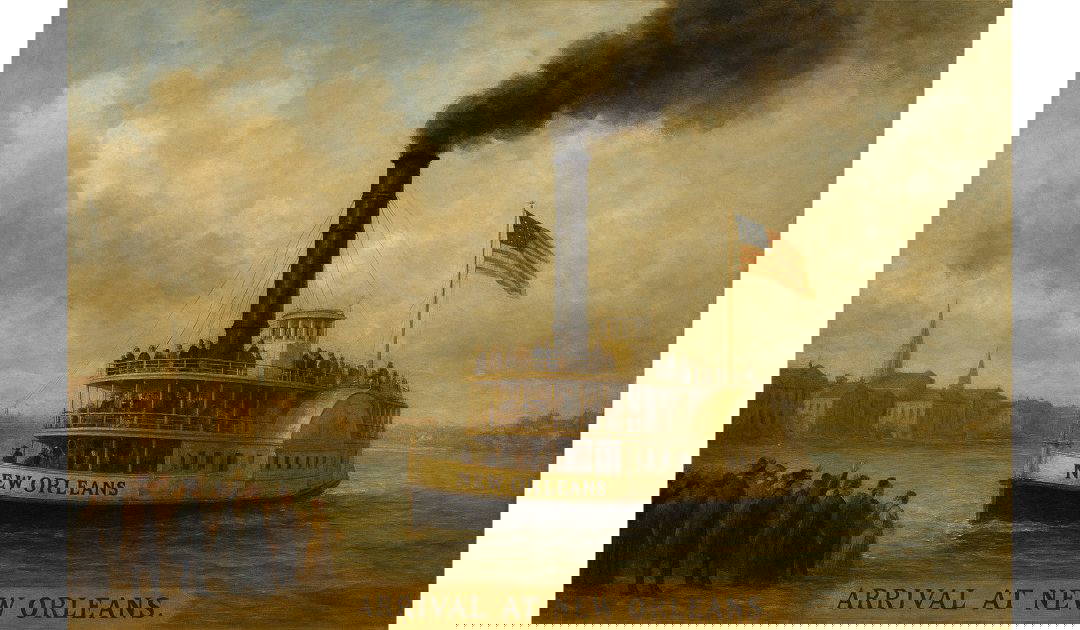
On the 10th of January, 1812, the steamboat New Orleans arrived in New Orleans 82 days after departing from Pittsburgh. It was the first steamboat to make the journey along the Ohio and Misissippi rivers.
The New Orleans was a remarkable vessel that forever changed travel and commerce on America’s western rivers. Constructed in 1811 at Pittsburgh, Pennsylvania, it was the first steamboat to navigate the Ohio and Mississippi rivers successfully. Its creation stemmed from the vision of Robert Fulton and Robert Livingston, the pioneers of steam-powered navigation, who saw the potential of linking the developing frontier settlements with the bustling port of New Orleans. The on-site supervision of the project fell to Nicholas Roosevelt, who not only oversaw the steamboat’s construction but also commanded it on its historic maiden voyage.
The building of the New Orleans was a bold venture. Steamboats were still a rare curiosity, and the challenges of navigating long rivers with shifting sandbars, snags, and unpredictable currents were many. Nevertheless, by September 1811, construction was complete. The vessel boasted a single-cylinder, low-pressure steam engine that drove a paddlewheel, capable of moving against the current of the Mississippi. This design was innovative for its time, representing an ambitious leap in both engineering and faith in the power of steam.
The maiden voyage began in October 1811, as the New Orleans left Pittsburgh and began its slow journey down the Ohio River. The crew and passengers were few, as many remained sceptical about the feasibility of steam navigation over such long distances. Early in the trip, the steamboat passed settlements like Wheeling in modern-day West Virginia and continued on to Cincinnati and Louisville, Kentucky. Its passage drew the attention of riverside residents, many of whom had never seen such a machine. For the people of the frontier, the sight of a boat churning upriver without sails or oars seemed almost magical, a herald of a new era in transport.
As the voyage progressed, the New Orleans faced unexpected challenges that made its journey legendary. During this period, the Mississippi Valley was struck by the series of violent New Madrid earthquakes, which began in December 1811 and continued into 1812. The tremors were so strong that they caused landslides along the riverbanks and even temporarily reversed the flow of sections of the Mississippi River. Travelling through this unstable environment, the crew witnessed the river’s surface heaving and shifting, trees falling into the water, and large areas of the bank collapsing. The steamboat narrowly avoided disaster on several occasions, navigating carefully around new sandbars and floating debris. For the passengers and crew, the journey was a mixture of awe and terror, as nature itself seemed to protest their passage.
Despite these extraordinary hazards, the New Orleans pressed onward. By late December, it had completed its passage along the Ohio and reached the Mississippi, continuing south toward its namesake city. Each mile of the journey proved the practicality of steam propulsion and the skill of its builders and crew. Finally, on 10 January 1812, the New Orleans arrived triumphantly in New Orleans, completing a voyage of more than 1,000 miles. Its arrival was a landmark moment in American history, signalling that the age of the steamboat had truly begun.
The significance of the New Orleans cannot be overstated. Before its voyage, river travel depended entirely on flatboats, keelboats, and other craft that could only travel downstream easily, with arduous and often impractical returns against the current. The New Orleans demonstrated that reliable two-way traffic on the rivers was possible, ushering in a new era of commerce. Goods could now be moved quickly and predictably between frontier towns and the major port of New Orleans, a development that linked the interior of the United States to international trade networks. Passengers, too, benefited from the relative comfort and speed of steamboat travel compared to the labour-intensive alternatives of rowing or poling.
In the years that followed, the success of the New Orleans inspired a boom in steamboat construction. By the 1820s, hundreds of such vessels plied the Mississippi and its tributaries, turning the rivers into vital commercial highways and accelerating the settlement and economic development of the American interior. The journey of the New Orleans, perilous and groundbreaking, was thus both a technological triumph and a defining moment in the story of the United States, a powerful demonstration of human ingenuity meeting the challenges of nature to open new frontiers.