
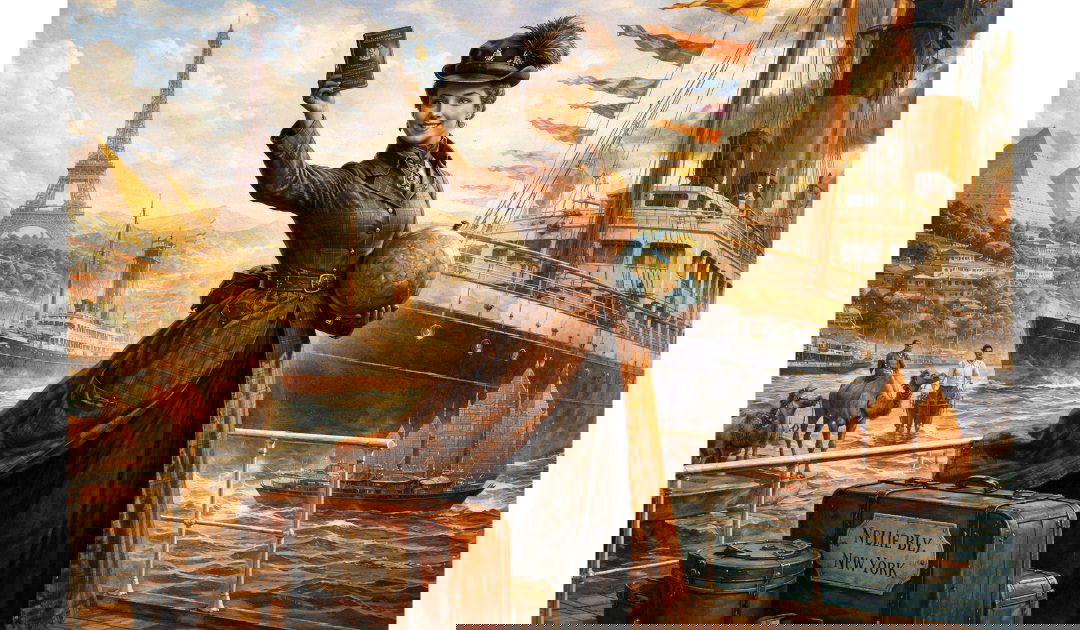
On the 25th of January, 1890, Nellie Bly completed her round-the-world journey in 72 days. Around the World in Eighty Days by Jules Verne was published in 1872, and Nellie was trying to emulate the hero, Phileas Fogg. I have posted about Sir Francis Drake’s circumnavigation, and I’ve also mentioned Jules Verne, so why not Nellie Bly?
Nellie Bly was one of the most remarkable journalists and adventurers of the late nineteenth century, a woman whose courage, ingenuity, and relentless curiosity reshaped investigative reporting and expanded the possibilities open to women in public life. Born Elizabeth Jane Cochran on 5 May 1864 in Cochran’s Mills, Pennsylvania, she adopted the pen name “Nellie Bly” early in her career, a choice that would become synonymous with daring reportage and bold social reform.
Bly’s entry into journalism was itself an act of defiance. In 1885, the Pittsburgh Dispatch published a misogynistic column entitled “What Girls Are Good For,” which argued that women belonged strictly in the domestic sphere. Outraged, Cochran wrote a fiery rebuttal under the pseudonym “Lonely Orphan Girl.” The editor was so impressed by the force and clarity of her argument that he offered her a job. At a time when most female journalists were confined to writing about fashion or society, Bly quickly distinguished herself by tackling labour conditions, poverty, and the exploitation of women workers. Her early reporting already displayed the traits that would define her career: empathy for the powerless, impatience with hypocrisy, and a willingness to immerse herself directly in the story.
Her most famous and consequential work began in 1887 after she moved to New York and joined Joseph Pulitzer’s New York World. There, Bly proposed an audacious idea: she would feign insanity in order to be committed to the Women’s Lunatic Asylum on Blackwell’s Island (now Roosevelt Island), allowing her to expose conditions inside from firsthand experience. After practising deranged behaviour in a boarding house, she was declared insane by doctors and sent to the asylum. For ten days, Bly endured freezing baths, spoiled food, physical abuse, and neglect, all while observing how sane women could easily be institutionalised with little hope of release.
Her resulting exposé, published as Ten Days in a Mad-House, was a sensation. More importantly, it led to tangible reform. A grand jury investigation followed, funding for mental health care was increased, and public awareness of institutional abuse was dramatically raised. Bly had effectively pioneered what would later be called “stunt journalism” or immersive investigative reporting, demonstrating that exposing injustice sometimes required personal risk.
Bly’s appetite for adventure was not limited to social reform. In 1889 she embarked on the exploit that made her a global celebrity: an attempt to travel around the world faster than the fictional Phileas Fogg in Jules Verne’s Around the World in Eighty Days. Armed with little more than a single bag and her determination, Bly departed New York and raced across Europe, the Middle East, Asia, and the Pacific. She even met Jules Verne himself in France. After 72 days, 6 hours, and 11 minutes, she returned home, smashing the fictional record and captivating readers across America. The journey cemented her reputation not just as a journalist, but as a symbol of modern womanhood—independent, resilient, and unafraid of the wider world.
Despite her fame, Bly’s career was not a smooth ascent. She left journalism for a time after marrying industrialist Robert Seaman in 1895, helping to manage his manufacturing businesses. Widowed in 1904 and left with financial difficulties, she eventually returned to reporting, covering everything from political corruption to the First World War. During the war she became one of the first female journalists to report from the Eastern Front, further underscoring her fearlessness and adaptability.
Nellie Bly died in 1922 at the age of 57, but her legacy has only grown. She helped transform journalism from passive observation into active investigation, proving that reporters could be agents of change rather than mere chroniclers of events. Equally important, she shattered contemporary assumptions about women’s intellectual and physical limits. At a time when women were often denied public authority, Bly forced society to reckon with uncomfortable truths by placing herself directly in harm’s way.
Today, Nellie Bly is remembered not just as a journalist or an adventurer, but as a pioneer of modern investigative reporting and a trailblazer for women in the profession. Her life stands as a testament to the power of curiosity, moral courage, and the refusal to accept injustice as inevitable.