
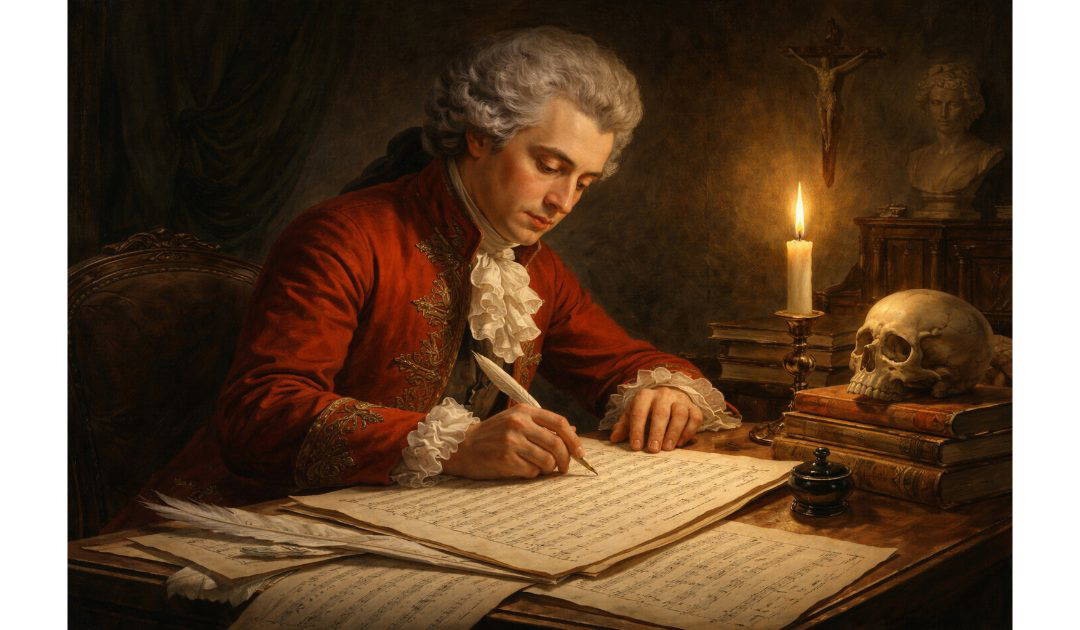
On the 9th of July, 1763, the Mozart family began their grand tour of Europe which greatly enhanced son Wolfgang Amadeus’s profile. I have written about Beethoven, and if I’m honest, I can’t think of a piece that would make it to my desert island discs, yet Mozart’s requiem definitely would.
Wolfgang Amadeus Mozart was born on the 27th of January, 1756, in Salzburg, then part of the Holy Roman Empire. He displayed prodigious musical talent from an extraordinarily young age. His father, Leopold Mozart, was a respected composer, violinist, and teacher who quickly recognised his son’s gifts and dedicated himself to nurturing them.
By the age of five, Mozart was already composing simple pieces and performing before European royalty. Throughout his childhood, he toured extensively with his sister, Maria Anna Mozart, known as Nannerl, herself a gifted musician. These journeys took the family to major cultural centres such as Vienna, Paris, and London, where Mozart encountered leading composers and absorbed a wide range of musical styles. This early exposure helped shape his versatility and deep understanding of musical forms.
Mozart’s early compositions already demonstrated an exceptional command of melody and structure. However, as he matured, his works became more sophisticated and emotionally expressive. During his teenage years, he spent time in Italy, where he composed operas and studied the Italian style, which would profoundly influence his later masterpieces.
Despite his genius, Mozart’s professional life was often marked by frustration. He served as a court musician in Salzburg under Archbishop Hieronymus Colloredo, but he found the position restrictive and sought greater independence. In 1781, after a dispute with the Archbishop, Mozart left Salzburg and settled in Vienna, hoping to establish himself as a freelance composer and performer.
Vienna offered opportunities but also financial uncertainty. Mozart achieved considerable success as a pianist and composer, particularly during the mid-1780s. He produced a series of brilliant piano concertos, string quartets, and symphonies, many of which are still central to the classical repertoire. His music is often associated with the Classical style, characterised by clarity, balance, and elegance, yet Mozart infused these qualities with emotional depth and dramatic intensity.
One of Mozart’s greatest achievements was in the field of opera. His collaborations with the librettist Lorenzo Da Ponte resulted in three of the most celebrated operas ever written: The Marriage of Figaro, Don Giovanni, and Così fan tutte. These works combine vivid characterisation, intricate plots, and music of extraordinary beauty and psychological insight. Mozart had a unique ability to portray human emotions—love, jealousy, humour, and despair—through music, making his operas enduringly compelling.
Mozart also composed a vast range of instrumental music, including symphonies, chamber works, and sacred compositions. Among his most famous works are his final three symphonies—Nos. 39, 40, and 41 (the “Jupiter” Symphony)—which are widely regarded as masterpieces of the symphonic form. His chamber music, such as the string quintets and quartets, reveals an intimate and conversational style, while his piano sonatas and concertos showcase both technical brilliance and expressive nuance.
In 1782, Mozart married Constanze Weber. Although their marriage appears to have been affectionate, the couple often faced financial difficulties. Mozart’s income was inconsistent, and he struggled with debt, especially in his later years. Nevertheless, even during times of hardship, his creative output remained astonishingly rich.
Mozart’s final years were marked by declining health and continued financial strain. In 1791, he composed some of his most celebrated works, including the opera The Magic Flute and the unfinished Requiem. The Requiem, shrouded in mystery due to its anonymous commission, has become one of his most famous and haunting compositions. Mozart died on the 5th of December, 1791, at the age of just 35. The exact cause of his death remains uncertain, though it is generally believed to have been due to illness rather than the romanticised notions of poisoning that later emerged.
Despite his short life, Mozart’s output was extraordinarily prolific—he composed over 600 works across nearly every musical genre of his time. His influence on subsequent composers, including Ludwig van Beethoven, was profound. Beethoven admired Mozart deeply and built upon the foundations Mozart had helped to establish.
Mozart’s legacy endures not only because of the sheer volume of his work, but because of its enduring quality. His music continues to be performed, studied, and loved around the world. It is admired for its beauty, technical perfection, and emotional resonance. Whether in the grandeur of his symphonies, the intimacy of his chamber music, or the drama of his operas, Mozart’s genius remains unmistakable.