
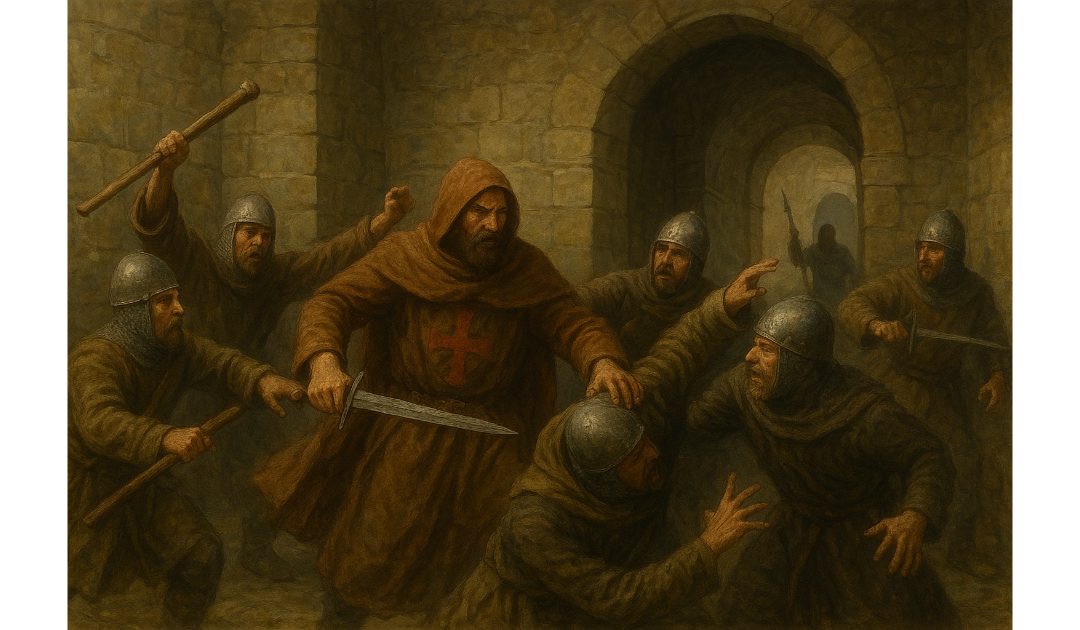
On the 8th of January, 1297, François Grimaldi captured the Rock of Monaco. The Grimaldis trace their origins to the powerful Genoese aristocracy of the Middle Ages. They were originally a prominent Guelph family in Genoa, aligned with the papal faction against the Ghibellines, who supported the Holy Roman Emperor. Genoa in the 13th century was a turbulent city-state, torn by factional conflict, and the Grimaldis were frequently at odds with their political rivals. Their involvement in these disputes ultimately led them to seek opportunities beyond the borders of Genoa.
The Rock of Monaco, a natural fortress projecting into the Mediterranean Sea, was a key maritime stronghold. In 1191, the Holy Roman Emperor Henry VI granted Monaco to Genoa, and the Genoese constructed a fortress there in 1215. This fortification became a contested prize in the Guelph-Ghibelline struggles, and in 1297 the Grimaldis made their decisive move. According to legend, François Grimaldi, known as “Malizia” (the Cunning), seized the Rock by disguising himself and his men as Franciscan friars. Gaining entry to the fortress under the pretence of seeking shelter, he and his men overpowered the guards and captured Monaco. This event, commemorated in the principality’s coat of arms depicting two monks holding swords, marks the beginning of Grimaldi rule.
Despite this dramatic seizure, the early years of Grimaldi control were far from secure. Monaco changed hands several times in the following decades due to pressure from rival factions and external powers. The Grimaldis alternated between being exiles and lords of the Rock, eventually consolidating their hold in 1419, when they purchased Monaco outright from the Crown of Aragon. From that point onwards, the family established themselves as hereditary rulers of the territory.
The survival of the Grimaldis as sovereign princes over the centuries is a testament to their political pragmatism. Surrounded by larger powers—France, Savoy, Spain, and later Italy—they navigated a careful course of diplomacy, alliances, and occasional concessions. In the early modern period, they secured French protection, which guaranteed their independence while tying Monaco’s foreign policy closely to that of France. This strategic alignment helped them weather the rise of nation-states and the upheavals of European wars.
Monaco’s small size and lack of natural resources necessitated a flexible approach to governance and finance. The principality’s economy long depended on maritime trade, tolls, and later, in the 19th century, on the development of tourism and gaming. The opening of the famous Monte Carlo Casino in the 1860s, under the reign of Charles III, transformed Monaco into a glamorous destination for Europe’s elite and provided a vital source of revenue, further securing the Grimaldis’ autonomy.
The 20th century was not without its challenges. During both World Wars, Monaco maintained a position of neutrality, though its fate was inevitably tied to France’s strategic situation. After World War II, Prince Rainier III (r. 1949–2005) played a crucial role in modernising the principality and raising its international profile. His marriage to the American actress Grace Kelly in 1956 captured worldwide attention, turning Monaco into a symbol of romance and glamour.
In the contemporary era, the Grimaldi family continues to rule Monaco as a constitutional monarchy. Prince Albert II, the son of Rainier III and Grace Kelly, ascended to the throne in 2005. Under his reign, Monaco has maintained its status as a stable, prosperous microstate and a centre for finance, tourism, and international cultural events. The principality’s independence is guaranteed by treaties with France, and the Grimaldis remain among the longest-reigning dynasties in Europe.
The enduring rule of the Grimaldi family over Monaco is remarkable in the context of European history, where so many other dynasties have fallen to revolutions, annexations, or political upheaval. From François Grimaldi’s daring capture of the Rock in 1297 to the present day, the family’s story is one of adaptation and resilience. Their ability to balance diplomacy with symbolic legitimacy, to transform Monaco into a unique economic and cultural hub, and to maintain the loyalty of their people underpins their unbroken sovereignty. Over seven centuries after that fateful night of subterfuge and ambition, the Grimaldi name remains synonymous with the Rock of Monaco, an enduring monument to dynastic survival.