
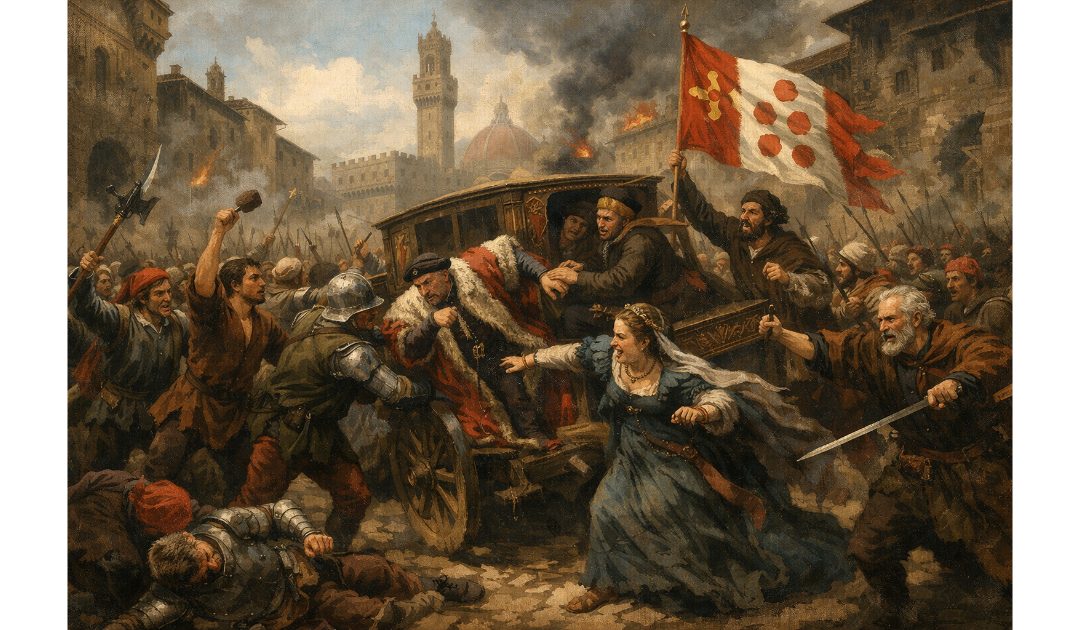
On the 16th of May, 1527, the people of Florence drove out the Medici family for the seconnd time, and re-established Florence as a republic. Both Catherine de Medici and Marie de Medici have featured in the Sir Anthony Standen Adventures. Let us take a closer look at the Medici family.
The rise, fall, and restoration of the Medici family is one of the defining dramas of Renaissance Italy. By the time they were expelled from Florence in 1527, the Medici had dominated the city’s politics for nearly a century, shaped its artistic flowering, and entangled it deeply in the shifting power struggles of Europe. Their removal was not simply a local revolt but the result of international war, papal politics, and long-simmering republican resentment.
The Medici first rose to prominence in the early fifteenth century as bankers. Under Cosimo de’ Medici, known as Cosimo the Elder, the family bank became one of the most powerful financial institutions in Europe, with branches in Rome, London, Bruges, and elsewhere. Cosimo translated economic power into political influence. Although Florence remained formally a republic, governed by councils and elected magistrates, Cosimo exercised authority behind the scenes, managing alliances and ensuring that his supporters filled key offices. His rule was subtle rather than overtly tyrannical, and he earned respect through patronage of churches, libraries, and artists.
His grandson, Lorenzo de’ Medici, known as Lorenzo the Magnificent, brought Medici prestige to its height. A poet, diplomat, and patron of figures such as Botticelli and the young Michelangelo, Lorenzo balanced the rival Italian states—Milan, Venice, Naples, and the Papal States—through careful diplomacy. Florence under Lorenzo became synonymous with Renaissance brilliance. Yet his dominance also deepened the gap between the republican constitution and the reality of one-family control.
After Lorenzo’s death in 1492, Medici fortunes faltered. His son Piero proved politically inept. When the French king Charles VIII of France invaded Italy in 1494, Piero’s concessions to the French outraged Florentines. He was expelled, and the city briefly restored a more overtly republican government. During this period, the fiery preacher Girolamo Savonarola exerted influence before his own downfall and execution. In 1512, however, Spanish troops supporting the Medici defeated the Florentine republic, and the family returned to power.
By the early sixteenth century, the Medici were no longer merely Florentine bankers. Two family members became popes: Pope Leo X (r. 1513–1521), Lorenzo’s son, and later Pope Clement VII (r. 1523–1534). This elevated the family to the center of European politics. Florence itself was governed by Medici relatives, notably Cardinal Giulio de’ Medici (the future Clement VII) and then by the young Alessandro and Ippolito de’ Medici.
The crisis that led to the 1527 expulsion stemmed from the wider conflict known as the Italian Wars. Europe was divided chiefly between the Habsburg emperor Charles V and the French king Francis I. Pope Clement VII, a Medici, attempted to preserve papal independence by shifting alliances. In 1526 he joined the anti-imperial League of Cognac against Charles V. This proved disastrous. Imperial troops, many of them unpaid and mutinous, marched on Rome.
In May 1527 came the catastrophic Sack of Rome. Imperial forces stormed the city, looted it brutally, and effectively imprisoned Pope Clement VII. News of the sack shocked Italy. In Florence, resentment toward Medici rule—already present among republican-minded citizens—boiled over. The Medici were associated not only with oligarchic dominance but now with political catastrophe. Their papal kinsman’s failed diplomacy had brought ruin upon Rome and endangered Florence.
Sensing weakness, Florentine opponents of the Medici moved swiftly. In May 1527, a popular uprising forced the young Medici rulers to flee. Once again, Florence declared itself a republic. The expulsion was driven by a mixture of ideological and practical motives. Many citizens genuinely believed in the republican traditions of the city, recalling earlier periods when Florence had governed itself without a dominant family. Others were motivated by factional rivalry or fear that association with the Medici would invite imperial retaliation.
The new republic attempted to defend its independence, even as imperial and papal forces regained strength. For several years Florence resisted. The city endured a prolonged siege from 1529 to 1530 by imperial troops acting on behalf of Charles V and Pope Clement VII, who had reconciled. Despite heroic defense and figures such as Michelangelo overseeing fortifications, the republic eventually fell in 1530.
The Medici returned yet again—but this time their rule changed in character. In 1532, Florence was transformed from a republic into a hereditary duchy under Alessandro de’ Medici. The old republican framework was effectively ended. Later, under Cosimo I, the Medici consolidated control and eventually became Grand Dukes of Tuscany.
Thus, the expulsion of 1527 was both a climax and a turning point. It reflected long-standing tension between republican ideals and dynastic control, but it was triggered by the international upheaval of the Italian Wars and the humiliation of the Sack of Rome. Although the Medici were driven out in a burst of civic anger and political opportunity, their story in Florence was far from over.