
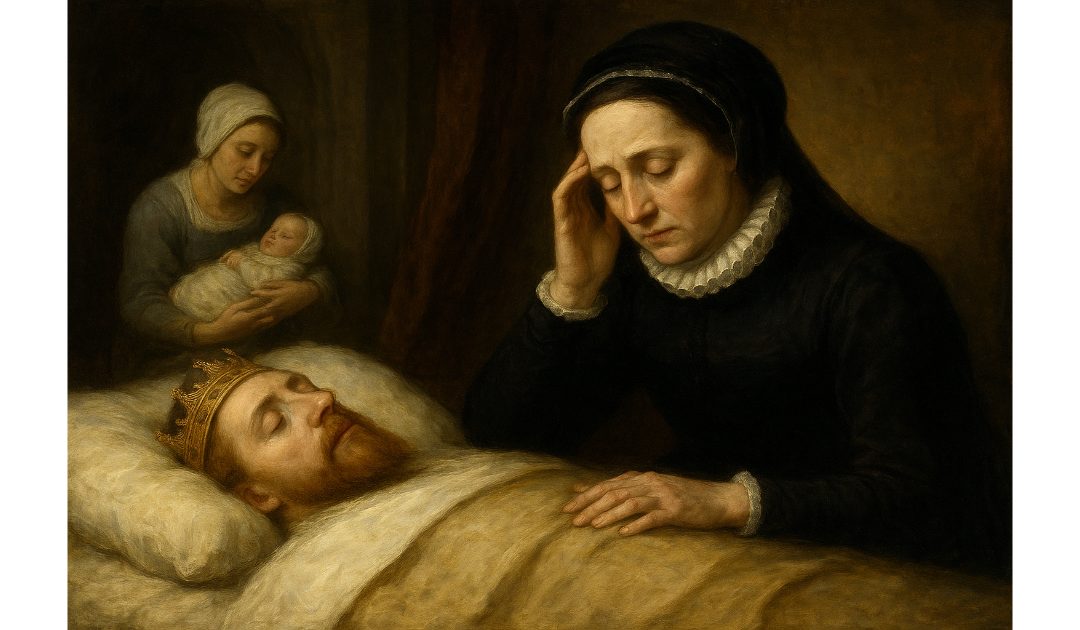
On the 14th of December, 1542, Mary Stuart became Queen of Scots on the death of her father, King James V of Scotland. Mary was just six days old. I have taken an interest in Mary since discovering Sir Anthony Standen, an Elizabethan spy, and the only man I know to have been knighted by both Mary Queen of Scots and Queen Elizabeth I.
Mary, Queen of Scots, also known as Mary Stuart or Mary I of Scotland, is one of the most compelling figures in British history, her life filled with drama, intrigue, and tragedy. Born on the 8th of December 1542 at Linlithgow Palace, she was the only surviving legitimate child of King James V of Scotland and his French wife, Mary of Guise. Her reign began in name almost immediately, but as a child-queen, she was placed under the guidance of regents.
At the age of five, Mary was sent to France to be raised at the French court, largely for her safety and to strengthen the longstanding Auld Alliance between Scotland and France. She was betrothed to the French Dauphin, Francis, and eventually married him in 1558. When Francis ascended to the throne as Francis II in 1559, Mary briefly became Queen Consort of France. However, Francis died the following year, leaving Mary a teenage widow at just eighteen. Her time in France had insulated her from the turbulent Scottish politics dominated by Protestant Reformation struggles, but Francis’s death compelled her to return to Scotland in 1561.
Mary returned to a Scotland that had undergone significant religious transformation. The Scottish Reformation had taken firm hold, led by figures such as John Knox, and the country’s nobility was divided between Catholic and Protestant factions. Although Mary was a Catholic monarch ruling a now predominantly Protestant nation, she maintained a policy of relative tolerance, which initially preserved an uneasy peace.
In 1565, Mary married her cousin, Henry Stuart, Lord Darnley. The marriage proved disastrous. Darnley was arrogant, unstable, and politically ambitious, which led to tension at court. Matters turned darker when, in 1566, David Rizzio, Mary’s private secretary and close confidante, was brutally murdered by a group of conspirators including Darnley himself. This event shocked the court and damaged Mary’s reputation, though she continued to reign.
The following year, Darnley was found dead in suspicious circumstances after an explosion at Kirk o’ Field in Edinburgh. Although he had been killed before the blast, the situation cast suspicion upon Mary. Her subsequent marriage to James Hepburn, Earl of Bothwell—who was widely believed to have orchestrated Darnley’s murder—set off a political storm. Scottish nobles, outraged, rebelled against her. Mary was captured at Carberry Hill in June 1567, forced to abdicate in favour of her infant son, James VI, and imprisoned in Loch Leven Castle.
Mary managed a dramatic escape from Loch Leven in 1568 and raised an army to reclaim her throne, but she was defeated at the Battle of Langside. With few options left, she fled to England, seeking the protection of her cousin, Elizabeth I. Her arrival in England began nineteen long years of captivity. Elizabeth faced a dilemma: Mary was both a guest and a threat. As a Catholic with a legitimate claim to the English throne, she became a focal point for Catholic plots against Elizabeth.
Over the years, conspirators sought to use Mary to overthrow Elizabeth, culminating in the Babington Plot of 1586. Letters proved Mary’s involvement in endorsing Elizabeth’s assassination, providing the justification Elizabeth’s government needed. Reluctantly, Elizabeth signed the death warrant.
On the 8th of February 1587, Mary was executed at Fotheringhay Castle. She met her death with remarkable composure, dressed in crimson to symbolise Catholic martyrdom. Her execution sent shockwaves across Europe, further straining relations between Protestant England and Catholic powers.
Mary’s life was a tapestry of power, vulnerability, and fatal misjudgements. She was a queen who inspired loyalty and controversy, a woman whose personal choices became inseparable from the political struggles of her time. Her legacy lives on in history and culture, as both a romanticised tragic heroine and a cautionary figure in the deadly game of dynastic politics.