
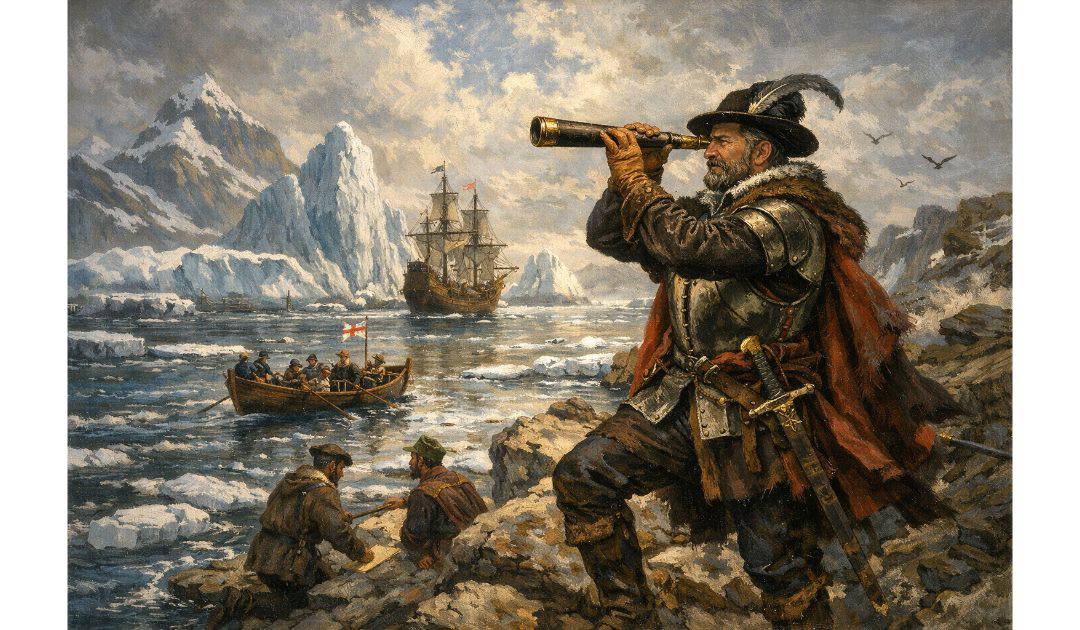
On the 11th of July, 1576, Martin Frobisher sighted Greenland whilst exploring the North Atlantic seeking the Northwest Passage. Well it hasn’t been that long since Trump threatened to take Greenland from NATO partner Greenland. But even a few weeks seems like a lifetime in Trumpland. I have mentioned Martin Frobisher before but only in the contest of ChatGBT confusing him with Sir Anthony Standen, my ancestor and hero of my Sir Anthony Standen Adventures.
Frobisher was born around 1535 in Yorkshire, England, into a modest gentry family. After the early death of his father, he was raised by relatives in London, where he was exposed to the maritime world that would shape his future. As a young man, he entered the service of merchants and soon gained experience as a sailor and privateer. These early years were marked by both opportunity and trouble; he was involved in ventures that skirted the edges of legality, including accusations of piracy. At one point, he was even imprisoned, though such episodes were not uncommon for seamen operating in the competitive and often lawless waters of international trade.
Frobisher’s ambitions extended beyond commerce and privateering. Like many Englishmen of his time, he was captivated by the idea of finding a northern sea route to Asia—the fabled Northwest Passage—which would provide a direct and lucrative path to the riches of the East. After years of lobbying for support, he secured backing from influential figures and financiers, including members of the Muscovy Company.
In 1576, Frobisher set sail on his first voyage with three small ships: the Gabriel, the Michael, and a pinnace. The expedition was fraught with difficulty from the outset. Storms forced the smallest vessel to turn back, and the Michael eventually deserted. Undeterred, Frobisher pressed on with the Gabriel and reached the coast of what is now northern Canada, likely Baffin Island. Believing he had found the entrance to the Northwest Passage, he claimed the land for England and named the inlet Frobisher Strait (now known as Frobisher Bay). During this voyage, he also encountered the Inuit people, interactions that were marked by both curiosity and conflict.
One of the most consequential outcomes of the voyage was the discovery of a black stone that Frobisher believed contained gold. This sparked intense excitement back in England and led to further expeditions. In 1577, he returned with a larger fleet, bringing miners and refiners to exploit the supposed treasure. Large quantities of the ore were collected and transported back to England.
Encouraged by initial (and ultimately mistaken) assays suggesting the presence of gold, a third and much larger expedition was launched in 1578. This time, Frobisher commanded a fleet of fifteen ships, not only to mine but also to establish a settlement. However, the harsh Arctic conditions, combined with logistical challenges and growing doubts about the value of the ore, led to failure. The planned colony was abandoned, and the ships returned to England laden with what was eventually proven to be worthless rock.
The collapse of the Frobisher expeditions was a significant blow, both financially and reputationally. Yet Frobisher himself remained a respected and capable seaman. He shifted his focus back to naval service and privateering, becoming an important figure in England’s maritime defence.
His finest hour came during the conflict with Spain, particularly in 1588 during the Spanish Armada. Frobisher served as a vice-admiral in the English fleet under Charles Howard, 1st Earl of Nottingham, and alongside commanders such as Francis Drake. He commanded the ship Triumph and played a key role in several engagements against the Spanish fleet. His experience and aggressive tactics contributed significantly to the English victory, which marked a turning point in the balance of naval power in Europe.
Following the Armada, Frobisher continued to serve in naval expeditions. In 1590, he was knighted in recognition of his service. He later took part in operations against Spanish interests in the Caribbean and along the French coast during the wars of religion. In 1594, while leading an attack on the Spanish-held fortress of Crozon in Brittany, he was wounded in battle. The injury proved fatal, and he died shortly thereafter.
Martin Frobisher’s legacy is a complex one. His voyages to the Arctic were marked by courage and endurance, even if they failed to achieve their ultimate goal. His mistaken belief in the value of the “gold ore” stands as a cautionary tale about the dangers of wishful thinking and speculative investment. Yet his contributions to England’s naval strength, particularly during the Spanish Armada, secured his place in history.