
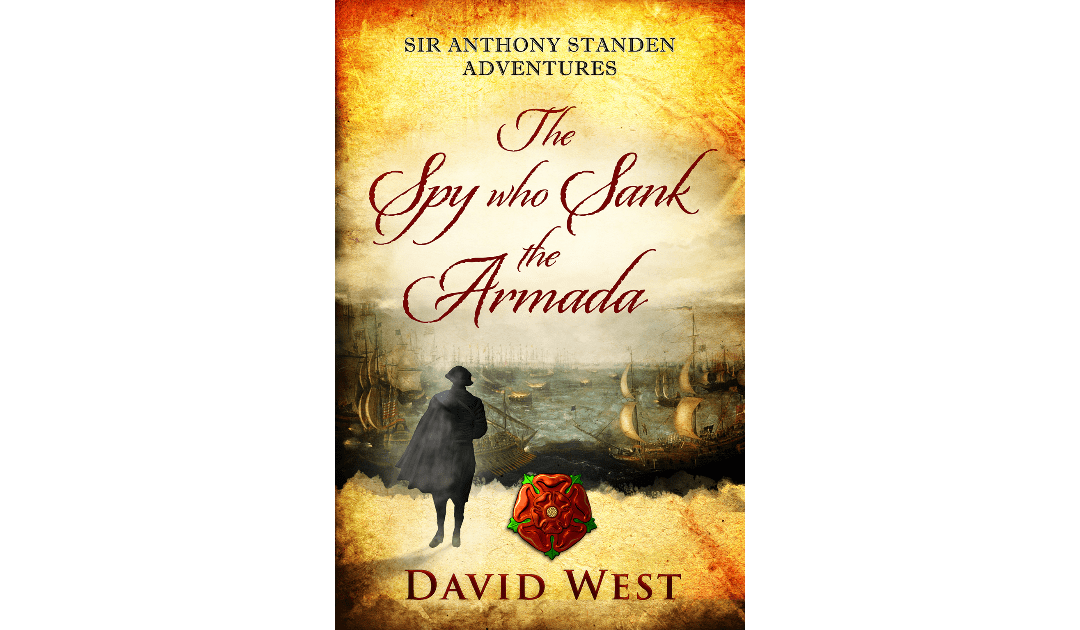
Marie de Medici was born on the 26th of April 1575. She is a character in two of the published books in my Sir Anthony Standen Adventures, The Spy who Sank the Armada and The Suggested Assassin. She is a central character in the fifth book in the series, Serpents Teeth. She does not feature in my work in progress, Cade’s Legacy. I hope to publish these works by the end of the year, or early next year. In reality Sir Anthony was sent to spy on Marie’s father the Grand Duke of Tuscany, Marie’s father, by Francis Walsingham.
Marie de Medici (1575–1642) was Queen of France as the second wife of King Henry IV and later served as regent for her son, Louis XIII. Her life was marked by political ambition, factional intrigue, cultural patronage, and eventual exile—an arc that reflects the turbulence of early seventeenth-century France.
She was the daughter of Francesco I de’ Medici, Grand Duke of Tuscany, and Joanna of Austria. As a member of the powerful Medici dynasty, she grew up surrounded by wealth, court ceremony, and the political calculations of Renaissance Italy. Though not widely praised for beauty or intellectual brilliance, she was known for determination and a strong sense of dynastic pride.
After Henry IV of France annulled his childless marriage to Margaret of Valois, he sought a politically advantageous new bride. The Medici connection offered financial security as well as Catholic prestige. Marie married Henry by proxy in Florence in 1600 and arrived in France soon afterward. The marriage was politically useful but personally strained. Henry IV was famously unfaithful and maintained several mistresses, yet Marie fulfilled her essential dynastic duty. She bore six children, including the future Louis XIII, as well as Elizabeth (later Queen of Spain) and Henrietta Maria (later Queen of England as the wife of Charles I).
In 1610, Henry IV was assassinated in Paris by François Ravaillac. Their son Louis was only eight years old, and Marie was declared regent. As regent (1610–1617), she governed France during a delicate period. Henry IV had strengthened royal authority after the Wars of Religion, but tensions remained between Catholics and Huguenots, as well as between the crown and powerful nobles.
Marie relied heavily on Italian advisers, particularly Concino Concini and his wife, Leonora Galigai, the daughter of Maria’s infant wet-nurse. Concini rose rapidly in influence, becoming Marshal of France. His prominence, combined with his foreign origins, angered many French nobles and members of the political elite. They viewed him as corrupt and resented the queen’s dependence on him. Marie also pursued a foreign policy that aligned France more closely with Catholic Spain, arranging the double marriage of her son Louis XIII to Anne of Austria and her daughter Elizabeth to the future Philip IV of Spain. Critics feared this policy undermined the more independent course Henry IV had charted.
As Louis XIII grew older, he and his supporters became increasingly frustrated with his mother’s dominance. In 1617, at the age of sixteen, Louis orchestrated a coup. Concini was arrested and killed on the king’s orders. Marie was exiled to the Château de Blois, effectively removed from power. However, she did not accept her marginalisation quietly. In 1619 she escaped from Blois and rallied supporters, leading to a brief civil conflict between her faction and the king’s forces. Eventually, reconciliation was negotiated.
During this period, one of Marie’s most consequential decisions was supporting the rise of Cardinal Richelieu. Initially a protégé of hers, Richelieu became a central political figure in France. Ironically, once firmly established as chief minister under Louis XIII, Richelieu prioritised royal authority over factional loyalties, and Marie’s influence waned once more.
Despite political setbacks, Marie de Medici left a lasting cultural legacy. She was a major patron of the arts and architecture. Her most famous commission was the Luxembourg Palace in Paris, inspired by the Palazzo Pitti of her native Florence. To decorate it, she commissioned the Flemish painter Peter Paul Rubens to create a grand cycle of paintings depicting her life. The “Marie de’ Medici Cycle,” now in the Louvre, presents her story in mythological and allegorical form, elevating her political struggles into epic narrative. This artistic programme reveals her acute awareness of image and propaganda.
By the 1630s, her relationship with Richelieu had deteriorated. She opposed his policies and sought to undermine him. In 1630, during the so-called “Day of the Dupes,” it briefly appeared that she had succeeded in persuading Louis XIII to dismiss the cardinal. However, Richelieu retained the king’s confidence. Marie, having misjudged the outcome, found herself politically isolated.
In 1631 she was forced into exile. She spent her remaining years moving between the Spanish Netherlands, England (where her daughter Henrietta Maria was queen), and the Dutch Republic. Once a queen and regent at the centre of European politics, she died in relative obscurity in Cologne in 1642.
Marie de Medici’s reputation has often been coloured by accusations of political ineptitude and favouritism. Yet such judgments can oversimplify a complex figure operating in a male-dominated and faction-ridden court. As regent, she preserved the monarchy during her son’s minority, maintained dynastic continuity, and fostered alliances that shaped European politics. Her patronage enriched French cultural life, and her architectural and artistic commissions remain significant.
Ultimately, Marie’s life illustrates the precarious nature of power in early modern Europe. She was a queen, a regent, a political player, a mother of monarchs—and finally an exile. Her story is one of ambition, resilience, and the volatile interplay between personal loyalty and statecraft in seventeenth-century France.