
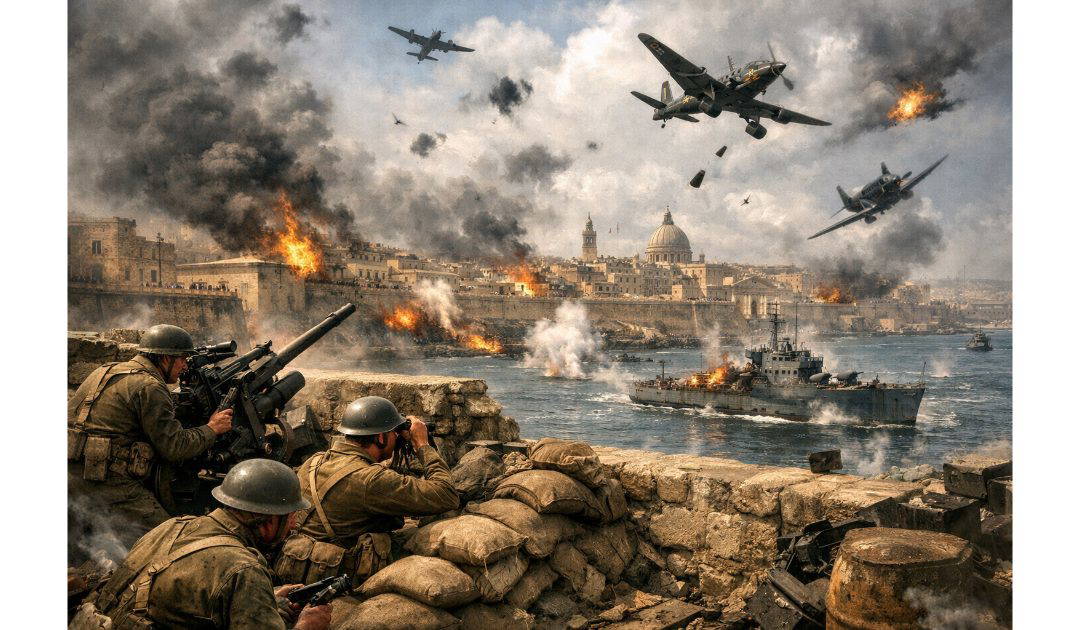
The siege of Malta began on the 11th of June, 1940. I learnt to SCUBA dive in Malta in 1988. I haven’t been back to Malta since, but I don’t know why, I really enjoyed it.
The Siege of Malta during World War II was one of the longest and most intense sieges of the war. Lasting roughly from June 1940 to November 1942, it saw the small Mediterranean island of Malta subjected to relentless bombing and blockade by Axis forces. Despite severe shortages and near-constant attack, the island held out and played a crucial role in the Allied victory in the Mediterranean.
Malta’s strategic importance came from its location in the centre of the Mediterranean Sea, between Sicily and North Africa. It was a British colony and served as a base from which Allied aircraft, submarines, and ships could attack Axis supply routes to Libya, where Erwin Rommel and his Afrika Korps were fighting British forces. Because Axis armies in North Africa depended heavily on supplies shipped across the Mediterranean, Malta posed a serious threat to their operations.
When Italy entered the war in June 1940 under Benito Mussolini, Malta immediately became a target. Italian aircraft began bombing the island within hours of the declaration of war. At first the island’s air defences were extremely weak. Legend holds that only three obsolete Gloster Gladiator biplane fighters—nicknamed Faith, Hope, and Charity—defended the island in the early weeks, although in reality the situation was slightly less desperate. Even so, the British defenders struggled to repel the frequent raids.
In 1941 the siege intensified when Germany joined the effort to neutralise the island. The Luftwaffe deployed large numbers of bombers and fighters to Sicily, launching devastating attacks on Malta’s harbours, airfields, and towns. Aircraft such as the Junkers Ju 87 Stuka dive bomber and Junkers Ju 88 medium bomber struck repeatedly at the island’s key facilities, especially the Grand Harbour near Valletta.
The bombing was among the heaviest sustained air assaults of the war. At times Malta endured multiple raids per day. Civilians sheltered in caves, tunnels, and underground shelters carved into the island’s limestone rock. Many buildings were destroyed, including historic churches and homes. Food, fuel, and medical supplies grew scarce as Axis aircraft and submarines attacked supply convoys heading from Gibraltar or Alexandria.
Yet Malta continued to strike back. British submarines and aircraft operating from the island attacked Axis shipping carrying fuel, ammunition, and reinforcements to North Africa. These attacks significantly disrupted supply lines supporting Erwin Rommel’s campaigns against British forces. Because of Malta’s interference, many Axis convoys suffered heavy losses before reaching their destination.
The courage of Malta’s civilian population became widely admired. Despite hunger, bombing, and destruction, the island’s inhabitants continued to support the Allied war effort. In recognition of their bravery, King George VI awarded the entire island the George Cross in April 1942. The decoration, normally given for acts of individual bravery, was inscribed with the words praising “the heroism and devotion of its people.”
By early 1942 the situation had become critical. Axis bombing reached its peak, and Malta’s supplies were nearly exhausted. Several convoys attempting to reach the island were destroyed or forced to turn back. The island came close to starvation.
The turning point came in August 1942 with Operation Pedestal, one of the most dramatic convoy operations of the war. A heavily escorted British convoy fought its way through intense Axis attacks in order to deliver desperately needed supplies. Many ships were sunk during the operation, but one tanker, the SS Ohio, managed to limp into Grand Harbour with vital fuel. The arrival of this convoy ensured Malta’s survival.
After late 1942 the situation gradually improved. Allied victories in North Africa and increasing Allied air superiority reduced the pressure on the island. Instead of merely surviving, Malta became an offensive base once again. Aircraft and submarines operating from the island began attacking Axis shipping even more aggressively.
The siege effectively ended after the Allied victory at the Second Battle of El Alamein in October–November 1942 and the Allied landings in North Africa during Operation Torch. With Axis forces retreating and their supply routes collapsing, Malta’s role shifted from a besieged outpost to a key launching point for Allied offensives, including the invasion of Sicily in 1943.
The Siege of Malta demonstrated the strategic importance of the island and the resilience of its people. Despite massive bombing and severe shortages, Malta held out and helped choke the Axis supply lines to North Africa. Its endurance contributed significantly to the eventual Allied victory in the Mediterranean theatre of World War II.