
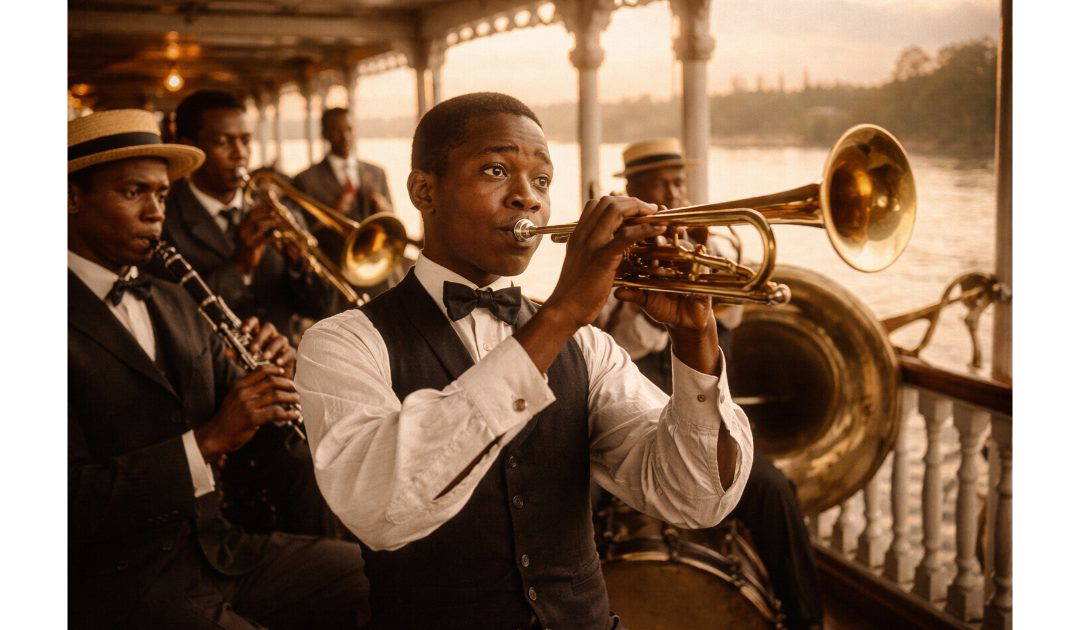
Louis Armstrong was born on the 4th of August, 1901 in New Orleans. He gets a mention in my post on Hoagy Carmichael and James Bond, but deserves more. He grew up in extreme poverty in a rough neighbourhood known as “The Battlefield.” His early life was marked by hardship, but also by the rich musical culture of New Orleans—a city where brass bands, blues, ragtime, and folk traditions blended into something new and vibrant.
Armstrong’s introduction to music came in unlikely circumstances. As a boy, he was sent to the Colored Waif’s Home for Boys after firing a gun into the air on New Year’s Eve. There, he received formal musical instruction and began playing the cornet. This experience proved transformative. Under the guidance of the home’s bandleader, he developed discipline and skill, laying the foundation for his future career.
After leaving the home, Armstrong immersed himself in the thriving New Orleans music scene. He idolised the great cornetist Joe “King” Oliver, who became both mentor and employer. In 1922, Armstrong joined Oliver’s Creole Jazz Band in Chicago, marking his first major professional breakthrough. His powerful tone, inventive phrasing, and natural sense of swing quickly set him apart.
The 1920s were a period of extraordinary artistic growth. Armstrong moved to New York to play with Fletcher Henderson’s orchestra, where his rhythmic innovations began influencing the emerging big band style. Yet it was his recordings under his own name, particularly the “Hot Five” and “Hot Seven” sessions, that revolutionised jazz. These recordings shifted the focus from collective improvisation to the soloist, establishing the virtuoso improviser as the central figure in jazz performance.
Armstrong’s trumpet playing was dazzling. He possessed a brilliant tone, remarkable technical facility, and an ability to construct solos that were both spontaneous and architecturally coherent. His sense of swing—rhythmic momentum and phrasing—became a defining characteristic of jazz. Musicians across generations would study and emulate his style.
In addition to his instrumental prowess, Armstrong was a pioneering vocalist. His gravelly, expressive voice and relaxed delivery made him instantly recognisable. He popularised scat singing—wordless vocal improvisation—famously demonstrated in recordings like “Heebie Jeebies.” His vocal interpretations brought warmth, humour, and emotional depth to songs, helping to bridge the gap between jazz and mainstream popular music.
During the 1930s and 1940s, Armstrong became an international star. He led big bands, appeared in films, and toured extensively. His charismatic stage presence and broad smile made him a beloved entertainer, though some critics later debated whether his persona overshadowed his musical innovations. Nevertheless, his influence remained profound.
In 1947, Armstrong formed a smaller ensemble known as the All Stars, returning to a format that allowed for greater improvisational freedom. This group, featuring top musicians, toured the world and helped sustain traditional jazz during an era increasingly dominated by bebop. While younger musicians like Charlie Parker were pushing the music in new, complex directions, Armstrong remained committed to melody, swing, and emotional communication.
Armstrong’s later career included some of his most commercially successful recordings. Songs like “What a Wonderful World” and “Hello, Dolly!” became global hits, introducing his music to new audiences. In 1964, “Hello, Dolly!” famously displaced The Beatles from the top of the charts in the United States—a testament to his enduring appeal across generations.
Beyond music, Armstrong’s life intersected with important social issues. As an African American artist in a deeply segregated society, he navigated a complex landscape of opportunity and discrimination. Though sometimes criticised for not being overtly political, he did speak out forcefully on civil rights issues when he felt compelled, notably during the Little Rock crisis of 1957. His success itself challenged racial barriers, and he became a global symbol of American culture.
Armstrong died on the 6th of July, 1971, but his legacy endures. He is widely regarded as one of the founding figures of jazz, a musician who transformed it from a regional folk art into a sophisticated, internationally respected form. His recordings remain essential listening, not only for their historical importance but for their vitality and joy.
Perhaps the most remarkable aspect of Armstrong’s artistry is its humanity. His playing and singing conveyed a direct emotional honesty that transcended technical brilliance. Whether delivering a soaring trumpet solo or a tender ballad, he communicated a sense of life’s struggles and pleasures with unmatched sincerity.