
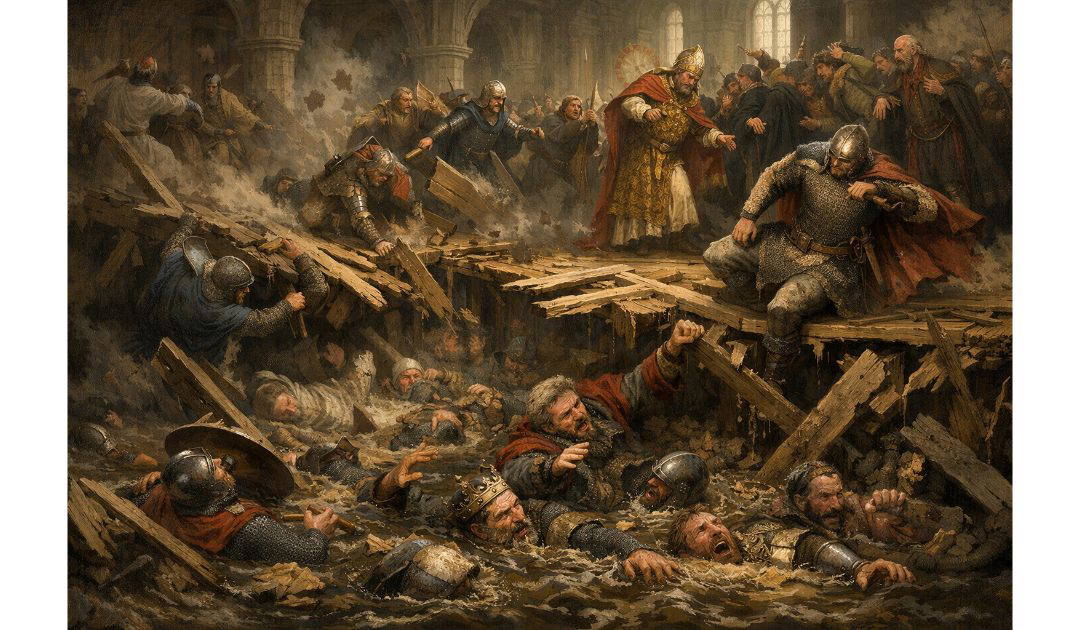
On the 26th of July, 1184, approximately sixty nobles died when the floor of a building next to Erfurt Cathedral collapsed and the fell through to drown in a cesspit. It became known as the Latrine Disaster.
The disaster took place during a bitter dispute between Louis III, Landgrave of Thuringia and Conrad of Mainz. Their quarrel had become serious enough that the young King Henry VI, was ordered by his father, Frederick I, Holy Roman Emperor, to settle the matter. I have mentioned the Latrine Disaster before in my post on insults, but I didn’t give all the gory details.
Henry summoned a great assembly of nobles and churchmen in Erfurt. The meeting was held in an upper room of a timber building near the cathedral. The room quickly became crowded with bishops, counts, knights and officials. Medieval chroniclers say that there were so many men present that the building was dangerously overloaded.
The old wooden beams beneath the floor were too weak to bear the weight. Suddenly the entire floor gave way. The nobles fell through the upper floor, then through the floor below, and finally into a large cesspit beneath the building.
Many died instantly from the fall or from being crushed by collapsing beams and masonry. Others drowned or suffocated in the sewage. The victims were weighed down by heavy clothing and armour, making escape almost impossible.
Among those killed were Friedrich I of Abenberg, Heinrich I of Schwarzburg, Gozmar III of Ziegenhain and Friedrich I of Kirchberg, together with many other lesser nobles and attendants.
Remarkably, Henry VI survived. He and Archbishop Conrad had been sitting in a stone window recess which did not collapse with the rest of the room. They managed to cling to the stonework until ladders were brought and they were rescued. Louis of Thuringia also survived, though he had to be pulled from the wreckage.
The political consequences were significant. So many noblemen died that several estates and titles passed unexpectedly to heirs, altering the balance of power in the region. Yet the original dispute remained unsettled. Shocked by what had happened, Henry left Erfurt soon afterwards and continued his journey east.
In later centuries the event became famous as the most bizarre disaster of the Middle Ages. Chroniclers and storytellers added colourful details and legends. One story claimed that Heinrich of Schwarzburg had once declared that he would rather drown in a privy than admit he was wrong, only to die exactly that way.
The Erfurt Latrine Disaster has remained famous because of the grotesque contrast between the dignity of the victims and the humiliating manner of their deaths. Powerful nobles who expected to settle political affairs instead met an absurd and terrible end through rotten floorboards and a badly placed medieval latrine.