
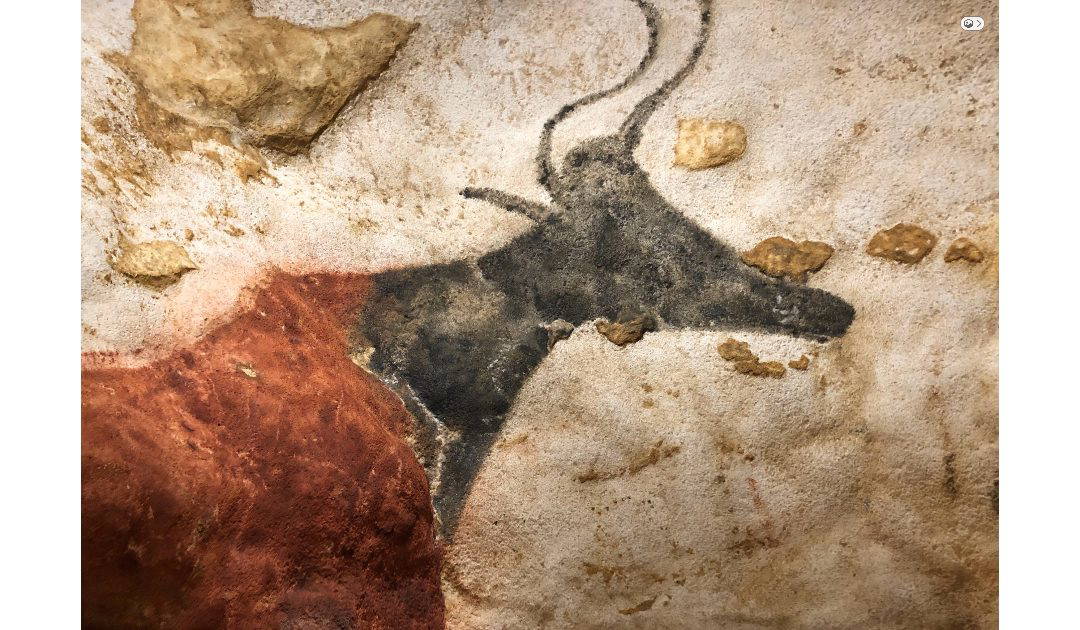
Scrolling through the list of events for the 12th of September, I got quite excited by the Battle of Marathon, but I’d done it. Simon de Montfort, I’d also done him. However I haven’t written about the Lascoux Cave paintings, discovered on this day in 1940. They are no longer open to tourists, but faithful copies have been made, which we have seen.
The Lascaux Cave Paintings are among the greatest surviving treasures of prehistoric art and offer a remarkable glimpse into the minds of people who lived around 17,000 years ago, during the Upper Paleolithic period. Located near the village of Montignac in the Dordogne region of southwestern France, the caves contain nearly 2,000 painted and engraved images of animals, abstract signs and occasional human figures. They demonstrate that Ice Age hunter-gatherers possessed not only practical survival skills but also a rich artistic and symbolic culture.
The cave was discovered by four local teenagers—Marcel Ravidat, Jacques Marsal, Georges Agnel and Simon Coencas—and Ravidat’s dog, Robot. The dog disappeared down a hole on a wooded hillside, prompting the boys to investigate. They soon found themselves in a vast underground chamber whose walls were covered with magnificent paintings. Archaeologist Henri Breuil quickly recognised the importance of the discovery, and Lascaux soon became one of the world’s most celebrated archaeological sites.
The paintings were created using natural pigments available to prehistoric artists. Black colours came mainly from charcoal and manganese dioxide, while reds, yellows and browns were produced from iron oxides such as ochre. These minerals were ground into fine powders and mixed with water, animal fat or plant juices before being applied with fingers, brushes made from animal hair or moss, and even by blowing pigment through hollow bones to create a primitive spray-painting technique. The artists also engraved many outlines into the soft limestone before adding colour.
The cave is divided into several spectacular chambers. The most famous is the Hall of the Bulls, an immense gallery containing enormous black and red aurochs—the wild ancestors of modern cattle—some measuring more than five metres in length. These are among the largest known prehistoric animal paintings. Horses, deer and mysterious creatures accompany the bulls, creating a sense of movement and vitality that still impresses modern viewers.
Another important section is the Axial Gallery, sometimes called the “Sistine Chapel of Prehistory.” Here, animals appear to gallop across the ceiling and walls in overlapping compositions. The artists skilfully exploited the natural contours of the rock to give the figures a three-dimensional appearance. Many animals seem almost alive, demonstrating a sophisticated understanding of anatomy and movement.
Other chambers include the Passageway, the Nave, the Apse and the Chamber of Felines. Altogether, the cave depicts more than 900 identifiable animals, most commonly horses, aurochs, red deer, bison and ibex. Curiously, reindeer, which formed an important part of the local diet, appear only rarely. There are no landscapes or vegetation, suggesting that the artists were primarily interested in the animals themselves rather than their surroundings.
One of the cave’s most intriguing images is found in the Shaft Scene. It shows a wounded bison facing what appears to be a bird-headed human figure lying on the ground beside a spear. Nearby stands a bird perched on a pole, while a rhinoceros walks away from the scene. This is one of the very few narrative compositions in Paleolithic art and one of the only examples featuring a recognisably human figure. Scholars continue to debate its meaning. Some believe it depicts a hunting accident, while others interpret it as a shamanic vision or mythological story.
The purpose of the paintings remains uncertain. Earlier archaeologists suggested they were intended as “hunting magic” to ensure successful hunts by symbolically controlling the animals. More recent theories propose that the caves were sacred spaces used for religious ceremonies, initiation rites or spiritual experiences. Some researchers believe the paintings represent early cosmological ideas or constellations in the night sky. Because there is no written record from this period, none of these interpretations can be proved conclusively.
Lascaux is remarkable not only for its artistic quality but also for the technical challenges overcome by its creators. Many paintings are located deep within the cave system, requiring the artists to work by the light of stone lamps fuelled with animal fat. They constructed simple scaffolding to reach high ceilings, and careful planning was needed to execute such large compositions in complete darkness.
Following its opening to the public after the Second World War, Lascaux attracted over 1,000 visitors a day. Unfortunately, human breath introduced carbon dioxide, humidity and microorganisms that began damaging the paintings. The cave was closed to the public in 1963, and conservation efforts have continued ever since. To allow visitors to appreciate the art without endangering the originals, highly accurate replicas—first Lascaux II, and later the more comprehensive Lascaux IV—have been created nearby.
Today, the Lascaux Cave Paintings remain one of humanity’s greatest artistic achievements. They reveal that long before the invention of writing, agriculture or cities, prehistoric people possessed imagination, technical skill and a profound desire to express ideas through art. The paintings continue to inspire archaeologists, artists and historians alike, reminding us that creativity has been a defining characteristic of our species for tens of thousands of years.