
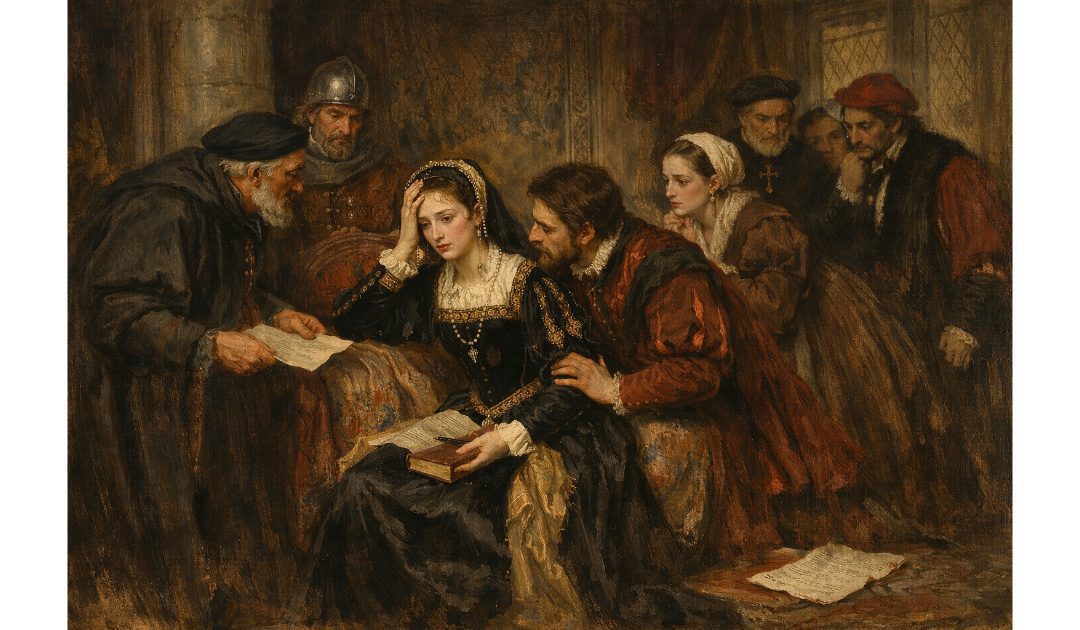
On the 19th of July, 1553, the Privy Council overturned the will of the recently deceased King Edward VI, and proclaimed Edward’s half-sister Mary as queen in place of Lady Jane Grey, who had been queen for just nine days.
Lady Jane Grey was born in October 1537 at Bradgate Park in Leicestershire. She lived for barely sixteen years, yet her brief life became one of the most famous and tragic stories of Tudor England. Remembered as the “Nine Days’ Queen”, she was proclaimed queen in July 1553, ruled for little more than a week, and was executed the following year.
Jane came from one of the highest-ranking noble families in England. Her father was Henry Grey, Duke of Suffolk, and her mother was Lady Frances Brandon. Through her mother, Jane was the great-granddaughter of Henry VII and therefore a cousin of Edward VI, Mary I and Elizabeth I.
From an early age Jane showed remarkable intelligence. Tudor noblewomen were expected to be educated, but Jane’s learning was exceptional even by the standards of the time. She studied Latin, Greek, French, Italian and Hebrew, and became deeply interested in religion and classical literature. Humanist scholars admired her. One famous visitor, the scholar Roger Ascham, met Jane at her family home and later wrote that while others were hunting in the park, Jane was quietly reading the Greek philosopher Plato indoors. Ascham described her as one of the cleverest and best educated young women in England.
Jane’s childhood was not especially happy. Her parents were ambitious and strict, and Jane later said that she feared them more than she loved them. When she was about nine years old she entered the household of Catherine Parr, who encouraged Jane’s studies and Protestant beliefs. Catherine Parr had married Thomas Seymour after the death of Henry VIII. After Catherine died in 1548, Jane briefly remained with Seymour, but his political ambitions led to his arrest and execution in 1549. Jane then returned to her parents.
By the early 1550s religion and politics dominated England. King Edward VI was a committed Protestant, while his half-sister Mary was a Catholic. Jane was also a devout Protestant, and this made her important to powerful politicians who feared that Mary would reverse the Protestant reforms if she became queen.
In May 1553 Jane was married to Guildford Dudley. The marriage was arranged by Guildford’s father, John Dudley, Duke of Northumberland, the most powerful man in England and the chief adviser to Edward VI. Northumberland hoped to keep power after Edward’s death. Edward was dying, and because he wanted England to remain Protestant, he agreed to change the succession. Instead of allowing Mary to inherit the throne, Edward named Jane as his successor.
Edward died on the 6th of July 1553. Jane was told that she was to be queen and reportedly fainted when she heard the news. She did not want the crown, but she accepted it because her family and the leading councillors insisted. On the 10th of July she was proclaimed queen in London. Yet from the beginning her position was weak. Most people believed that Mary was the rightful heir under the will of Henry VIII, and Mary quickly gathered supporters.
For nine days Jane remained in the Tower of London awaiting her coronation. Meanwhile Mary raised an army in East Anglia. The Privy Council, seeing that Mary had greater support, abandoned Jane. On the 19th of July, 1553, they proclaimed Mary queen instead. Jane lost the crown almost as suddenly as she had gained it.
Jane and Guildford were imprisoned in the Tower. At first Mary was reluctant to kill her young cousin. Jane was tried for treason in November 1553 and sentenced to death, but the sentence was not immediately carried out. Mary hoped Jane could be spared. However, in early 1554 Jane’s father joined Wyatt’s Rebellion, a revolt against Mary’s planned marriage to Philip of Spain. The rebellion failed, and Mary decided that Jane was too dangerous to leave alive.
On the 12th of February, 1554, Guildford Dudley was executed first. Jane was then led to the scaffold within the Tower. Calm and dignified, she declared that although she had accepted the crown, she had never sought it. She said she died as a true Christian. Jane was beheaded at about sixteen years of age and buried in the chapel of St Peter ad Vincula inside the Tower of London.
After her death Jane became a symbol of innocence and Protestant faith. Later generations remembered Lady Jane Grey not as an ambitious queen, but as a learned and tragic young woman destroyed by the ambitions of others.