
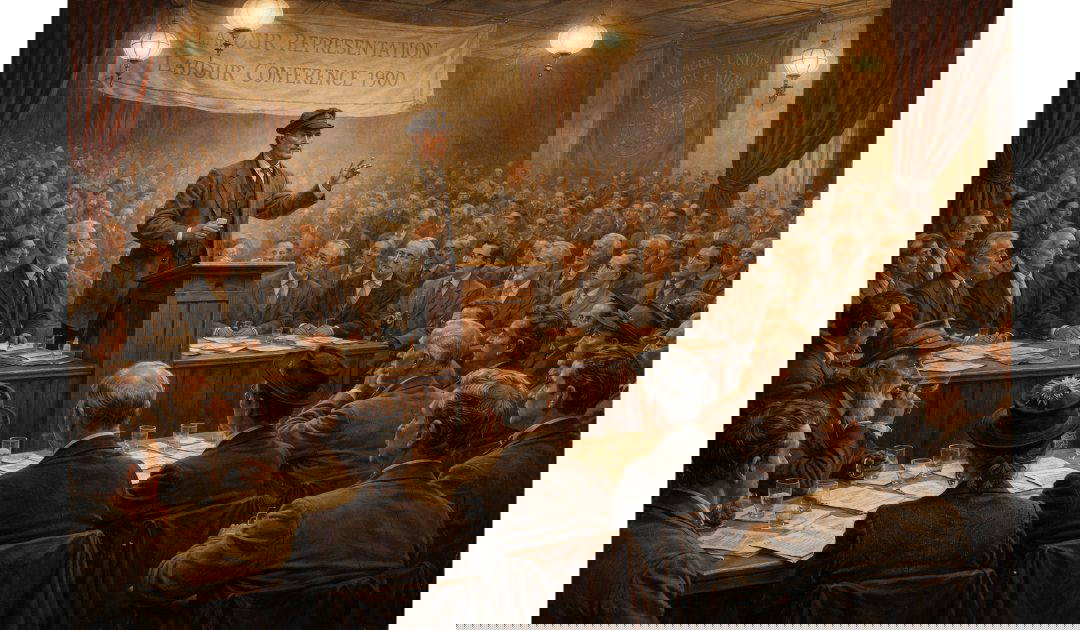
On the 27th of February, well, I fear I’m running out of history. King Henry IV of France was crowned, but I’ve covered him. Lord Byron gave his first address to the House of Lords, but I’ve covered him too. I could go on, but thankfully in 1900 the Labour Party was formed.
The Labour Party of the United Kingdom emerged at the turn of the twentieth century as a political expression of organised labour and socialist ideas, responding to the social and economic dislocations created by industrialisation. Its formation marked a decisive shift in British politics, introducing a mass party rooted in trade unions and working-class representation that would eventually rival and often supplant the older Liberal Party.
The origins of Labour lie in the late Victorian era, when rapid industrial growth had produced a large urban working class with limited political voice. Although the Reform Acts of the nineteenth century had expanded the franchise, most Members of Parliament still came from aristocratic or middle-class backgrounds. Trade unions, which had grown in strength and organisation, increasingly recognised that industrial action alone was insufficient to secure lasting improvements in wages, working conditions, and social welfare. At the same time, socialist organisations such as the Independent Labour Party (ILP), founded in 1893 by Keir Hardie, and the Fabian Society, established in 1884, were advocating political solutions to social inequality.
In 1900, representatives of trade unions, socialist societies, and cooperative organisations met in London to create the Labour Representation Committee (LRC). Its purpose was straightforward: to promote the election of working-class MPs to Parliament. The LRC was not initially a single, ideologically unified party, but a federation of groups with overlapping aims. In the general election later that year, it succeeded in returning two MPs, including Hardie. The breakthrough came in 1906, when the LRC won 29 seats and formally adopted the name “Labour Party.” This election also marked the beginning of Labour’s emergence as a national political force.
In its early years, Labour worked closely with the Liberal Party, often supporting Liberal governments that introduced social reforms such as old-age pensions and national insurance. However, Labour was increasingly defined by its independence and its commitment to representing working-class interests directly. The party’s influence grew during and after the First World War, a period that transformed British society and politics. The extension of the franchise in 1918 dramatically increased the electorate, benefiting Labour’s mass membership model. In the same year, the party adopted a new constitution, including the famous Clause IV, which committed Labour to the “common ownership of the means of production, distribution and exchange,” reflecting its socialist aspirations.
Labour formed its first government in 1924 under Ramsay MacDonald, although it was a minority administration that lasted less than a year. A second minority government followed in 1929, but the onset of the Great Depression led to deep internal divisions. MacDonald’s decision to lead a National Government dominated by Conservatives in 1931 was seen as a betrayal by many in Labour, and the party suffered a devastating electoral defeat. Rebuilding during the 1930s, Labour refined its policies and leadership, preparing for a more decisive role.
That role came after the Second World War. In the 1945 general election, Labour, led by Clement Attlee, won a landslide victory. The Attlee government is widely regarded as the most transformative in Labour’s history. It established the modern welfare state, including the National Health Service, expanded social security, and nationalised key industries such as coal, steel, and railways. These reforms reshaped Britain and cemented Labour’s reputation as the party of social justice and collective provision.
In the post-war decades, Labour alternated in power with the Conservatives, governing under leaders such as Harold Wilson and James Callaghan. Wilson’s governments of the 1960s introduced social reforms in education and civil liberties, while grappling with economic challenges. The 1970s proved difficult, marked by industrial unrest and economic crisis, culminating in Labour’s defeat in 1979.
The 1980s were a period of introspection and division for Labour, as it struggled to respond to the dominance of Margaret Thatcher’s Conservative governments. Internal conflicts between left-wing and moderate factions, and a series of electoral defeats, prompted a gradual rethinking of the party’s direction. This process culminated in the 1990s with the rise of “New Labour” under Tony Blair. In 1995, Clause IV was revised, signalling a move away from traditional state socialism towards a more market-friendly social democracy.
Labour returned to power in 1997 with another landslide victory. Blair’s governments invested heavily in public services, introduced devolution to Scotland and Wales, and played a prominent role in international affairs. Subsequent years have seen Labour continue to evolve, balancing its historic commitment to equality and workers’ rights with changing economic and social realities.
Kier Starmer’s landslide victory in the 2024 election may owe more to disillusion with twelve years of conservative government than any hope for change that Labour could offer. It seems to me that Starmer set down so many red lines, particularly over reversing the catastrophe that Brexit had been, that he stitched himself into a straight jacket. Nevertheless, we have a Labour government again.
From its origins as a coalition seeking basic representation, the Labour Party has become one of the central institutions of British political life. Its history reflects the broader struggles over class, welfare, and the role of the state, and it remains a key vehicle for debates about fairness and social justice in the UK.