
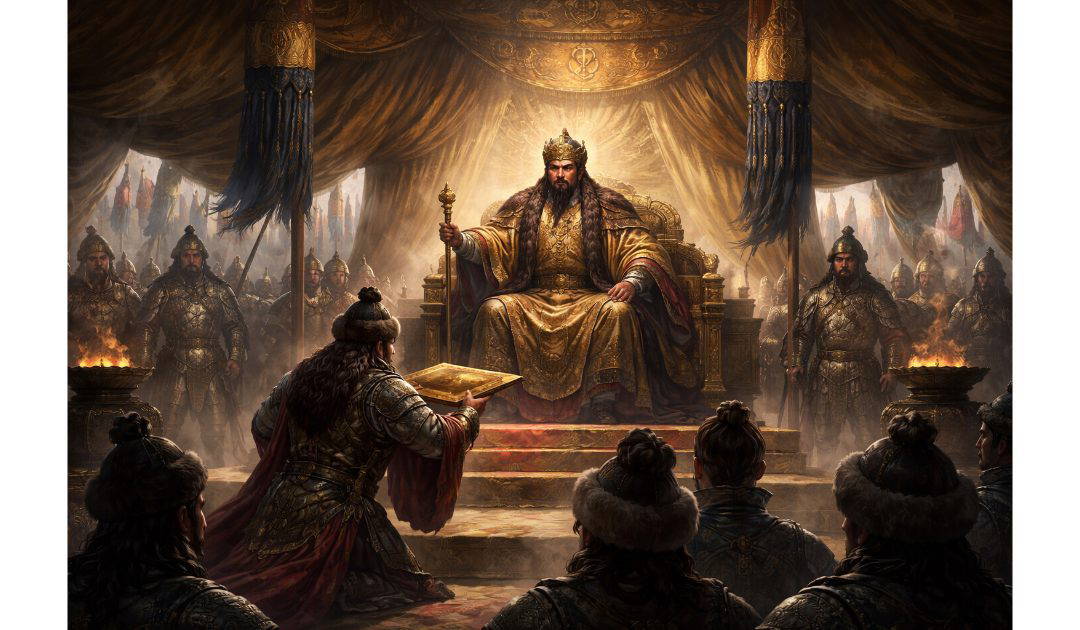
On the 5th of May, 1260, Kublai Khan became ruler of the Mongul Empire. Kublai Khan (1215–1294) was one of the most formidable rulers in world history, a man who transformed the vast, mobile conquests of the Mongols into a structured imperial state and became the founding emperor of China’s Yuan dynasty. Grandson of Genghis Khan, Kublai inherited not only a tradition of conquest but also the immense challenge of ruling an empire that stretched from the steppes of Mongolia to the shores of the Pacific.
Born in 1215, the year before Genghis Khan captured Beijing (then Zhongdu), Kublai grew up amid the relentless expansion of Mongol power. Unlike his grandfather, who was forged entirely in the harsh nomadic world of the steppe, Kublai came of age in an empire already engaging deeply with sedentary civilizations. His mother, Sorghaghtani Beki, was a highly capable and politically astute woman who ensured that her sons received not only military training but also an education that exposed them to Chinese, Persian, and Islamic administrative traditions. This broader outlook would shape Kublai’s rule.
Kublai first proved himself as a capable administrator in northern China during the reign of his brother, Möngke Khan. Appointed to govern recently conquered Chinese territories, he surrounded himself with Confucian advisers and began experimenting with more settled forms of governance. He promoted agriculture, reduced some harsh exactions, and sought to rebuild war-torn regions. These policies distinguished him from more traditional Mongol leaders who preferred tribute extraction and mobility over bureaucratic administration.
In 1259, Möngke Khan died during a campaign against the Southern Song dynasty. A succession crisis followed. Kublai declared himself Great Khan in 1260, but his younger brother Ariq Böke also claimed the title from the Mongol heartland in Karakorum. The ensuing civil war lasted four years. Ultimately, Kublai prevailed in 1264, consolidating his authority over the Mongol Empire—though in practice the western khanates increasingly acted independently. Even so, Kublai retained the supreme title of Great Khan, marking him as the nominal head of the entire Mongol world.
Kublai’s greatest achievement was the final conquest of southern China. For decades, the Southern Song dynasty had resisted Mongol advances. Kublai committed vast resources to the campaign, combining traditional Mongol cavalry tactics with naval warfare and Chinese siege technology. In 1271 he formally proclaimed the Yuan dynasty, adopting a Chinese dynastic name to legitimize his rule over China. By 1279, after the decisive naval Battle of Yamen, the Song resistance collapsed. For the first time in centuries, all of China was unified under a single ruler—and that ruler was a Mongol.
As emperor, Kublai established his capital at Dadu (modern Beijing), transforming it into a grand imperial city. He embraced many aspects of Chinese statecraft, maintaining Confucian rituals and employing Chinese officials in the bureaucracy. Yet he also preserved Mongol privileges. Society under the Yuan was formally divided into categories: Mongols at the top, followed by Central and West Asians (often called “Semuren”), northern Chinese, and finally southern Chinese. This hierarchy ensured Mongol dominance but also fostered resentment.
Kublai promoted trade and communication across his domains. The Pax Mongolica facilitated the movement of goods, technologies, and ideas from East Asia to Europe. It was during his reign that the Venetian merchant Marco Polo claimed to have visited his court, later describing its splendour in accounts that captivated Europe. Whether entirely accurate or not, these descriptions cemented Kublai’s reputation in the Western imagination as a ruler of immense wealth and sophistication.
Despite his successes, Kublai’s reign was not without setbacks. He launched ambitious but costly military campaigns beyond China. His invasions of Japan in 1274 and 1281 ended in failure, the latter famously disrupted by typhoons later called “kamikaze,” or divine winds. Campaigns in Vietnam, Burma, and Java also drained resources and met with limited success. These ventures strained the empire’s finances and exposed the limits of Mongol expansion.
In his later years, Kublai faced personal and political difficulties. The death of his wife Chabi and his chosen heir deeply affected him. He grew increasingly isolated and reportedly struggled with ill health and overindulgence. Administratively, corruption and inflation became mounting problems. Paper currency, widely used under the Yuan, lost value as overissuance and fiscal mismanagement took their toll.
When Kublai Khan died in 1294, he had ruled for more than three decades as Great Khan and over China as emperor. He was buried according to Mongol custom in a secret location in Mongolia. Though the Yuan dynasty he founded would eventually fall in 1368, replaced by the Ming, Kublai’s impact was enduring. He had shifted the centre of Mongol power from the steppe to China, transforming a conquering confederation into a dynastic state.