
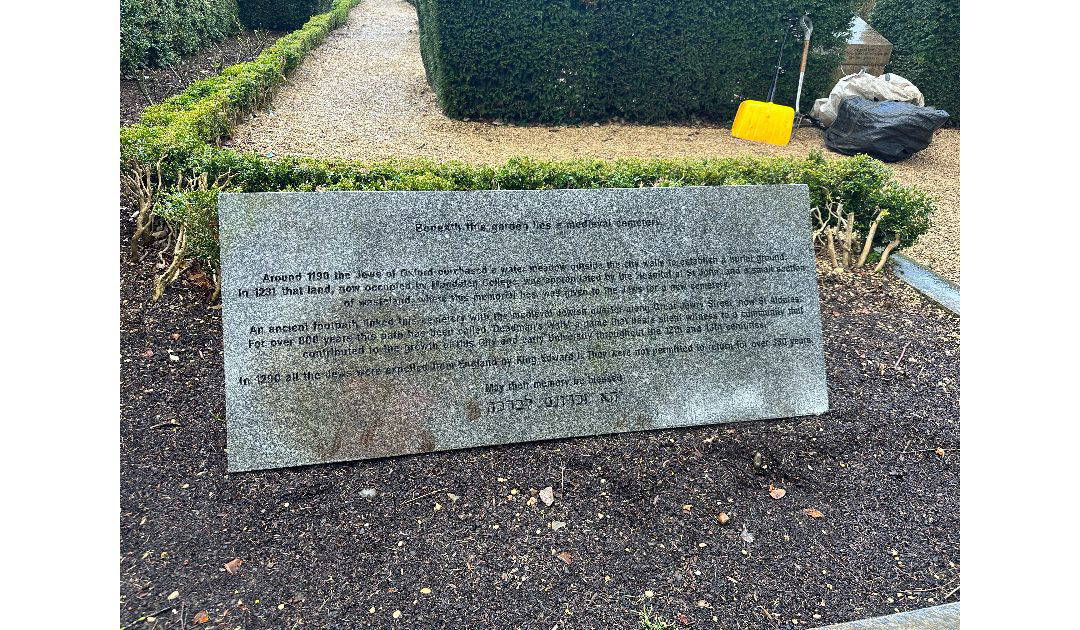
On the 18th of July, 1290, King Edward I of England issued the Edict of Expulsion banishing all Jews from England. There were around 16,000 Jews in England at that time. I haven’t written much about Edward I although he did get a mention in my post on Clifford’s Tower.
Edward I of England, often known as “Longshanks” because of his height and imposing presence, was one of the most formidable and consequential monarchs in medieval English history. Born in 1239, the son of Henry III of England and Eleanor of Provence, Edward grew up during a turbulent period marked by baronial unrest and constitutional conflict. These early experiences shaped his political outlook and his determination to assert royal authority.
Edward first came to prominence during the conflict known as the Second Barons’ War. Initially aligned with the reformist barons led by Simon de Montfort, Edward later returned to his father’s side. His military skill was demonstrated at the Battle of Evesham in 1265, where Montfort was defeated and killed. This victory restored royal power and marked Edward as a capable and decisive leader.
Before becoming king, Edward undertook a crusade to the Holy Land, participating in what is often called the Ninth Crusade. Although militarily limited, this expedition enhanced his reputation as a Christian warrior. When Henry III died in 1272, Edward was still abroad, but he was proclaimed king without opposition, returning to England in 1274 to be crowned.
Edward’s reign is often characterised by his legal and administrative reforms. Determined to strengthen royal governance, he initiated a series of statutes that clarified and codified English law. Among these were the Statutes of Westminster, which sought to address abuses of feudal rights and improve the functioning of the courts. His efforts earned him a reputation as the “English Justinian,” a reference to the Byzantine emperor known for codifying Roman law. Edward also expanded the role of Parliament, summoning what became known as the “Model Parliament” in 1295, which included representatives from the commons as well as the nobility and clergy. This development was a significant step in the evolution of England’s parliamentary system.
Edward is perhaps most famously associated with his campaigns in Wales and Scotland. In Wales, he pursued a determined policy of conquest against Llywelyn ap Gruffudd, the Prince of Wales. After a series of campaigns culminating in 1282, Llywelyn was killed, and Wales was effectively annexed to the English crown. To consolidate his control, Edward constructed a series of formidable castles, including those at Caernarfon, Conwy, and Harlech. These fortifications remain among the most impressive examples of medieval military architecture.
Edward’s involvement in Scotland proved more protracted and controversial. Following a succession crisis, he was invited to arbitrate between rival claimants to the Scottish throne, eventually supporting John Balliol. However, Edward treated Scotland as a vassal state, leading to rebellion. His campaigns included victories such as the Battle of Dunbar in 1296, but resistance continued under leaders like William Wallace and later Robert the Bruce. Edward’s efforts to subdue Scotland were ultimately incomplete, and the conflict persisted beyond his death.
In 1290, he issued the Edict of Expulsion, ordering the expulsion of Jews from England. This reflected widespread medieval prejudice and had lasting social and economic consequences. Edward’s decision to issue the Edict of Expulsion in 1290 was driven by a combination of financial, political, and social pressures. For decades, the Jewish population in England had been heavily taxed by the Crown, as they were legally considered royal dependants. By the late 13th century, however, their economic usefulness to the monarchy had declined, partly because Christian moneylenders had begun to take over their traditional role. At the same time, widespread hostility toward Jews—fuelled by religious prejudice and false accusations—made them an easy target. By expelling them, Edward could present himself as a pious Christian king, gain popular support, and secure a grant of taxation from Parliament in return.
Personally, Edward was known for his strong will, energy, and sometimes ruthless determination. His marriage to Eleanor of Castile was notably affectionate by the standards of the time. Following her death in 1290, Edward ordered the construction of a series of memorial crosses, known as the Eleanor Crosses, marking the route of her funeral procession.
Edward I died in 1307 while campaigning against the Scots near the border. He was succeeded by his son, Edward II of England, whose reign would prove far less effective.
In conclusion, Edward I was a king of immense capability and ambition. His legal reforms, military conquests, and administrative innovations left a profound mark on England and the British Isles. Yet his legacy is complex, combining achievements in governance with harsh policies and relentless warfare. He remains one of the most commanding figures of medieval English history.