
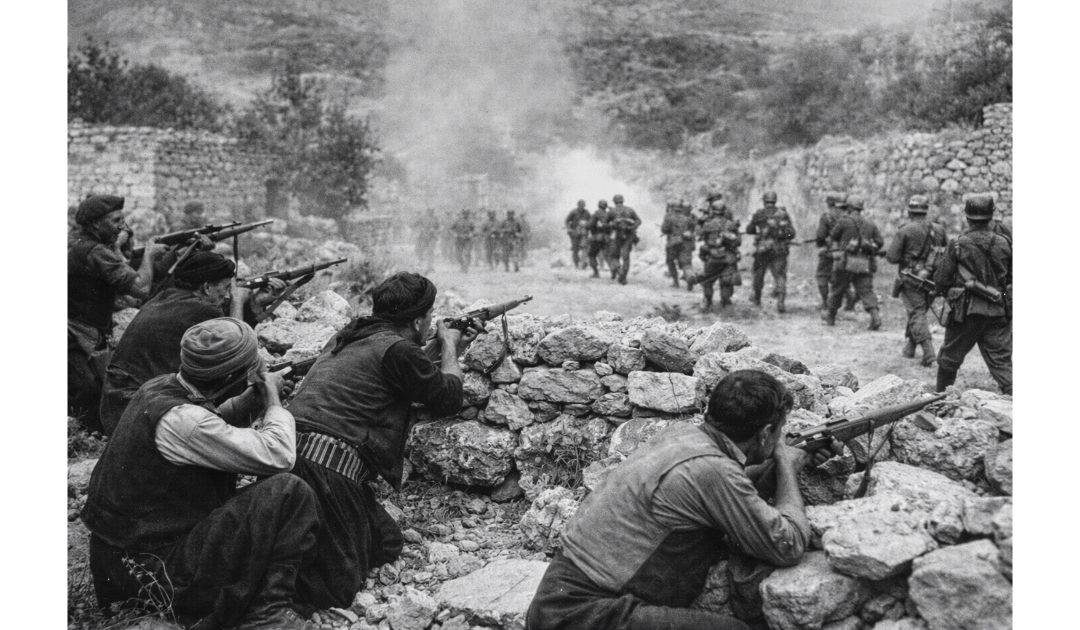
On the 3rd of June, 1941, the German army razed the Greek village of Kandanos to the ground, and murdered 180 of its citizens. During the Battle of Crete resistance fighters had held advancing German troops for two days. The attrocity was German retribution.
The small Cretan village of Kandanos became the scene of one of the most tragic episodes of the Second World War during the wider conflict known as the Battle of Crete. Though modest in size, Kandanos entered history as a symbol of fierce local resistance and brutal reprisal.
The Battle of Crete began on the 20th of May, 1941, when Nazi Germany launched Operation Mercury, the first large-scale airborne invasion in history. Following the German conquest of mainland Greece in April 1941, the island of Crete remained in Allied hands, defended by British, Australian, New Zealand, and Greek troops under the overall command of British General Bernard Freyberg. The island’s strategic position in the eastern Mediterranean made it vital for control of sea routes and air operations.
German forces, under General Kurt Student, relied heavily on paratroopers (Fallschirmjäger) to seize key airfields, particularly at Maleme, Heraklion, and Rethymno. The invasion was costly from the outset. Paratroopers descended into fierce resistance not only from Allied soldiers but also from Cretan civilians, many of whom took up arms spontaneously. Farmers, shepherds, and townspeople fought with hunting rifles, old military weapons, or even agricultural tools. The intensity of civilian resistance shocked German commanders, who had not anticipated such widespread popular involvement.
In western Crete, near the town of Chania, Kandanos lay along an important route connecting the north coast with the south. As German forces pushed inland, local Cretans, alongside elements of retreating Greek soldiers, attempted to block their advance through the mountainous terrain around the village. Over several days in late May 1941, skirmishes and ambushes slowed German movements in the region. Though lightly armed and lacking formal organisation, the defenders used their knowledge of the rugged landscape to advantage.
Despite determined resistance, the overall battle turned in Germany’s favour. The capture of Maleme airfield allowed German reinforcements to land in strength, tipping the balance. Allied forces were gradually forced into retreat toward the island’s southern coast, from which many were evacuated to Egypt. By the 1st of June, 1941, Crete was effectively under German control. However, German casualties had been extraordinarily high, particularly among elite paratroopers. The losses were so severe that Adolf Hitler reportedly forbade large-scale airborne operations of this type in the future.
In the aftermath of the fighting, German commanders implemented harsh reprisals against Cretan communities accused of resisting or aiding Allied troops. Kandanos was singled out as an example. On the 3rd of June 1941, German forces entered the village and carried out systematic destruction. Houses were burned, property was looted, and 180 inhabitants were killed. The village was razed to the ground.
To underscore the punishment, the Germans erected signs in Greek and German stating that Kandanos had been destroyed in retaliation for the “murder” of German soldiers and that it was never to be rebuilt. These signs were intended as a warning to other communities: resistance would bring collective punishment. The destruction of Kandanos was not an isolated act; similar reprisals occurred elsewhere on Crete, including at villages such as Kondomari and later at Viannos. Yet Kandanos became one of the most emblematic examples because of the deliberate, public nature of its obliteration.
The suffering of Kandanos formed part of a broader pattern of occupation in Crete. The island remained under Axis control until 1945, divided between German and Italian zones. Cretan resistance, however, did not cease with the conquest. Instead, it evolved into an organised underground movement, supported by British Special Operations Executive (SOE) agents. Acts of sabotage and intelligence-gathering continued throughout the occupation, culminating in operations such as the abduction of German General Heinrich Kreipe in 1944.
After the war, Kandanos was rebuilt. The memory of its destruction became central to local identity and to Greek remembrance of wartime atrocities. Today, memorials in the village commemorate those who were killed and the suffering endured. The German warning signs were preserved as historical evidence of the policy of collective reprisal.
The Battle of Crete as a whole had significant military and political consequences. Although Germany secured the island, the heavy casualties weakened its airborne forces. Some historians argue that the delay and losses contributed indirectly to the postponement of Operation Barbarossa, the invasion of the Soviet Union, though this remains debated. For the Allies, the battle demonstrated both the vulnerability of airborne troops and the potential power of popular resistance.
For the people of Kandanos, however, the battle’s legacy was deeply personal. Their village’s destruction symbolised both the courage of ordinary civilians who chose to resist and the ruthless nature of occupation warfare. In Greek national memory, Kandanos stands as a testament to sacrifice and defiance in the face of overwhelming force.