
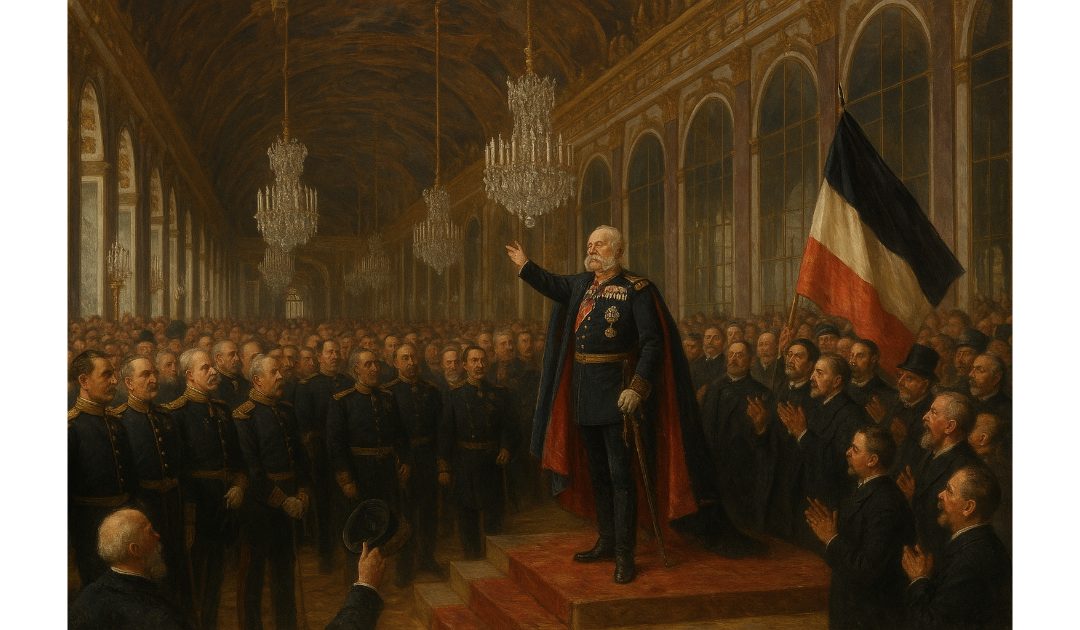
On the 18th of January, 1871, Wilhelm I of Germany was proclaimed Kaiser Wilhelm in the Hall of Mirrors of the Palace of Versailles towards the end of the Franco-Prussian War.
Kaiser Wilhelm I (1797–1888), born Prince Wilhelm of Prussia, was the first German Emperor and one of the most consequential monarchs of the 19th century. Though often overshadowed by his brilliant and forceful minister Otto von Bismarck, Wilhelm played a crucial role in the unification of Germany and the shaping of modern Europe. His reign bridged the traditional world of post-Napoleonic monarchy and the industrial, nationalistic age that followed.
Wilhelm was born in Berlin in March 1797, the second son of King Frederick William III. As a younger son, Wilhelm was not originally destined for the throne, but early military training shaped his outlook for life. He came of age during the upheavals of the Napoleonic Wars, and his service against Napoleon in 1814–1815 instilled in him a lifelong attachment to the Prussian army. Wilhelm was a soldier first, a conservative monarch second, and a statesman only by necessity.
During the early decades of his life, Prussia struggled to reconcile old absolutist traditions with rising demands for constitutional government. Wilhelm’s instincts were staunchly conservative. He opposed revolutionary movements and feared liberal reforms as threats to order and monarchy. This earned him the nickname “the Prince of Grapeshot” after 1848, when he advocated firm military measures against revolutionaries. Yet, despite his caution, he also possessed a sense of responsibility and understood the importance of careful compromise in moments of crisis.
Wilhelm became Prince Regent in 1858 when his brother Frederick William IV descended into mental incapacity, and he ascended to the Prussian throne in 1861. His early years were marked by a bitter conflict with the Prussian parliament over military reform. Wilhelm insisted on modernising and expanding the army, while liberals objected to the increased budget and what they saw as militarism. In frustration, Wilhelm nearly abdicated—but the appointment of Otto von Bismarck as Minister-President in 1862 changed the course of his reign, and indeed European history.
The partnership between Wilhelm I and Bismarck became one of the most famous political alliances of the 19th century. Their temperaments and ideologies differed—Wilhelm gentlemanly and cautious, Bismarck cunning and uncompromising—but their goals aligned. Bismarck offered the iron will and political ruthlessness that Wilhelm lacked, while Wilhelm provided legitimacy and a stabilising presence. Despite occasional tension, especially when Bismarck pushed the boundaries of royal authority, Wilhelm usually deferred to his minister’s judgement, trusting in his results.
The unification of Germany under Prussian leadership unfolded through three short, decisive wars: the Danish War (1864), the Austro-Prussian War (1866), and the Franco-Prussian War (1870–1871). Wilhelm played an active role in military leadership, particularly in 1870, often appearing at the front and embodying the warlike spirit of the Prussian monarchy. Victories in these conflicts allowed Bismarck to reorganise German states under Prussian dominance.
The culmination came on the 18th of January, 1871, when Wilhelm was proclaimed German Emperor in the Hall of Mirrors at Versailles. Although he harboured personal reluctance—fearing the title might diminish the dignity of the Prussian crown—he eventually accepted. The new German Empire became the most powerful state in continental Europe, and Wilhelm its symbolic figurehead.
As emperor, Wilhelm ruled with dignity, reserve, and a sense of paternal responsibility. Unlike his grandson Wilhelm II, he was not flamboyant. He preferred ceremony to innovation and stability to grandeur. The constitution of the German Empire gave the emperor significant powers, but Wilhelm rarely used them independently; his governance depended heavily on Bismarck. The two men oversaw a period of dramatic industrialisation, diplomatic manoeuvring, and internal consolidation.
Wilhelm’s long reign also saw tensions between conservative forces and liberals, Catholics, and social democrats—groups perceived as potential threats to the unity of the new empire. The Kulturkampf, Bismarck’s confrontation with the Catholic Church, unfolded under Wilhelm’s watch, though the emperor himself was more moderate and inclined toward reconciliation.
By the time of his death in 1888—at the age of 90—Wilhelm had become a beloved figure, regarded as a symbol of unity, duty, and the old Prussian virtues of order and loyalty. His passing marked the beginning of the “Year of the Three Emperors,” as he was succeeded by his son Frederick III, and then by his more volatile grandson Wilhelm II.
Kaiser Wilhelm I remains an understated yet essential figure in European history. Not a visionary strategist nor a revolutionary thinker, he nevertheless provided the legitimacy, continuity, and calm authority required for Bismarck’s bold policies to succeed. Through a combination of tradition, military prestige, and steady leadership, Wilhelm presided over the birth of the German nation-state and helped shape the geopolitical landscape that defined Europe until the First World War.