
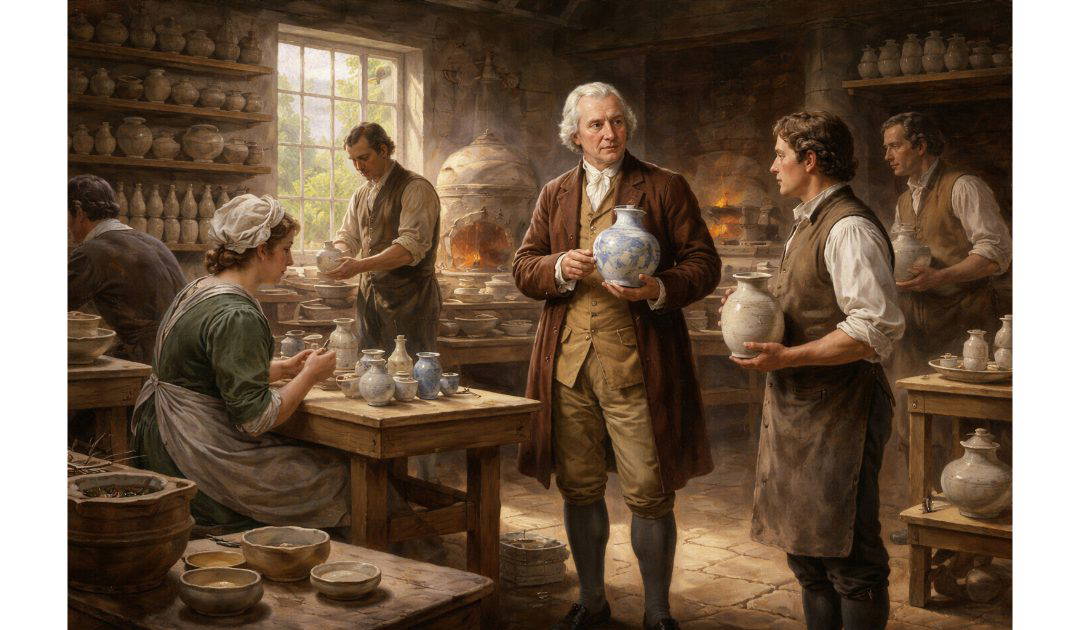
Josiah Wedgwood (1730–1795) was one of the most influential figures of the Industrial Revolution in Britain, a master potter whose innovations transformed ceramics from a craft into a sophisticated industry. His life combined artistic vision, scientific curiosity, and entrepreneurial skill, and his legacy continues to shape both design and manufacturing.
He was born on the 12th of July, 1730, in the village of Burslem in Staffordshire, one of the six towns that would later form Stoke-on-Trent, the heart of the English pottery industry. Wedgwood came from a long line of potters, and after his father’s death when Josiah was just nine years old, he was apprenticed to his elder brother Thomas. This early exposure to the trade laid the foundation for his later achievements, though his progress was interrupted by a bout of smallpox that left him with a weakened leg. This disability ultimately prevented him from working the potter’s wheel for long periods, pushing him instead toward design, experimentation, and management—areas in which he excelled.
Wedgwood’s early career included a partnership with the potter Thomas Whieldon, one of the most skilled ceramicists of the day. During this time, Wedgwood honed his technical knowledge and began experimenting with new glazes and forms. By the 1760s, he had established his own business and was producing increasingly refined wares that appealed to Britain’s growing middle and upper classes.
One of his first major successes came in 1765, when he secured the patronage of Queen Charlotte, wife of King George III. He created an elegant cream-coloured earthenware service for her, which she allowed to be marketed as “Queen’s Ware.” This endorsement significantly boosted Wedgwood’s reputation and helped him expand his market both domestically and internationally.
Wedgwood was not only a craftsman but also a pioneer of industrial methods and marketing. He introduced systematic production techniques, division of labour, and rigorous quality control to pottery manufacturing. His factory at Etruria, established in 1769, was a model industrial complex, carefully planned to maximise efficiency and worker productivity. It also reflected Enlightenment ideals of order and progress, with improved working conditions compared to many contemporary factories. He was the pioneer of direst mail, money back guarantees, self-service, buy one get one free, and illustrated catalogues.
Perhaps Wedgwood’s most famous artistic achievement was the development of Jasperware in the 1770s. This unglazed, finely textured stoneware, often in pale blue with white classical reliefs, became synonymous with elegance and neoclassical taste. Inspired by ancient Greek and Roman art, Jasperware featured motifs such as gods, muses, and mythological scenes, aligning perfectly with the era’s fascination with antiquity. These pieces were highly prized and remain iconic today.
Wedgwood’s success was closely tied to his engagement with the intellectual currents of his time. He was associated with the Lunar Society, a group of prominent thinkers, scientists, and industrialists that included figures such as Erasmus Darwin and Matthew Boulton. Through this network, Wedgwood exchanged ideas about science, technology, and industry, applying new knowledge to improve his manufacturing processes.
He also made important contributions to science. Wedgwood developed a pyrometer, a device for measuring high temperatures in kilns, which allowed for more precise control in firing ceramics. His interest in chemistry and materials science was crucial to his success, enabling him to create new types of pottery that were both durable and aesthetically refined.
Beyond his business achievements, Wedgwood was a committed social reformer. He was a prominent supporter of the movement to abolish the transatlantic slave trade. In 1787, he produced a now-famous medallion depicting an enslaved African man in chains with the inscription “Am I Not a Man and a Brother?” This image became a powerful symbol of the abolitionist cause and was widely distributed, helping to raise awareness and sympathy.
Wedgwood’s personal life also connected him to important historical figures. His daughter Susannah married Robert Darwin, and their son was Charles Darwin, the future author of On the Origin of Species. Thus, Wedgwood’s legacy extended into the scientific revolution of the nineteenth century.
He died on the 3rd of January, 1795, leaving behind a thriving business and a transformed industry. The company he founded, Wedgwood, continued to flourish long after his death and remains a symbol of British craftsmanship and design.