
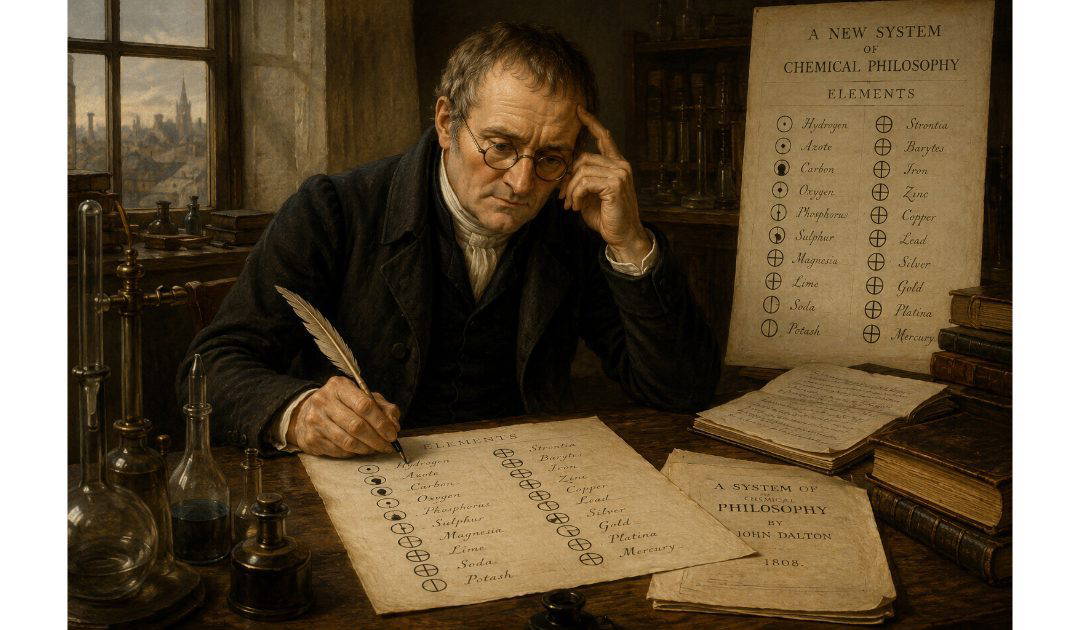
Wikipedia tells me that on the 6th of September, 1803, John Dalton began using symbols to represent chemical elements. I wonder if he chose his birthday to do that or it was coincidence. I have posted about Dalton before in relation to his colour blindness.
John Dalton (1766–1844) was an English chemist, physicist and meteorologist whose work transformed the scientific understanding of matter. Although he made important contributions to several branches of science, he is best remembered for developing the first modern atomic theory. His ideas provided a coherent explanation for how elements combine to form compounds and laid the foundation for modern chemistry. While later discoveries showed that some aspects of his theory were incomplete, its central principles remain fundamental to science today.
Dalton was born on the 6th of September, 1766, in the village of Eaglesfield, Cumberland (now part of Cumbria), into a modest Quaker family. The Quakers valued education, honesty and practical knowledge, despite facing restrictions in English society because they did not belong to the established Church of England. These values strongly influenced Dalton’s character, making him disciplined, humble and devoted to careful observation.
A gifted student, Dalton began teaching at the age of just twelve in a local school. By fifteen he was running the school himself, demonstrating remarkable maturity and intellectual ability. In 1793 he moved to Manchester to teach mathematics and natural philosophy at New College, an institution founded for religious dissenters. Manchester would remain his home for the rest of his life and became the centre of his scientific work.
Dalton’s earliest scientific interests lay in meteorology. For over fifty years he maintained meticulous daily weather records, ultimately making more than 200,000 observations. He measured temperature, atmospheric pressure, humidity and rainfall with exceptional diligence. His studies of gases arose naturally from this interest in the atmosphere and eventually led him towards chemistry.
One of Dalton’s first major scientific achievements was his work on colour blindness. Dalton himself was colour blind and struggled to distinguish red from green. In 1794 he published the first scientific paper describing the condition, believing that the coloured fluid inside his eyes caused the problem. Although this explanation proved incorrect, his careful observations brought attention to the disorder. In several languages, colour blindness is still sometimes referred to as “Daltonism” in his honour.
Dalton’s most influential work concerned the behaviour of gases. He investigated how different gases mixed and exerted pressure, leading to what is now known as Dalton’s Law of Partial Pressures. This law states that in a mixture of gases, each gas behaves independently and contributes its own pressure to the total pressure. Today this principle remains essential in chemistry, physics, engineering and medicine, particularly in understanding breathing, diving and industrial gas systems.
While studying gases and chemical reactions, Dalton recognised that substances always combined in fixed proportions by mass. Existing observations, including the Law of Definite Proportions established by other chemists, suggested that matter might consist of tiny indivisible particles. Dalton expanded these ideas into a comprehensive atomic theory, which he first presented in 1803 and later published in his influential work A New System of Chemical Philosophy.
Dalton’s atomic theory rested on several key principles. He proposed that all matter is composed of tiny particles called atoms; that atoms of a given element are identical in mass and properties; that atoms of different elements differ from one another; that atoms cannot be created, destroyed or divided during chemical reactions; and that compounds are formed when atoms combine in simple whole-number ratios. Chemical reactions, he argued, simply rearrange these atoms without altering their fundamental nature.
Although later discoveries revealed that atoms are divisible into electrons, protons and neutrons, and that elements can exist as isotopes with different masses, Dalton’s central insight—that matter consists of atoms combining in predictable ways—proved revolutionary. His theory explained why chemical reactions followed precise mathematical laws and gave chemists a powerful framework for understanding compounds.
Dalton also attempted to calculate the relative weights of atoms. Working with limited experimental data, he assigned hydrogen an atomic weight of one and estimated the weights of other elements relative to it. Many of his values were inaccurate because he misunderstood the composition of certain compounds, but his approach introduced the concept of atomic weights, an essential step towards the modern periodic table.
Unlike many scientists of his era, Dalton led a simple and modest life. He never married and devoted nearly all his time to research, teaching and writing. Friends described him as quiet, sincere and unpretentious. He became a Fellow of the Royal Society in 1822 and received numerous honours during his lifetime, although he remained personally modest about his achievements.
When Dalton died in Manchester on the 27th of July, 1844, he was widely recognised as one of Britain’s greatest scientists. More than 40,000 people are said to have filed past his coffin as he lay in state, an extraordinary tribute for a man who had spent his life in patient scientific investigation.
John Dalton’s legacy extends far beyond his own discoveries. His atomic theory became the cornerstone of modern chemistry, influencing generations of scientists and paving the way for later breakthroughs in physics, materials science and molecular biology. Though refined by subsequent discoveries, his vision of matter as an orderly arrangement of atoms remains one of the most important concepts in the history of science.