
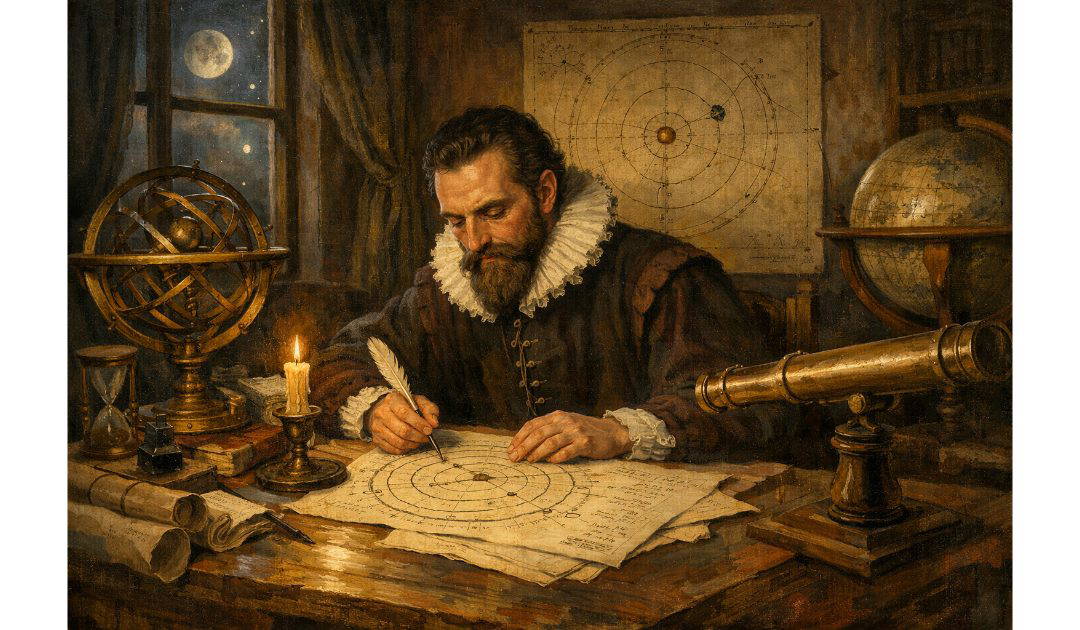
On the 15th of May, 1618, Johannes Kepler confirmed his previously rejected third law of planetary motion. He first formulated it on the 8th of March but rejected it after initial calculations. I find it extraordinary that in 1633 Galileo was tried for defending heliocentricity, whilst in 1618 Kepler had established the mathematics of planetary motion. The heresy of heliocentricity inspired Fire and Earth, the second book in the Sir Anthony Standen Adventures. My work in progress, Cade’s Point, is set in 1618, and Galileo crops up again.
Kepler was born in Weil der Stadt, in the Duchy of Württemberg, in the Holy Roman Empire. Frail in health but precociously gifted in mathematics, he studied theology at the University of Tübingen. There he encountered the Copernican system of Nicolaus Copernicus, which placed the Sun rather than the Earth at the centre of the cosmos. Although the Copernican model was controversial, Kepler was immediately convinced of its truth. Unlike Copernicus, however, Kepler believed that the heavens were governed not merely by geometric elegance but by physical causes.
His first major work, Mysterium Cosmographicum (1596), attempted to explain the spacing of the planets through nested Platonic solids. Though this theory proved incorrect, it demonstrated Kepler’s lifelong conviction that the universe was built according to deep mathematical harmonies. He sought not just to describe planetary motion but to uncover the divine geometry behind it.
A decisive turning point came in 1600 when Kepler joined the great Danish observer Tycho Brahe in Prague. Tycho had amassed the most precise astronomical observations ever made before the invention of the telescope. When Tycho died in 1601, Kepler inherited his data—especially the painstaking records of Mars’s motion. These observations would prove both a treasure and a torment.
For centuries, astronomers had assumed that planets moved in perfect circles, often supplemented by smaller circular motions called epicycles. Yet when Kepler attempted to fit Mars’s orbit into a circular framework, the numbers stubbornly refused to agree. A discrepancy of just eight arcminutes—tiny, yet significant—convinced him that the error lay not in observation but in theory. After years of laborious calculation, he reached a revolutionary conclusion: Mars does not move in a circle.
In 1609, in his book Astronomia Nova, Kepler published his first two laws of planetary motion. The First Law states that planets move in ellipses, with the Sun at one focus. This simple but radical claim shattered the ancient belief in celestial circular perfection. The ellipse, a slightly flattened circle, provided the exact fit that circular models could not.
The Second Law, often called the Law of Equal Areas, states that a line drawn from a planet to the Sun sweeps out equal areas in equal times. This means that planets move faster when they are closer to the Sun and slower when they are farther away. For the first time, planetary speed was understood to vary in a precise and measurable way. Kepler had uncovered a dynamic principle rather than a static geometric trick.
Kepler’s Third Law came a decade later, in Harmonices Mundi (1619). It states that the square of a planet’s orbital period is proportional to the cube of its average distance from the Sun. In simpler terms, the farther a planet is from the Sun, the longer it takes to orbit, according to a consistent mathematical relationship. This law revealed a unifying harmony across the solar system, linking all planetary motions into a single coherent framework.
What made Kepler’s achievement remarkable was not merely the laws themselves but his method. He combined meticulous empirical data with bold theoretical reasoning. Unlike many predecessors, he insisted that astronomy must describe real physical forces. He speculated that a force emanating from the Sun drove planetary motion—an idea that foreshadowed Newton’s theory of universal gravitation.
Kepler’s life, however, was far from tranquil. He lived through the turbulence of the Reformation and the early years of the Thirty Years’ War. As a Protestant in Catholic territories, he faced religious persecution and frequent displacement. His mother was even tried for witchcraft, and Kepler personally undertook her legal defence. Financial hardship dogged him throughout his career, and he was often forced to take up astrological work to support his family, despite his more scientific ambitions.
Beyond planetary motion, Kepler made major contributions to optics. In Astronomiae Pars Optica (1604), he explained how the eye forms images and described the inverse-square law of light intensity. He also improved the design of the telescope, creating what is now known as the Keplerian telescope.
Yet it is his planetary laws that secured his enduring fame. By replacing circular orbits with ellipses and uncovering precise mathematical relationships governing speed and distance, Kepler transformed astronomy from a system of geometric description into a science of physical law. When Newton later demonstrated that Kepler’s laws could be derived from the force of gravity, the unity of the heavens and the Earth was finally established.
Kepler’s vision of a mathematically ordered cosmos—elegant, harmonious, yet governed by discoverable laws—marked a decisive step toward modern science. His work stands as one of the great intellectual triumphs of the seventeenth century, revealing that the motions of the planets are neither arbitrary nor mystical, but written in the language of mathematics.