
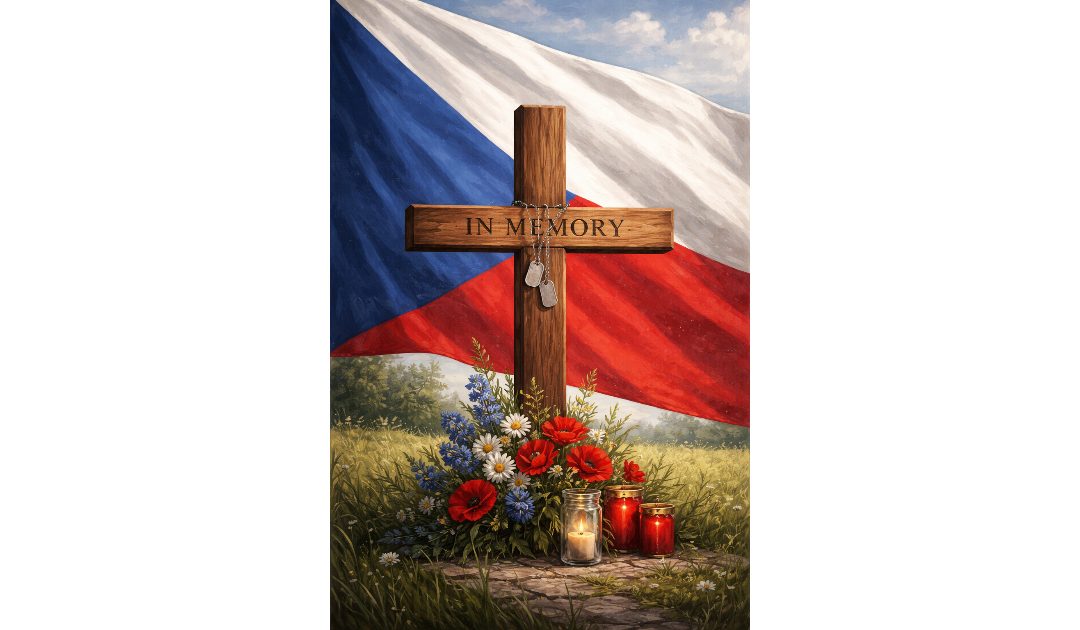
It was on the 19th of January, 1969, that Jan Palach died. I was ten years old. I have recently read John Le Carré’s George Smiley series, which deals with what the West knew as the Cold War. Jim Prideaux was Le Carré’s character who dealt with Czechoslovakia. I wonder if his choice of name, and the similarity in initials and syllables, was conscious of unconscious?
Jan Palach was born on the 11th of August, 1948, in Všetaty, a small town north of Prague, in what was then Czechoslovakia. He grew up in a family of modest means; his father ran a small confectionery business that was later nationalised by the communist regime. Palach was a diligent and thoughtful student, first studying economics at the University of Economics in Prague before transferring to Charles University, where he studied history and political economy. Those who knew him described him as quiet, serious, and introspective rather than overtly radical. He was not a political agitator by temperament, but he possessed a strong sense of moral responsibility and a deep concern for truth and freedom.
The defining context of Palach’s life was the Prague Spring of 1968. Under the leadership of Alexander Dubček, Czechoslovakia embarked on a bold experiment in “socialism with a human face.” Censorship was relaxed, political debate flourished, and there was genuine hope that socialism could coexist with democracy and civil liberties. For many young people, including Palach, this period was exhilarating. It seemed to promise not just reform, but dignity and agency for ordinary citizens.
That hope was brutally extinguished in August 1968, when Warsaw Pact troops led by the Soviet Union invaded Czechoslovakia. Tanks rolled into Prague, reformist leaders were arrested, and the process of “normalisation” began: a systematic restoration of hardline communist control. While there was initial public resistance, including demonstrations and acts of non-violent defiance, these gradually subsided under pressure, censorship, and intimidation. By the end of 1968, apathy and resignation were spreading. It was this moral numbness that most disturbed Palach.
On the 16th of January, 1969, Jan Palach set himself on fire in Wenceslas Square, the symbolic heart of Prague. Before doing so, he left letters explaining his motives. He described himself as “Torch No. 1,” suggesting that others might follow if his demands were ignored. These demands included the abolition of censorship and the banning of a pro-Soviet propaganda newspaper. Crucially, Palach insisted that his act was not suicidal in intent, but a sacrifice meant to shock the nation into reclaiming its freedom.
Palach survived for three days, suffering horrific burns over most of his body. During this time, he remained lucid and reiterated that his action was aimed at rousing the public conscience. He died on the 19th of January, 1969, at the age of twenty. His funeral became a massive public demonstration, attended by tens of thousands. For a brief moment, his death pierced the fog of fear and silence, reminding people of what had been lost.
The communist authorities quickly moved to neutralise Palach’s legacy. Public discussion of his motives was restricted, his grave was eventually removed to prevent it becoming a pilgrimage site, and his act was officially portrayed as the result of psychological instability. Yet the regime never fully succeeded in erasing him from collective memory. Other acts of protest followed, most notably that of Jan Zajíc a month later, though none achieved the same symbolic resonance.
Palach’s true significance emerged fully after the fall of communism in 1989. During the Velvet Revolution, his name and image reappeared on banners and in speeches, linking the democratic uprising to earlier, suppressed acts of resistance. Wenceslas Square, where he had burned, once again became a site of moral reckoning. In post-communist Czech society, Palach is honoured as a national hero, with memorials, plaques, and academic debates dedicated to his life and meaning.
Jan Palach’s legacy is complex and often uncomfortable. His act raises profound ethical questions about self-sacrifice, political protest, and the limits of moral responsibility. Yet whatever one’s judgment, his gesture cannot be dismissed as futile. Palach forced a confrontation with truth at a moment when lies and resignation threatened to prevail. More than half a century later, he endures as a stark reminder that history is not shaped only by armies and governments, but sometimes by a single individual willing to pay the ultimate price to assert the value of freedom and conscience.