
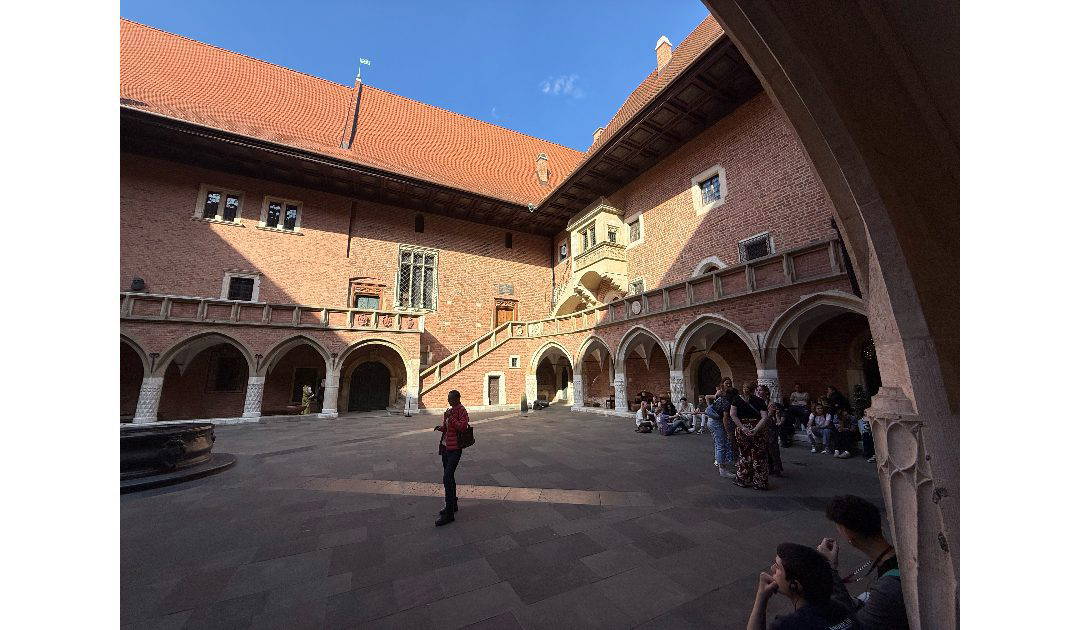
The Jagiellonian University was founded on the 12th of May 1364 in Kraków, Poland. Claire and I visited it last year. Unfortunately we didn’t get inside as it was closed during our stay. The library houses many treasures including the manuscript of De revolutionibus orbium coelestium by the university alumnus, Nicolaus Copernicus. This book shook the world in that science was confounding what the church preached. Now I have to say I think the church were extremely foolish to profess a view that the sun revolved around the earth. It might seem like it, but the assertion was based on an obscure verse in the Old Testament, Joshua chapter ten, verses twelve to fourteen: “At that time Joshua spoke to the Lord in the day when the Lord gave the Amorites over to the sons of Israel, and he said in the sight of Israel, Sun stand still at Gibeon, and Moon in the valley of Aijalon. And the sun stood still and the moon stopped, until the nation took vengence on their enemies.”
Believe it or not, the Catholic Church held to that view until Pope John Paul II admitted, in 1992, that Galileo (and Copernicus) had been right. This conflict between faith and reason inspired Fire and Earth, the second book in my Sir Anthony Standen Adventures. But I must get back to the Jagiellonian University.
The Jagiellonian University (Uniwersytet Jagielloński) in Kraków is one of the oldest universities in Europe and the oldest in Poland. It was founded in 1364 by King Casimir III the Great, at a time when the Kingdom of Poland sought to strengthen its legal and administrative institutions. Originally known as the Studium Generale, it was modelled on established centres of learning such as Bologna and Paris, with a strong emphasis on law.
After Casimir’s death, the university declined temporarily but was refounded in 1400 through the efforts of Queen Jadwiga of Poland and King Wladyslaw II Jagiello. It was from this royal association that the institution later derived the name “Jagiellonian.” The refoundation endowed it with new faculties, including theology, and secured its place as a major intellectual centre in Central Europe.
During the fifteenth and sixteenth centuries, the university flourished. It became an important hub for astronomy, mathematics, philosophy, and the humanities. Among its most famous students was Nicolaus Copernicus, who studied there in the 1490s before developing his heliocentric theory. The intellectual atmosphere of Kraków at the time reflected Renaissance humanism, and the university attracted scholars from across Poland, Lithuania, Hungary, Bohemia, and Germany.
The Collegium Maius, the oldest surviving university building, remains a striking example of Gothic architecture. Its courtyard, lecture halls, and library evoke the medieval origins of European higher education. Today, the building houses a museum containing scientific instruments, manuscripts, and artefacts associated with the university’s long history.
The seventeenth and eighteenth centuries brought challenges, including wars, political instability, and shifting intellectual currents. The partitions of Poland at the end of the eighteenth century placed Kraków under Austrian control, yet the university continued to function and became an important centre for Polish culture and scholarship during periods when the Polish state ceased to exist.
The twentieth century was marked by both tragedy and resilience. In November 1939, during the Nazi occupation of Poland, German authorities arrested many of the university’s professors in what became known as Sonderaktion Krakau. Several died in concentration camps. Despite this assault on its intellectual leadership, the university survived the war and resumed its activities, later operating under communist rule until 1989.
Today, the Jagiellonian University is a leading research institution with faculties spanning the humanities, sciences, medicine, and law. It plays a central role in Polish academic life and maintains extensive international partnerships. With over six and a half centuries of history, it stands as a symbol of continuity in European learning, embodying both medieval tradition and modern scholarship.