
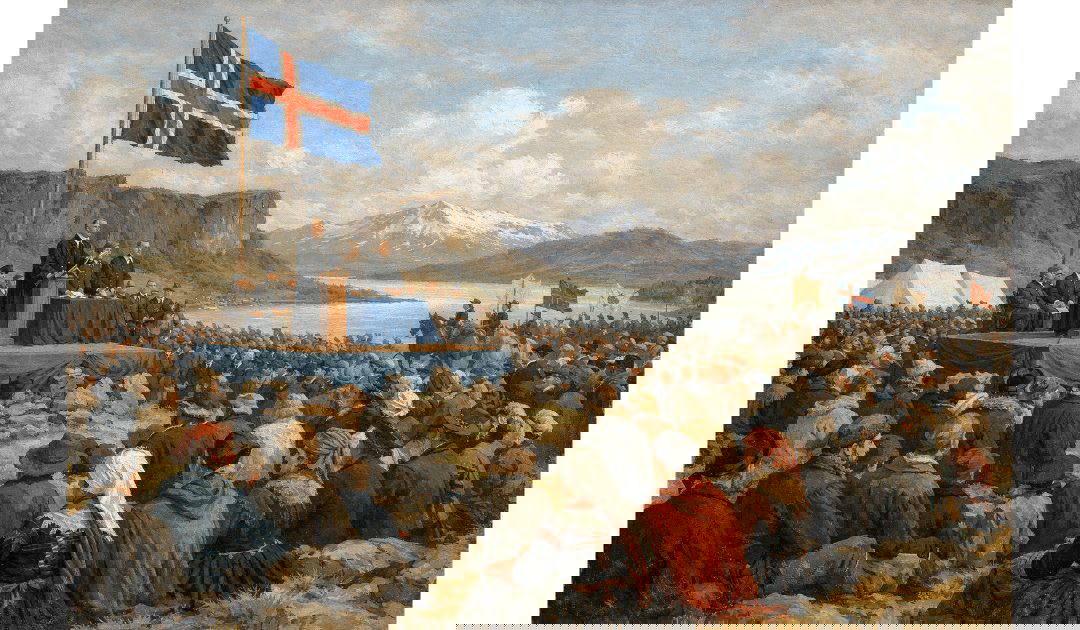
On the 8th of March, 1844, the Althing, Iceland’s parliament, reopened after 45 years of closure. Judging by AI’s painting it seems to be a bit of an open-air affair. Hardy people the Icelanders, clearly. Wikipedia tells me that it is the oldest surviving parliament in the world. That got me scratching my head because I’d heard something about the Tynwald on the Isle of Man. Well the Tynwald is the world’s longest continuously operating parliament. The Tynwald was founded in 979 whereas the Althing was founded in 930 but had that 45 years of closure. I’d like to visit Iceland one day, let’s do some research.
Iceland’s history is a story of isolation, endurance, law, and literature played out on a remote volcanic island at the edge of the Arctic. Though sparsely populated and often battered by nature, Iceland developed one of the world’s earliest parliamentary traditions and preserved a remarkable body of medieval writing that still shapes its national identity.
The island was settled relatively late. While Irish monks may have visited earlier, permanent settlement began in the late ninth century when Norse seafarers, many from western Norway, arrived with their families, livestock, and enslaved people of Celtic origin from Ireland and Scotland. According to the medieval Landnámabók (Book of Settlements), the first permanent settler was Ingólfr Arnarson, who established a homestead at what is now Reykjavík around 874.
These settlers brought no king with them. Instead, they created a society based on chieftaincies and law. In 930 they founded the Alþingi (Althing) at Þingvellir, a dramatic rift valley where the Eurasian and North American tectonic plates meet. The Althing served as a national assembly where laws were recited, disputes settled, and political alliances formed. It is often described as one of the oldest parliaments in the world. Iceland during this period, known as the Icelandic Commonwealth (930–1262), had no central executive authority but relied on a complex system of legal obligations and honor.
In the year 1000, Iceland made a peaceful transition from paganism to Christianity after a decision taken at the Althing. This compromise, allowing some private pagan practices to continue temporarily, helped prevent civil war and bound Iceland more closely to Christian Europe. Monasteries and bishoprics were established, and literacy grew, laying the foundations for Iceland’s extraordinary literary culture.
The twelfth and thirteenth centuries produced the great Icelandic sagas and eddas—works such as Njáls saga, Egils saga, and the Prose Edda of Snorri Sturluson. These texts preserved Norse mythology, recounted family feuds, and offered detailed portraits of early Icelandic life. They remain central to Icelandic identity and are among the most important sources for understanding medieval Scandinavia.
However, the Commonwealth era ended in conflict. Internal feuds among powerful families, known as the Age of the Sturlungs, weakened the island. In 1262–64, Icelanders accepted the authority of the Norwegian king in what is known as the Old Covenant. Iceland thus became part of the Norwegian kingdom, and when Norway entered into union with Denmark in 1380, Iceland passed under Danish rule.
The following centuries were harsh. Iceland’s economy depended on subsistence farming and fishing, vulnerable to volcanic eruptions, harsh winters, and sea ice that blocked trade routes. The Black Death devastated the population in the fifteenth century. Danish trade monopolies in the seventeenth and eighteenth centuries restricted economic development. Perhaps the greatest disaster came in 1783–84 when the Laki volcanic eruption released vast quantities of lava and toxic gases, killing livestock and causing famine that reduced the population by about a quarter.
Yet cultural continuity persisted. The Icelandic language changed little over the centuries, allowing modern Icelanders to read medieval texts with relative ease. Education, literacy, and a strong sense of historical memory became defining traits.
The nineteenth century brought a national awakening. Influenced by European romantic nationalism, Icelandic intellectuals looked to the sagas and the ancient Althing as symbols of independence. In 1844, the Althing was re-established as a consultative assembly in Reykjavík after having lapsed in earlier centuries. Leaders such as Jón Sigurðsson campaigned for greater autonomy from Denmark.
Progress came gradually. In 1874, Iceland received its own constitution and limited home rule. In 1904, it gained home rule with an Icelandic minister responsible to the Althing. In 1918, the Act of Union made Iceland a sovereign state in personal union with the Danish king, responsible for its own affairs but sharing a monarch and foreign policy.
The Second World War transformed Iceland’s position. Denmark was occupied by Germany in 1940, and British, then American, forces occupied Iceland to prevent German control of the North Atlantic. This brought economic stimulus and greater international awareness. In 1944, while Denmark was still under occupation, Icelanders voted overwhelmingly in a referendum to dissolve the union and establish the Republic of Iceland. The republic was formally proclaimed at Þingvellir on 17 June 1944.
Post-war Iceland modernized rapidly. Fishing became the backbone of the economy, leading to the “Cod Wars” with the United Kingdom over fishing limits in the mid-twentieth century. Iceland expanded its territorial waters successfully, securing control over rich fishing grounds. Later, the country harnessed its geothermal and hydroelectric resources to provide abundant renewable energy, supporting new industries such as aluminum smelting.
In 2008, Iceland experienced a dramatic financial crisis when its oversized banking sector collapsed. The crisis led to political upheaval, economic hardship, and reforms in financial regulation. Recovery was gradual but notable, aided by tourism, renewable energy, and a resilient society.
Today, Iceland is a small but prosperous republic known for its strong democracy, gender equality, environmental awareness, and cultural vitality. Its history—rooted in law, literature, and survival in a demanding landscape—continues to shape a nation that takes pride in both its ancient traditions and modern achievements.