
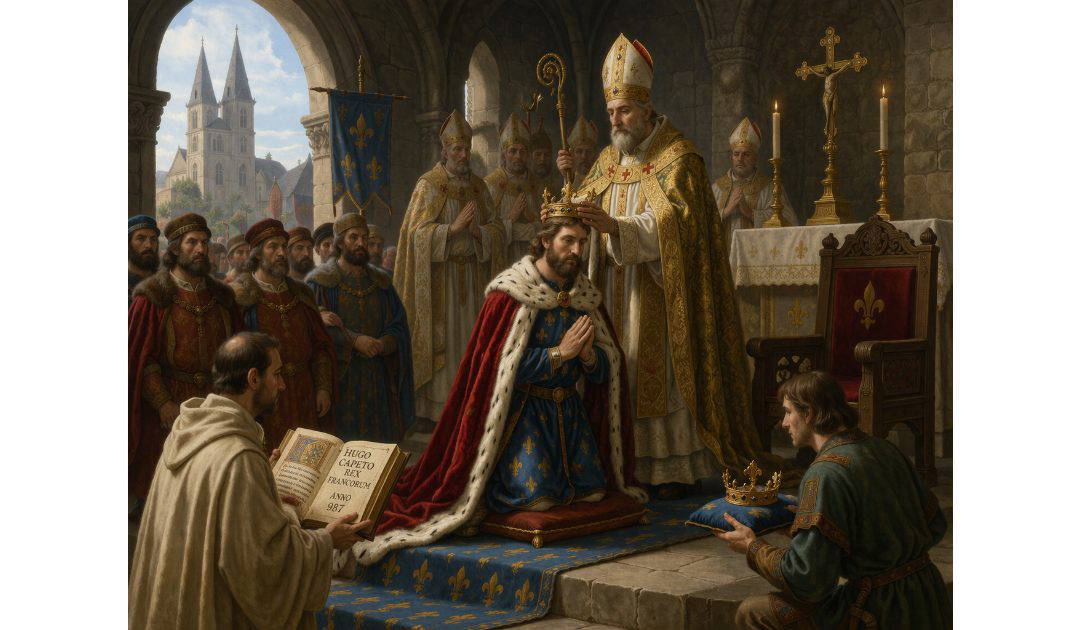
On the 3rd of July, 987, Hugh Capet was crowned King of France. Hugh Capet (c.939–996) was one of the most important, yet often understated figures in European history. As the founder of the Capetian dynasty, his accession to the throne in 987 marked the beginning of a royal line that would rule France, in various forms, for more than eight centuries. Though his own power was limited and his reign modest in outward achievement, the long-term consequences of his kingship were profound.
Hugh was born around 939 into the powerful Robertian family, a noble lineage that had long been influential in the politics of West Francia, the precursor to modern France. His father, Hugh the Great, was one of the most powerful magnates in the kingdom, holding vast lands and exercising significant authority, though he never claimed the crown. The Robertians had already produced a king in Odo of France, Hugh’s great-uncle, demonstrating their royal potential.
By the time Hugh Capet came of age, the Carolingian dynasty—the descendants of Charlemagne—was in steep decline. The last Carolingian king, Louis V, died in 987 without an heir. This created a power vacuum that the leading nobles and churchmen of the realm needed to fill. Rather than continuing the Carolingian line through a distant relative, they elected Hugh Capet as king. His election was supported strongly by Adalbero of Reims, one of the most influential church figures of the time, who argued that the throne should go to the most capable leader rather than simply by hereditary right.
Hugh was crowned king at Noyon, and later consecrated at Reims, the traditional site of French royal coronations. His election represented a significant shift: although kingship still carried an elective element, Hugh ensured the continuity of his line by having his son, Robert II of France, crowned as co-king during his own lifetime. This move was crucial in establishing the hereditary principle that would define the Capetian monarchy.
Despite his royal title, Hugh’s actual power was quite limited. His direct control extended mainly over a relatively small region around Paris and Orléans, known as the Île-de-France. Much of the rest of the kingdom was dominated by powerful regional lords, such as the dukes of Normandy, Aquitaine, and Burgundy, who often acted independently of the king. In many ways, Hugh was more a feudal overlord among equals than a dominant monarch.
One of Hugh’s main challenges came from lingering Carolingian loyalties. A rival claimant, Charles of Lorraine, contested Hugh’s right to the throne. Charles had a stronger hereditary claim as a direct descendant of the Carolingian line, and he managed to capture the important city of Laon for a time. However, Hugh ultimately prevailed, and Charles was captured and imprisoned, effectively ending serious Carolingian opposition.
Hugh Capet’s reign, which lasted until his death in 996, was relatively stable, though not marked by dramatic expansion or conquest. Instead, his importance lies in the consolidation of royal authority and the establishment of a new ruling dynasty. He worked closely with the Church, reinforcing the sacred nature of kingship and strengthening ties between the monarchy and ecclesiastical institutions. This alliance would become a cornerstone of Capetian rule.
Administratively, Hugh’s government was simple compared to later medieval monarchies. Royal authority was exercised through personal relationships and feudal obligations rather than a centralized bureaucracy. Nevertheless, Hugh laid the groundwork for the gradual expansion of royal power that his successors would achieve over the centuries.
The Capetian dynasty that Hugh founded proved remarkably durable. His descendants, including notable kings such as Philip II of France and Louis IX of France, would significantly expand royal authority and territory, transforming France into one of the most powerful kingdoms in Europe. The direct Capetian line ruled until 1328, after which cadet branches such as the Valois and Bourbon dynasties continued the lineage.
Hugh Capet died on the 24th of October, 996, and was buried in the Abbey of Saint-Denis, the traditional burial place of French kings. At the time of his death, he may not have appeared especially remarkable; his domain was small, and his authority often challenged. Yet his achievement in securing the throne and passing it to his son ensured the continuity of his dynasty.
Hugh Capet’s reign marks a turning point in French history. He represents the transition from the fragmented, post-Carolingian world to a more stable and enduring monarchy. While he did not create a powerful centralized state himself, he established the conditions under which such a state could eventually emerge. His legacy is therefore not one of immediate transformation, but of lasting foundations—an enduring royal line that would shape the history of France for centuries to come.