
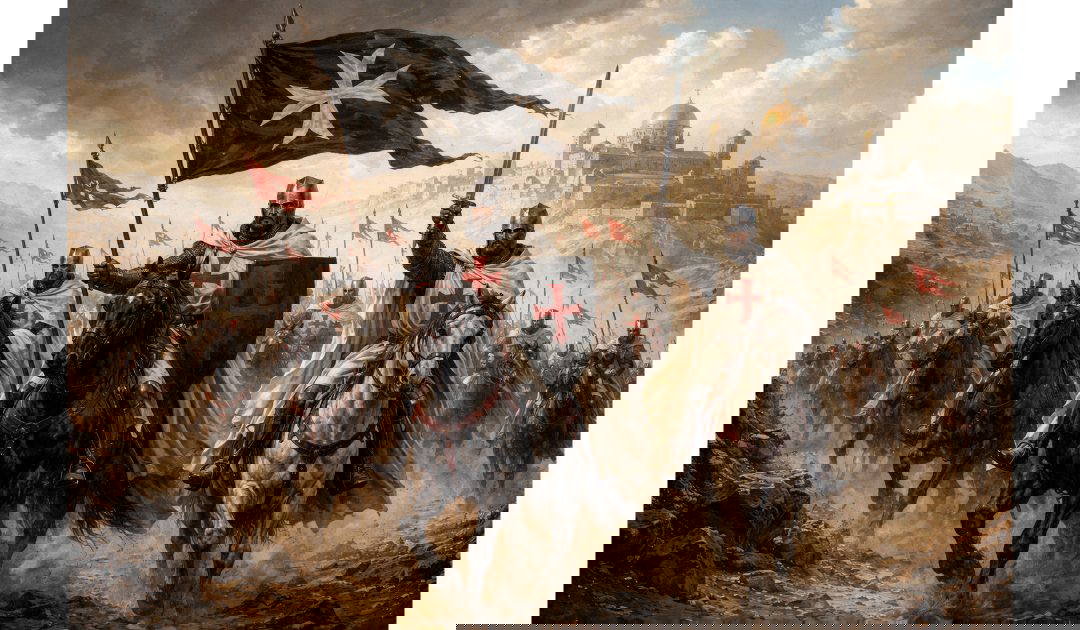
On the 15th of February, 1113, Pope Paschal II issued the Pie Postulatio Voluntatis recognising the Order of Hospitallers. I have written about the Knights Templar before, and the Hospitallers are the other major chivalric order that I’m aware of.
The Knights Hospitaller, formally known as the Order of the Hospital of Saint John of Jerusalem, were one of the most enduring and adaptable institutions of the medieval world. Founded in the crucible of the Crusades, they combined religious devotion, charitable care, and military discipline in a way that profoundly shaped the history of the eastern Mediterranean and beyond.
The origins of the order lie not in warfare but in charity. In the mid-11th century, before the First Crusade, merchants from Amalfi established a hospital in Jerusalem dedicated to Saint John the Baptist. Its purpose was simple yet radical: to care for poor, sick, and injured pilgrims visiting the Holy Land. After the capture of Jerusalem by the crusaders in 1099, the hospital expanded rapidly. Under the leadership of its first master, Blessed Gerard, the community was recognised by Pope Paschal II as a religious order, independent of secular and ecclesiastical interference. Its members took vows of poverty, chastity, and obedience, and their primary mission was hospitality — hence the name “Hospitallers.”
As the Crusader states became increasingly embattled, the order assumed a military role. By the 1130s and 1140s, the Knights Hospitaller, like their contemporaries the Knights Templar, were armed monks. This transformation did not replace their charitable function; rather, it complemented it. The Hospitallers believed that protecting pilgrims and defending Christendom was an extension of caring for the weak. Their black mantle bearing a white cross (later replaced in battle by a red surcoat with a white cross) became a familiar sight across the Levant.
The order grew wealthy and powerful through donations of land and money from across Europe. Commanderies were established from England and France to Spain and the Holy Roman Empire, providing income and recruits. This international structure made the Hospitallers unusually resilient. They constructed and garrisoned formidable fortresses in the Holy Land, most famously Krak des Chevaliers in Syria, one of the greatest castles of the Middle Ages. These strongholds were both military bases and symbols of Christian resolve.
The fall of Jerusalem to Saladin in 1187 marked a turning point, but not the end of the order. The Hospitallers retreated first to Acre, the last major Crusader city, and when that fell in 1291, they relocated to Cyprus. Unlike the Templars, who were suppressed in the early 14th century, the Hospitallers adapted. In 1309 they seized the island of Rhodes, transforming themselves into a naval power. From Rhodes, they fought Muslim corsairs, protected Christian shipping, and maintained their identity as warrior-monks, now oriented toward the sea.
In 1522, after a prolonged and heroic defence, Rhodes fell to the Ottoman sultan Suleiman the Magnificent. Once again displaced, the order found a new home in 1530 when Emperor Charles V granted them the islands of Malta and Gozo. From this barren outpost, the Hospitallers — now often called the Knights of Malta — reached the height of their fame. The Great Siege of Malta in 1565, in which a small Hospitaller force under Grand Master Jean de Valette resisted a massive Ottoman invasion, became one of the defining moments of early modern European history. The successful defence resonated across Christendom and cemented the order’s legendary status.
Yet the Hospitallers were never solely warriors. Throughout their history, hospitals remained central to their identity. Their medical facilities were among the most advanced of their time, emphasising cleanliness, diet, and humane treatment. In Malta, their great infirmary was renowned across Europe. Care was offered regardless of nationality or status, reflecting the order’s original charitable mission.
The decline of the Knights Hospitaller came gradually. Changes in warfare, politics, and religion eroded their military relevance. In 1798, Napoleon Bonaparte captured Malta, effectively ending the order’s sovereignty. However, the Hospitallers did not disappear. They evolved once more, shedding their military role while preserving their charitable ethos.
Today, the Sovereign Military Order of Malta exists as a humanitarian organisation recognised under international law. It operates hospitals, ambulances, and relief missions worldwide. Though centuries have passed since armoured knights rode beneath crusader banners, the legacy of the Knights Hospitaller endures — a rare example of an institution that transformed repeatedly yet remained faithful to its founding ideal: service to the sick and the poor.